When his Michigan house feels cold, Bill turns the thermostat up high. It works, he tells a man asking questions, “like stepping on the gas pedal.” Push it harder, in his account, and the furnace pours out more heat. He also says, “I really am ignorant about the functioning of these devices.” Why would a man with a whole working theory call himself ignorant?
The man asking questions was Willett Kempton, an anthropologist who studied how people run the heat at home. He published Bill’s words in 1986. Bill had a full account of his thermostat: what it does, what it predicts, and when to touch it. He had evidence, too: as a boy, he held his hand near the vent and felt it blow hotter as the number went up. He even had a rule. Turning the thermostat up high to get warm fast felt “sinful” to his “kind of Calvinist or Puritan feeling.” So some days he set it where he wanted the room and put up with the cold.
Still, someone had once given him the expert explanation, and he could not repeat it, so he counted his own account as nothing. And the box on his wall does not work the way his account says. Inside, it holds a switch that is only on or off. A higher setting keeps that switch on longer; the furnace burns no hotter.
Bill was not alone. Three people told Kempton the same story about their spouses. Each spouse turned the thermostat up to heat the house faster. Each partner had explained that the thermostat does not work that way. In Kempton’s words, “their repeated attempts to convince their spouse of this had failed.” His guess at why: each partner argued against one belief, when the spouse held a whole theory. From his interviews and two studies by others, Kempton estimated that a quarter to a half of Americans use at least part of Bill’s account. Two people, one hallway, one box on the wall, and two different boxes in their heads.
The first cold evening this month, you come home and your partner, or a housemate, has turned the setting to the top “to warm it faster.” The setting reads 85 degrees, the furnace roars, and the room creeps up from 62. Two hours later the room is too hot, and the setting is still at the top, because no one remembered to turn it back. Those two hours show up on this month’s heating bill, and the argument about them starts again. In a hot place, the air conditioner gets set to its coldest instead. Every evening like that costs two hours at the top and leaves one question open: whose copy of the thermostat is wrong? Until someone answers that question, the argument comes back with the next cold night.
The copy Bill carried in his head has a name in psychology: a mental model. Each arguing spouse carries one too, and so does the engineer who built the box. They cannot all be right about the box. How would any of them ever find out?
A Copy That Runs
A machine of brass wheels and wire stands behind glass in London’s Science Museum. William Thomson, later Lord Kelvin, built it in 1876 to predict the tides. Each wheel turns with one rhythm of the sea, such as the pull of the moon or the sun. A wire over the wheels adds their rhythms into one rise and fall: one harbor’s tide, drawn ahead of time. The machine is a copy of the sea that fits in a room.
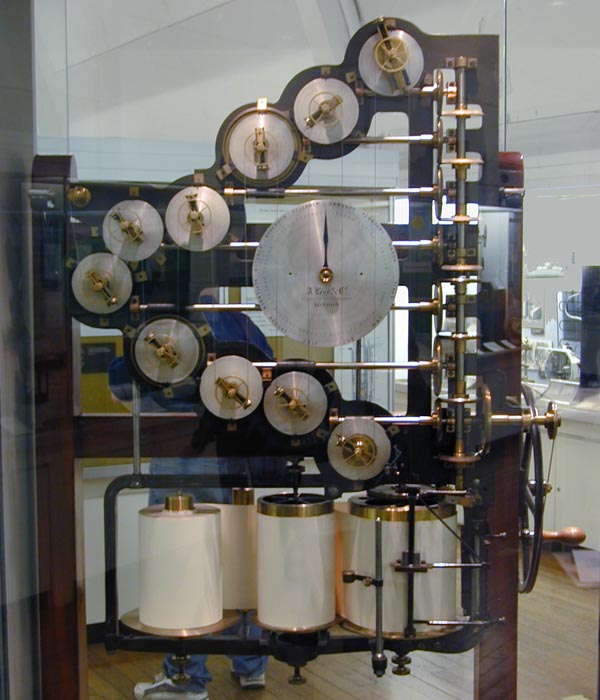
Figure 1. Thomson’s tide-predicting machine, 1876, Science Museum, London. Brass wheels, a wire, and not a drop of water, yet it drew a harbor’s tides ahead of time. Photograph by William M. Connolley, Wikimedia Commons, CC BY-SA 3.0.
It looks nothing like the sea, and it holds no water and no moon. Yet it says when the water will be high. In 1943, the Cambridge psychologist Kenneth Craik used Kelvin’s tide predictor to explain what a model is. A model, he wrote, “need not resemble the real object pictorially.” It has to work “in the same way as the process it parallels, in the aspects under consideration.” Then he moved the idea inside the head.
“If the organism carries a ‘small-scale model’ of external reality and of its own possible actions within its head, it is able to try out various alternatives, conclude which is the best of them, react to future situations before they arise …”
“The mental image of the world around you which you carry in your head is a model. One does not have a city or a government or a country in his head. He has only selected concepts and relationships which he uses to represent the real system.”
“Likewise, when they understand a description of the world, they can construct a similar, albeit less rich, representation … a mental model of the world based on the meaning of the description and on their knowledge.”
“A mental model of a dynamic system is a relatively enduring and accessible, but limited, internal conceptual representation of an external group of interrelated stocks and flows (i.e., a system) whose structure and relationships maintain the perceived structure and relationships of that system.”
Set side by side, the four agree on three things. A mental model is a copy of a system, in the sense this site’s first essay defines it. It is smaller than the thing it copies. And it runs: it can be pushed forward to say what happens next, as Kelvin’s wheels say when the water will rise. Each stresses something different. Craik stresses the use: trying things in the head before trying them in the world. Forrester stresses what is missing: “only selected concepts and relationships.” Johnson-Laird stresses the cost: the copy is “less rich,” and elsewhere he shows it makes errors of a predictable kind. Doyle and Ford stress the eye of the holder: the copy keeps the structure as its holder sees it, which may not be the structure that is there.
Before picking up the keys at rush hour, a driver runs a copy of the route home: the bridge, the left turn, the school zone. The copy holds the roads this driver always takes. It leaves out the one detour that would save twenty minutes tonight. Which parts does a copy leave out, and who chooses them?
Same House, Two Copies
Twenty-six families in identical New Jersey townhouses chose the numbers on their thermostats, and small machines logged them every hour. The records ran for two years, from a Princeton study that Kempton drew on. The houses were the same. The families were not.
Kempton found two copies of the thermostat in eight detailed interviews with twelve people in Michigan. He called them folk theories: ideas a group shares and learns from daily life, as opposed to the theories specialists learn from books and experiments. The first copy is the feedback copy, the one engineers build. The thermostat senses the room and turns the furnace on below the setting and off above it, a loop that keeps pulling the room back toward one temperature. The second copy is the valve copy, Bill’s. The setting opens the heat wider, like a gas pedal, so a higher number means more heat each hour.
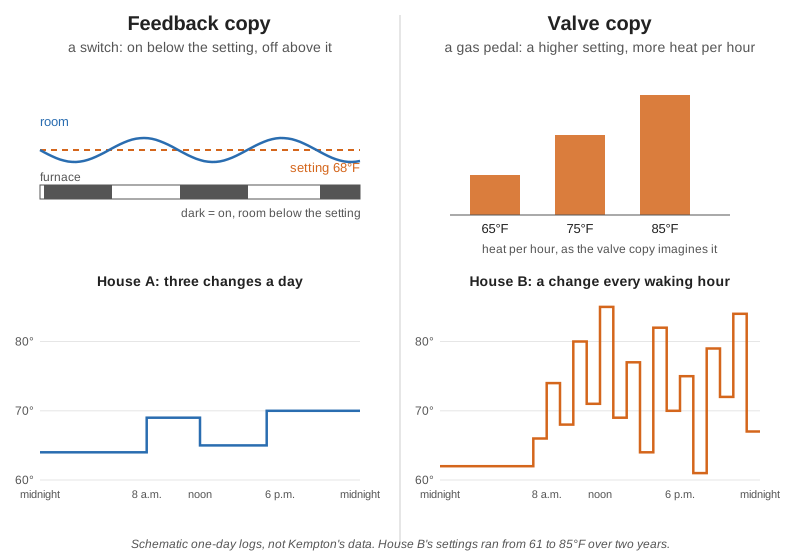
Figure 2. Two copies of one thermostat, and the kind of hourly log each copy leaves. Compare the two logs at the bottom: three steps a day against a step every waking hour. Drawn for this piece, after Kempton (1986). The logs are schematic, not Kempton’s data.
Kempton thought each copy left a trace in the records. In one house, in the winter of 1976, the setting changed at 8 a.m., at noon, and once in the evening, when the household’s day changed. In a second house, that winter, the number changed between almost every hourly reading, whenever anyone was awake. It stayed still only at night, from about 1 to 7 a.m. Across both years, that house’s setting ranged from 61 to 85°F. Three changes a day in one house; a change every waking hour in the other, across 24 degrees. Two hands, running two different copies.
Kempton was careful about those two houses. He never interviewed either family. In a footnote, he wrote that the frequent changes “could be due to other causes such as domestic conflict over desirable setting.” An argument over the thermostat would leave the same jagged line.
Those two copies show up in any hall. Walking into a cold house, or a hot one, a hand reaches for the thermostat or the air-conditioner remote. A hand that turns it past the target, to warm or cool the room faster, is running the valve copy, and the degrees past the target show how far. The valve copy is wrong about the box. Does that make it the worse copy to live with?
Wrong Inside, Right in Use
One woman told Kempton what living with her husband’s copy was like. He would argue with her “long enough,” she said, that turning the heat down at night saves nothing. Turn it down to 55 overnight, and every object in the house drops to 55. In the morning, the furnace must warm every object back up to 65. By her account, that uses “more fuel than if you would have left it at 65.”
The husband held the experts’ copy: the thermostat is a switch. His copy was right about the box and wrong about the bill. It left out one part of the house: a warm house leaks heat through its walls faster than a cool one. Every hour at 55 leaks less than an hour at 65, so the night turned down saves fuel.
Bill’s valve copy, wrong about the box, gets the bill right. It says a higher setting burns more fuel, and that prediction is true. In Kempton’s words, “The prediction is correct, even if the explanation is wrong.” In some of his interviews, people who held the valve copy were more likely to believe that turning the heat down at night saves fuel. His verdict: “A theory that is useful for designing thermostats is not guaranteed to be a good theory for using them.”
The valve copy has its own cost: a hand on the thermostat every hour, and a furnace burning all evening if no one turns the heat back down. Each copy left out a different part, so each was good for a different job.
Two housemates who argue at bedtime about turning the heat down can test their copies against the job. Each says what their copy predicts for the morning, and which part of the house that copy leaves out. Over a month, the bill counts the nights turned down against the nights left up. Both copies are wrong somewhere. How would either housemate find out where?
The Gap, Written Down
Bill nearly found out, from a sound he remembered in his parents’ house. In the night, the furnace there went on and off by itself, “making those irritating, windy sounds.” No hand had touched the thermostat. His valve copy had no room for that sound: in his copy, only a hand moves the heat. Later in the interview, Bill patched his copy. Maybe his parents had a smarter thermostat, one that measured the room and switched itself.
Seven months later, Kempton showed Bill his analysis. Bill said the patch was gone. “I discovered it for the moment, but later forgot it. When I went back to using the thermostat, I probably went back to doing it the same way.” The gap between his copy and the world had shown up as a sound in the night. He heard it, explained it, and let it go. He wrote nothing down, so nothing changed.
That gap has a name in any feedback loop: the error signal. In 1976, the statistician George Box wrote that it is the error signal that “can produce learning.” He gave an example: “the discrepancy between what tentative theory suggests should be so and what practice says is so.” He also wrote, “Since all models are wrong the scientist must be alert to what is importantly wrong.” The useful question is where a copy is wrong, and by how much.
Here is the move that makes a copy better: write the prediction down before the world answers, then measure the gap. The thermostat in the hall runs on that very gap: it compares the setting with the room and acts on the difference. A statistician reads a model built from data in the same way. Each of its predictions misses the measured value by a gap called the residual, and the parts the model left out show up there. A null hypothesis is a mental model written down before the data arrive, so the gap can be measured.
Try the move on the thermostat. Before turning the setting up on a cold evening, write on the back of an envelope how many minutes the room will take to feel warm. Then check the clock. A big miss is the valve copy meeting its error signal, in writing. A close guess means the copy did its job that evening.
Psychologists still argue over whether people reason by running copies like these at all. Kempton himself wrote that “further data is needed” on how a theory like Bill’s guides what people do at home. But Bill’s copy did not need a theory of the mind to improve. It needed one number on an envelope, propped against the wall beside the thermostat.
A Closing Invitation. The thermostat in the hall stood for the copy each person carries in their head. A copy is judged by its job, and it gets better when its guess is written down and checked.
- Find your copy. Now, where you sit, picture the thermostat or air-conditioner remote at home. The room is cold: would your hand go to the top, or to the number you want? Which copy just moved your hand, the switch or the valve, and how long would the setting stay there?
- Count the high nights. This weekend, guess from last month’s heating or cooling bill how many nights the setting stayed high. What would the person you share the house with, or a friend who pays the same kind of bill, guess? How far apart are you, and what would one night turned back sooner have saved?
- Guess the minutes. The first cold evening this month, or the first hot afternoon, before you touch the setting, write on a yellow sticky note beside the thermostat how many minutes the room will take to feel right. When your fingers warm up, or the sweat dries, how far off was the note? What did your copy leave out?
The thermostat hangs where it always did, set at the room you want. Beside it, a yellow note in pen says twenty minutes, and the clock across the hall keeps the gap.
Where This Came From
Craik wrote the “small-scale model” in Cambridge during the Second World War, in his short book The Nature of Explanation. Forrester carried the idea into system dynamics, the field he founded at MIT: by 1961, in Industrial Dynamics, he was telling managers that their mental models of a company “are not the real corporation” (as Doyle and Ford quote him). Johnson-Laird made it a theory of reasoning in his 1983 book Mental Models. By 1997, the term had grown loose enough that Doyle and Ford set out to fix its meaning. They offered their definition as a starting point and wrote, “We make no claim that this conceptual definition is correct or complete.”
Intellectual Honesty Note. Bill’s words come from Kempton’s interview transcript, quoted in short fragments with filler words such as “um” dropped at their edges. Figure 2 is a schematic drawn for this piece, not Kempton’s data. In the Johnson-Laird box, an ellipsis stands where the original has a dash, and the Craik box ends at an ellipsis. Reading Kempton’s two copies through Box’s error signal, and calling a null hypothesis a mental model written down, are this piece’s own readings. The driver, the housemates, the envelope and the sticky note are invented.
References
Box, G. E. P. (1976). Science and statistics. Journal of the American Statistical Association, 71(356), 791-799. https://doi.org/10.1080/01621459.1976.10480949
Connolley, W. M. (2005). Tide predicting machine, by Sir William Thomson in 1876 [Photograph]. Wikimedia Commons. https://commons.wikimedia.org/wiki/File:DSCN1739-thomson-tide-machine.jpg. CC BY-SA 3.0.

Craik, K. J. W. (1943). The nature of explanation. Cambridge University Press.
Doyle, J. K., & Ford, D. N. (1997). Mental models concepts for system dynamics research [Conference paper]. International System Dynamics Conference. https://proceedings.systemdynamics.org/1997/doyle2.htm
Forrester, J. W. (1971). Counterintuitive behavior of social systems. Technology Review, 73(3), 52-68.
Johnson-Laird, P. N. (1983). Mental models. Harvard University Press.
Johnson-Laird, P. N. (2010). Mental models and human reasoning. Proceedings of the National Academy of Sciences, 107(43), 18243-18250. https://doi.org/10.1073/pnas.1012933107
Kempton, W. (1986). Two theories of home heat control. Cognitive Science, 10(1), 75-90. https://doi.org/10.1207/s15516709cog1001_3