A 2022 paper in the American Journal of Epidemiology tested whether faster biological aging helps explain why Black Americans, on average, live fewer healthy years than White Americans. It measured biological age eight different ways in the same older adults. Two of those eight share a name. Both are versions of PhenoAge, a score built by Morgan Levine’s lab to estimate how old a person’s body looks from the inside. One version reads nine routine blood tests. The other reads chemical marks on DNA, called methylation, and was trained to reproduce the first.
Buried in the paper’s supplement is a result the paper never discusses. In the same people, the blood-test version says Black participants are about 2.8 years further ahead of their chronological age than White participants. The methylation version says there is essentially no difference.
Two instruments built to measure the same thing, pointed at the same people, giving different answers about race. I wanted to know whether that disagreement was real, and if it was, where it came from.
Does it reproduce
The paper used the Health and Retirement Study. I rebuilt the comparison in a different national sample: adults 50 and older from the National Health and Nutrition Examination Survey (NHANES), who had both blood chemistry and DNA methylation measured in 1999 to 2002, with deaths followed through 2019. Every file is public and downloads without an application.
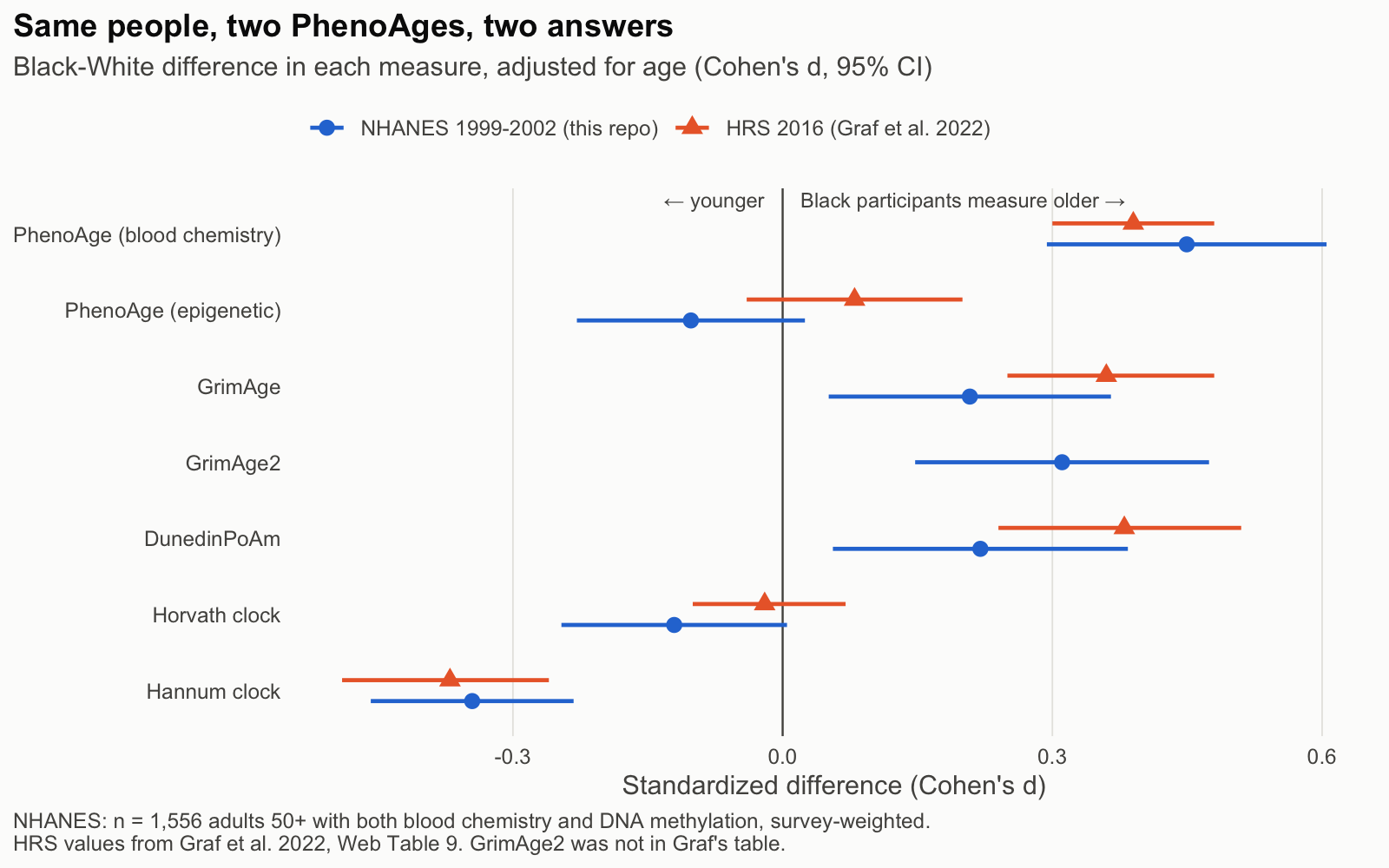
The disagreement reproduces, and it is wider here. Among 1,556 adults, the blood-test PhenoAge puts Black participants 4.3 years ahead; the methylation PhenoAge puts them 0.7 years behind, a difference that could be chance. Every other measure in the paper points the same direction in both samples.
Taking the gap apart
The blood-test PhenoAge has a useful property. Once the math is simplified, it is a weighted sum of its nine blood markers. That means the 4.3-year gap splits exactly into nine pieces, one per marker, with nothing left over.
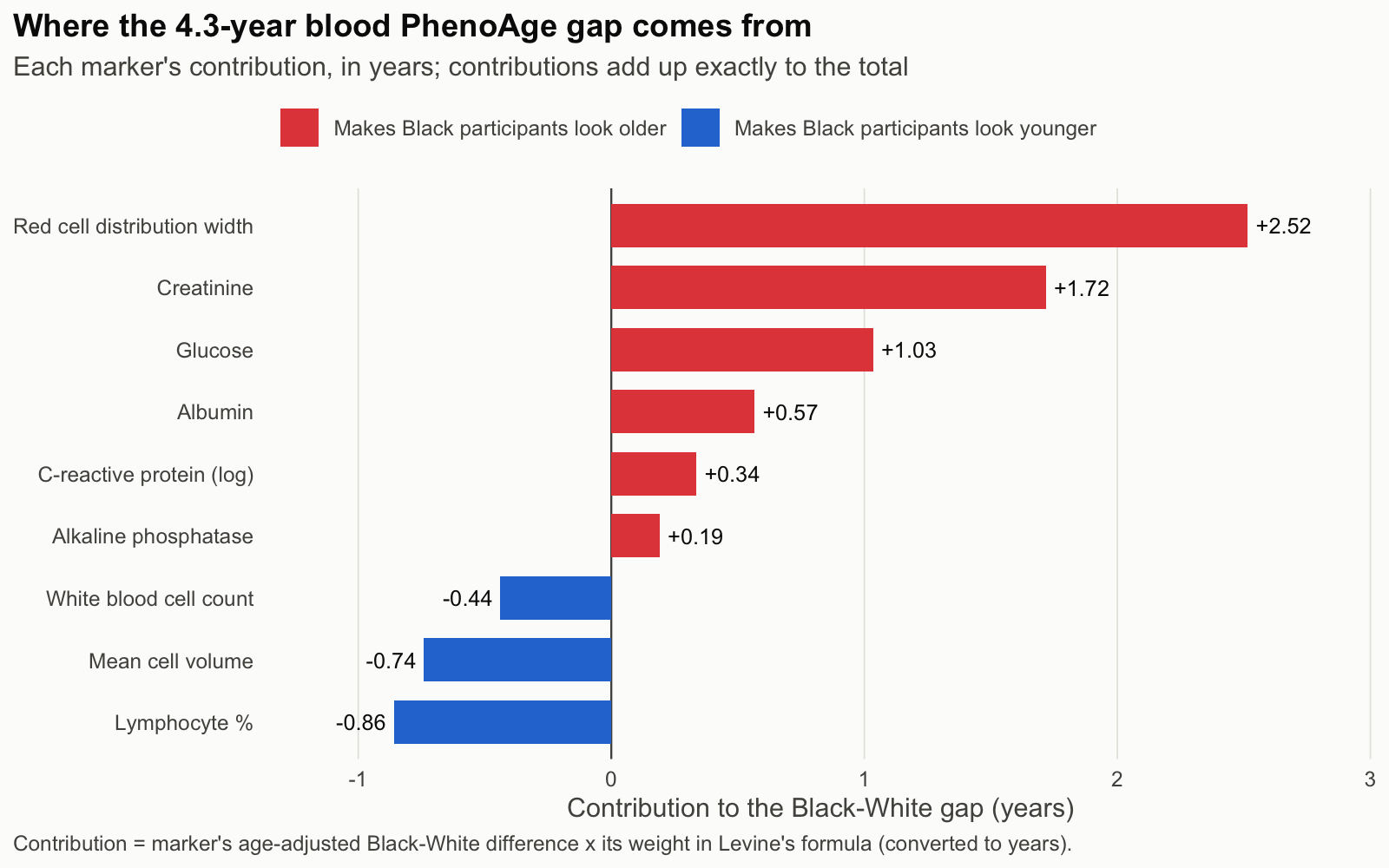
Three markers carry most of the story, and each turned out to mean something different.
Red cell distribution width, a measure of how much red blood cells vary in size, is the largest piece at 2.5 years. I did not expect it. Some inherited hemoglobin traits that are more common in people of African ancestry, including a form of alpha-thalassemia carried by roughly a third of African Americans and sickle cell trait, raise this measure without having anything to do with aging. Using effect sizes from a large published study, those traits plausibly account for about a third of the difference. Iron status accounts for a little more. The rest I could not explain.
Creatinine, a waste product of muscle that the kidneys clear, adds 1.7 years. I expected this to be mostly muscle mass, since creatinine runs higher in people with more muscle. It was not. Most of it came from 40 participants with advanced kidney disease, confirmed by a second kidney marker, and kidney disease is more common among Black participants. That part of the gap is real disease. Muscle mass, measured directly by body scan, accounts for only about 0.3 years.
The two white blood cell markers push the other way, subtracting 1.3 years. Many people of African ancestry carry a common, harmless variant called Duffy-null that lowers their neutrophil count for life. The formula reads that as younger. The pattern in the data matches that variant closely.
So the 4.3 years is not one quantity. It is a sum of parts pulling in different directions: some inherited traits that are not aging, some real disease, and some that remain unexplained.
A check that could not have caught this
The original paper argued its measures work equally well across groups by showing they predict health outcomes about equally well in Black and White participants. I tested that check directly. I copied the White participants into a synthetic second group, identical in every way, then shifted only their blood markers by the differences observed between the real groups. That created a 4.3-year gap that was entirely artificial. The check passed it perfectly. It can confirm a measure predicts equally well; it cannot tell whether the measure is shifted.
What this does and does not say
This does not show that Black Americans are not aging faster. Other measures in the same data, including the methylation clocks built to predict death, still find gaps of one to two years. It does not show that the methylation version is the unbiased one either; there is published evidence that it carries its own ancestry signal.
What it shows is narrower, and I think more useful. A biological age score can find a racial difference that another score, built toward the same target, does not. And what looks like a single number turns out to hold inherited traits, real disease, and something still unexplained, added together. Before a gap in a score like this is read as a gap in aging, it is worth asking which of its parts is doing the work.
The code, data-pull scripts, and every table behind these numbers are on GitHub, including the parts still open.