
Abelardo Aguilar, a doctor in Iloilo, sent a drug company some dirt. He sold medicines for Eli Lilly, and in 1949 he found a microbe in Iloilo soil that kept other bacteria from growing. Lilly’s chemists drew a drug out of the microbe, erythromycin. In 1952 the company sold it as Ilosone and Ilotycin, names taken from Iloilo. So a medicine had come out of dirt, something people sweep away, like the weeds they pull.
The place got the name. Aguilar got his salary. In 1993, the year he died, he asked for royalties to fund a foundation for poor and sick Filipinos, and Lilly said no.
Aguilar’s dirt settled that soil could hold a medicine, not whether a weed could, and my first research project was on one. In Aborlan, it comes up near the road and the mangroves where nobody planted it, hairy and strong-smelling (Figure 1), with small blue flowers. Folk healers in the Philippines, the herbolarios, use its leaves “to treat wounds, scabies and other skin ailments.” The Tagbanua of Palawan call it loko-loko, which also means crazy.
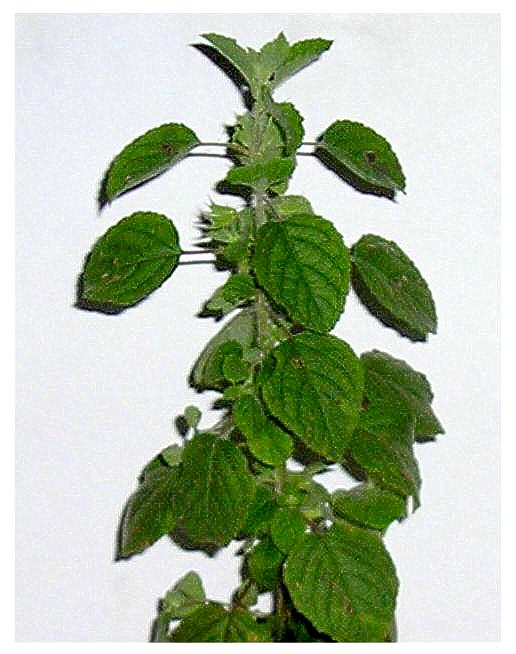
Figure 1. Hyptis suaveolens, loko-loko, at the vegetative stage, before it flowers. From my thesis (Gauran, 2004), Figure 1.
Its scientific name is Hyptis suaveolens. At the Agricultural Science High School of Western Philippines University, every senior wrote a thesis. Mine asked whether juice from the weed’s leaves could stop bacteria from growing.
My two favorite classes in high school were microbiology and statistics. My microbiology teacher, Mr. Alejandro Bernardo Jr., and my biology teacher, the late Mrs. Maria Dulce Amor Bunquin, advised me. My father, Dr. Noel Gauran, taught my first statistics class and was the statistician for the whole senior class.
I belong to the millennial generation, when every student in a class got ranked by cumulative subject scores. From kindergarten until junior year in high school, I had consistently ranked first in our class. Top grades did not make me sure of myself, and my doubt showed during the research. Mrs. Bunquin, Ma’am Dulce to us, told my mother I was a very intelligent girl who lacked confidence and doubted herself a lot. I wanted my research to be perfect so badly that I checked and rechecked everything.
In October and November of 2004, in the school’s laboratory, I poured six plates of agar for each of two kinds of bacteria, E. coli and S. aureus (Figure 2). Agar is a firm jelly that bacteria grow on. Into each plate I cut three wells 9 millimeters across, and my hands shook as I cut them. One well got tetracycline, an antibiotic. One got juice pounded from mature leaves with a mortar and pestle, and one got juice from young leaves. After three days at 37 degrees Celsius, a clear ring had opened around every well, where no bacteria could grow. I had seen rings like these in books and knew in theory what tetracycline is supposed to do. Seeing them in real time was different, and made me even more curious. I laid a ruler across each ring and wrote down its width.
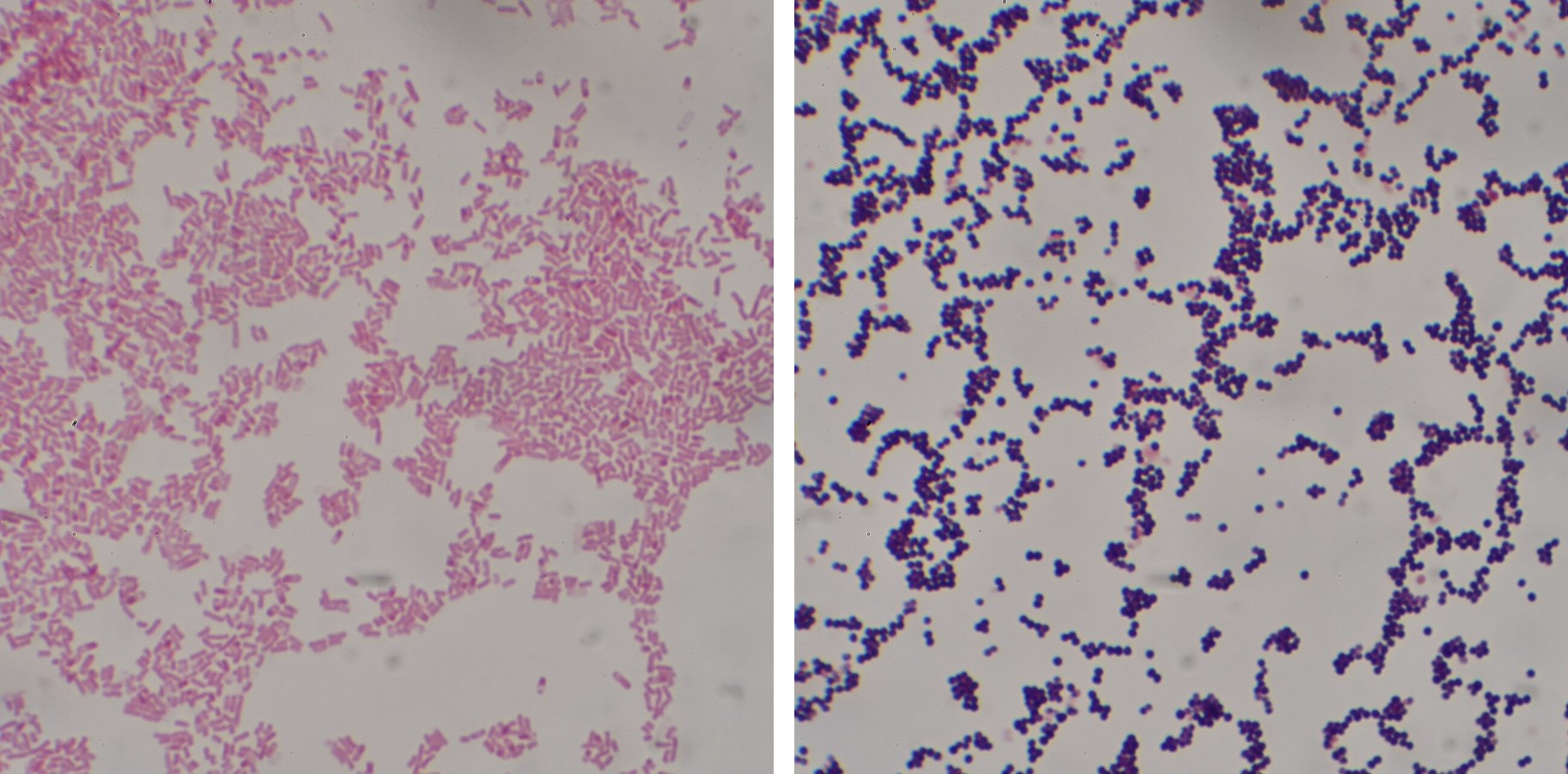
Figure 2. The two bacteria under a microscope after a Gram stain. Left, E. coli: rods that lose the violet dye and take a pink one, so they are Gram-negative. Right, S. aureus: round cells in clusters that keep the violet, so they are Gram-positive. The stain, from Hans Christian Gram in 1884, sorts bacteria by their walls: a Gram-positive wall is thick and holds the dye, while a Gram-negative wall is thin and wrapped in an outer membrane that also keeps many drugs out. Photos: Dr Graham Beards, Wikimedia Commons, CC BY-SA 4.0.
Thirty-six rings, two tables and one ruler made my first verdict. The antibiotic beat the leaf juices on both bacteria. Mature leaves beat young ones on S. aureus. On E. coli, I wrote, “their inhibiting effect on E. coli does not differ.” And I wrote that the data had “provided scientific basis or support” for the healers’ practice of treating wounds.
Every one of those sentences came from a test, and every test answered a narrower question than the one I wrote at the top of the page.
Say your child comes home this Saturday with a scraped knee. On the pharmacy shelf, a herbal wound spray says “antibacterial” on the front and costs three times the plain plasters beside it. Most likely, someone tested it on bacteria in a dish. The label does not say whether it helps a scrape heal faster.
If a ring in a dish can be measured to the millimeter, what can it tell a parent about a scraped knee, before paying triple for the spray?
What the Plant Was Asked
I wrote four objectives at the top of my thesis. The first was “to determine whether H. suaveolens has antibacterial property.” The second and third compared mature leaves, young leaves and tetracycline on two kinds of bacteria. The fourth asked “whether the results can provide scientific basis or support the folk practice of using H. suaveolens to treat wounds.”
A well of juice works like a drop of ink on a paper towel. What is in the well spreads outward, thinning as it goes, and where it is still strong enough, the bacteria cannot grow. Where the picture fails: ink only spreads, and bacteria fight back. The clear zone ends where the juice and the bacteria are evenly matched, and the zone’s width is what a plate reports.
A clear zone is also how a microbe like Aguilar’s first gets noticed: grown beside other bacteria, it clears the agar around itself.
Around 340 CE, the Chinese physician Ge Hong wrote a cure for fevers: soak “a handful of Qinghao” in water, strain it, and drink. Qinghao is sweet wormwood (Figure 3). In 1969, Tu Youyou searched 2,000 old recipes for a malaria drug, Ge Hong’s among them.
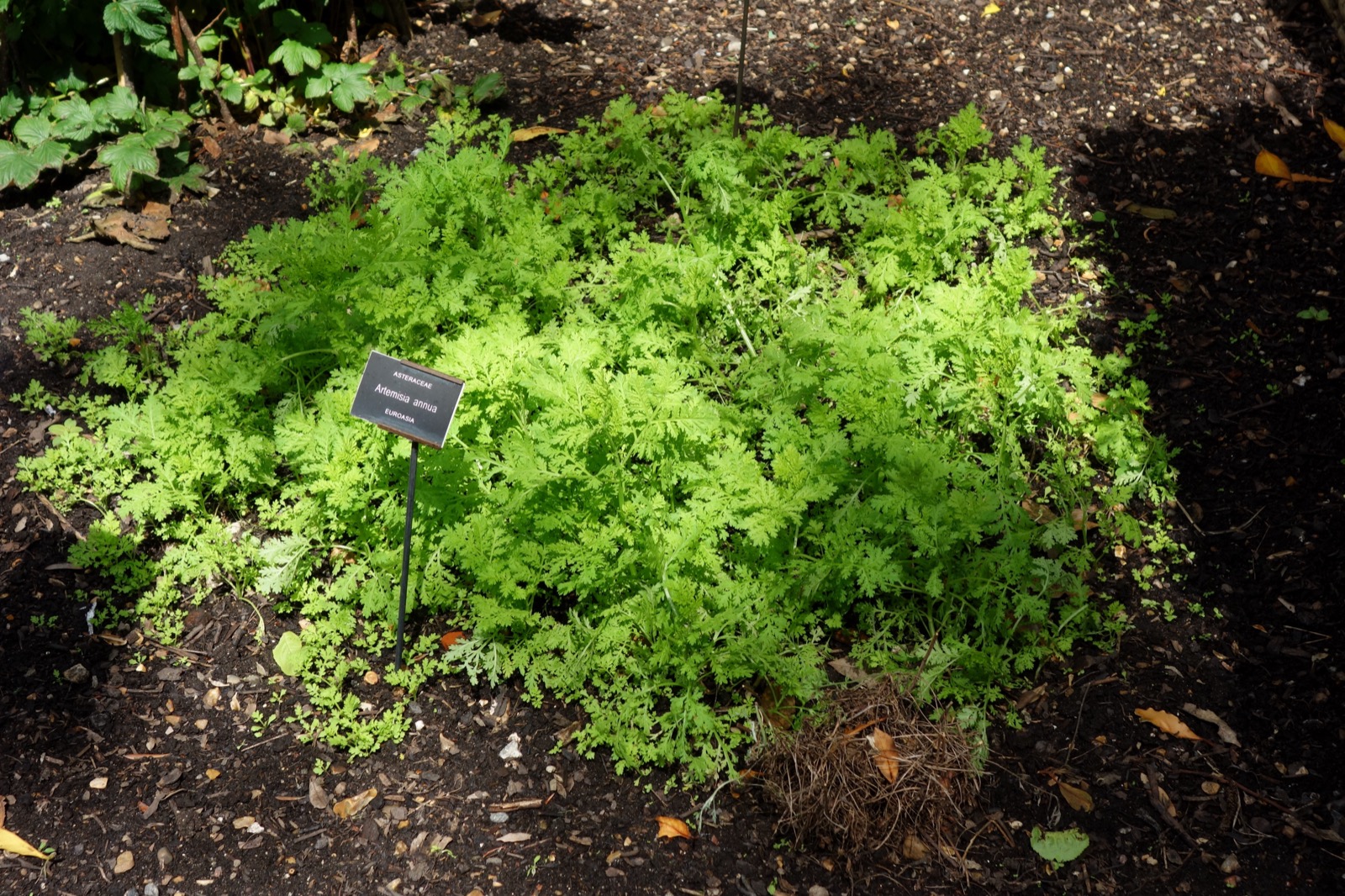
Figure 3. Sweet wormwood, Artemisia annua, the qinghao of Ge Hong’s handbook, in the Chelsea Physic Garden, London. Photo: Daderot, Wikimedia Commons, CC0.
On the pharmacy shelf, the spray’s “antibacterial” answers a question like my first three. The parent holding a bottle that costs three times the plasters is asking one like the fourth: will the knee heal better with it?
First, the rings had to become a verdict.
How the Rings Became a Verdict
Each kind of bacteria gave me eighteen clear rings in cloudy agar (Figure 4).
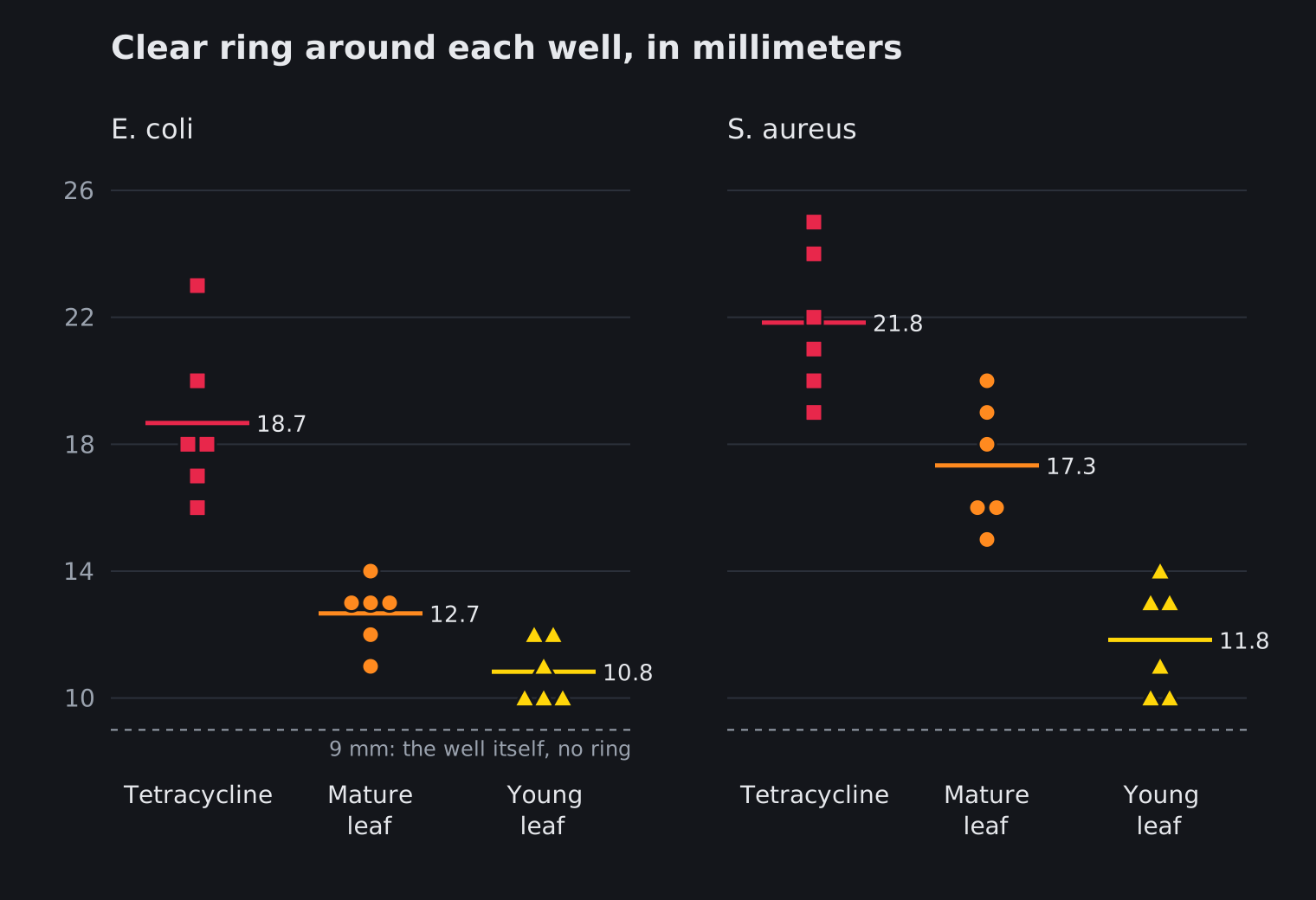
Figure 4. Width of the clear ring around each well, in millimeters, after incubation. Each mark is one plate; the tick and number give the treatment’s average. The dashed line is the 9-millimeter well itself, where a well with no ring would sit. Drawn from Gauran (2004), Tables 1 and 2.
The widths went through two models, a statistician’s word for a set of assumptions. The first assumed the wells were independent, none influencing another, as if each of the eighteen had its own dish. The second assumed that the three wells on one plate share that plate, and set what they share aside.
Two models went beyond anything taught in high school. My father ran both to show me that the same rings could be analyzed in more than one way, and that the results could change with the assumptions.
Both models began from the same guess: that the three treatments stop bacteria equally well, and every gap between the averages is chance. Statisticians call that guess the null hypothesis. It works like a jury’s presumption of innocence: the treatments count as alike until the data show otherwise.
The test for comparing three treatments is the analysis of variance, or ANOVA. It divides how far the three treatments’ averages sit apart by how far wells of one treatment stray from each other, plate to plate. The result is called F. If the treatments were truly alike, F would hover near 1. My E. coli rings gave 36.4, and my S. aureus rings gave 37.0.
A ratio that large would turn up by chance less than once in 10,000 tries. That chance is the p-value.
The second model had to ask what a plate shares.
What a Plate Shares
Each plate began as 20 milliliters of melted agar poured into a dish. Over it went 4 milliliters more, seeded with bacteria and tilted to cover the base. I poured the seed layer over and over until I had it right, because everything after rested on it. Three wells cut into one plate share that pour and that dose of bacteria. If the seed layer ran thick on one plate, all three of its wells could read narrow together.
Figure 5 sets each well against its treatment’s average. On four of the six E. coli plates, all three wells landed on the same side of their averages, and plate V read narrowest, or tied for narrowest, for all three treatments. On the S. aureus plates, no plate kept its three wells on one side.
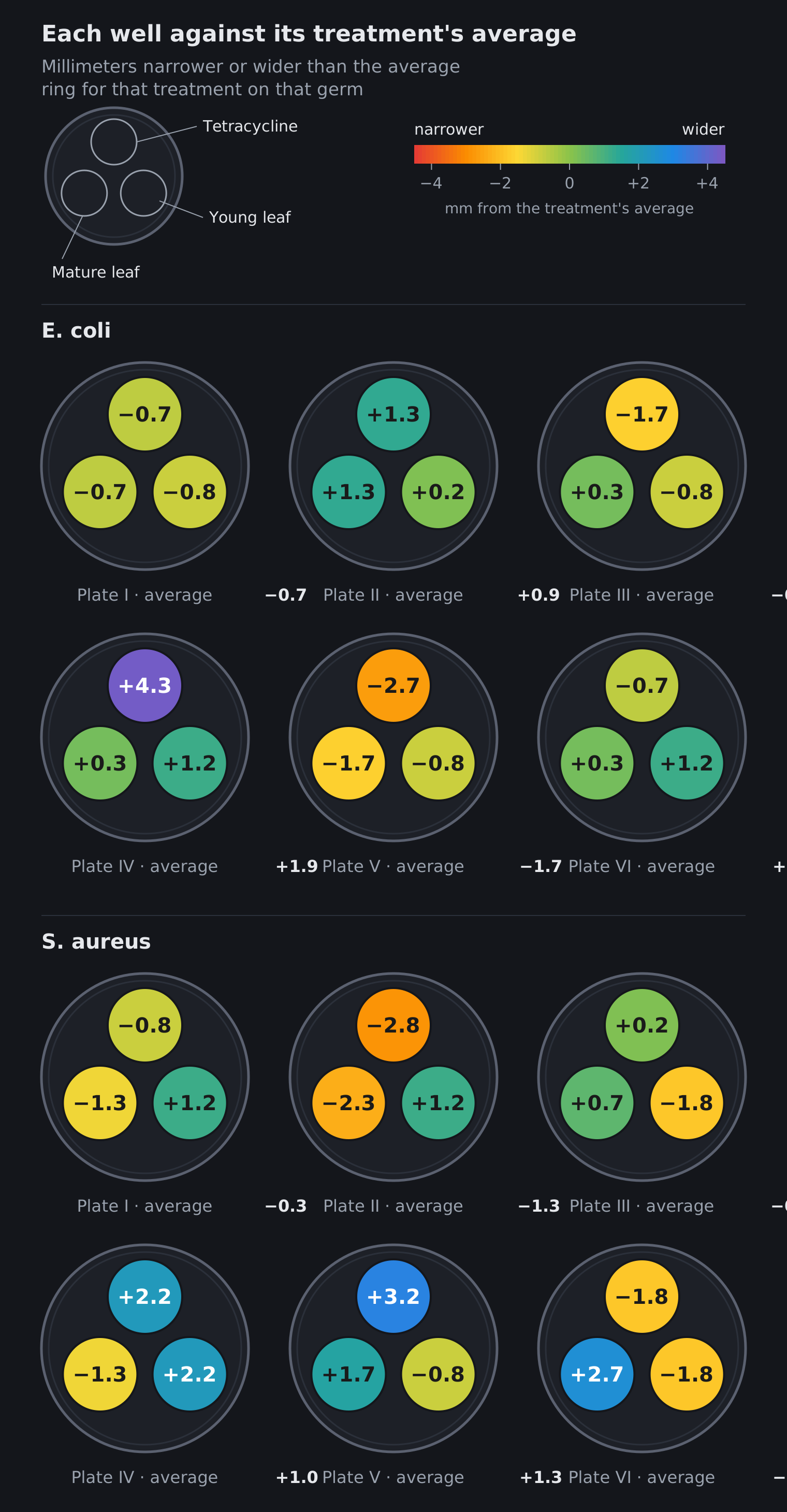
Figure 5. Each plate drawn as its dish, three wells to a plate. Each well shows its clear ring minus the average for its treatment on those bacteria, in millimeters, from red (narrower) through green (no difference) to violet (wider). Under each dish is the plate’s average difference. Well positions are fixed for reading. Drawn from Gauran (2004), Tables 1 and 2.
My father analyzed the plates as blocks.
“When we can control nuisance factors, an important technique known as blocking can be used to reduce or eliminate the contribution to experimental error contributed by nuisance factors. The basic concept is to create homogeneous blocks in which the nuisance factors are held constant and the factor of interest is allowed to vary.”
A block works like two Saturday weigh-ins on a bathroom scale, both before breakfast, to see what a week of walking did. One weigh-in after breakfast would mix the walking with the meal. Comparing wells on one plate leaves out the pour the same way.
Ronald Fisher randomized blocks on a farm in 1926, a line around each patch of shared soil. My plates were already blocks: every treatment had one well in every plate.
With each plate as a block, the noise on E. coli shrank: F rose from 36.4 to 66.2. On S. aureus, whose plates did not move together, F came to 32.5.
The verdicts held.
What blocking changed was the yardstick. On E. coli, the gap between mature and young leaves had to reach 2.8 millimeters to count under the first model, and 2.3 under blocks. The gap was 1.8. Mature leaves still beat young ones on every plate, by 1 to 3 millimeters.
Where that yardstick sits decides what a 1.8 millimeter gap means.
Where the Line Fell
The mature and young leaves on E. coli, 1.8 millimeters apart, got the same letter: b. Duncan’s test compares treatments two at a time and writes a letter beside each average, and means sharing a letter “are not significantly different at 0.01 level of significance.” That 0.01 was my thesis’s line: 1 in 100.
Move the line to 1 in 20, and the letter moves. Under blocks, a gap had to reach only 1.6 millimeters, and 1.8 would have counted. A strict line rarely calls a difference that is not there, the error statisticians call a Type I error. The price is that it misses more of the differences that are.
I wrote that the leaves’ effect “does not differ.” The test said less: at 1 in 100, six plates had not shown a difference. Not proven different is not proven alike, the way not guilty is not innocent.
In Tu’s lab, a wormwood extract slowed the malaria parasite in mice once, then failed. Ge Hong’s recipe says soak, not boil, so Tu switched to ether at low heat. In 1972 she reported that extract number 191 “obliterated Plasmodia in the blood of mice and monkeys.” The plant had not changed. The test had.
My tables answered questions about a dish. My objectives ended on one about wounds.
What a Ring Cannot Answer
A healer presses a bruised leaf onto a wound. The wound is not a plate at 37 degrees, and the leaf is not 0.2 milliliters of juice in a 9 millimeter well. My summary’s “scientific basis” for treating wounds starts with a width in a dish. Whether the poultice helps, harms, or does nothing a clean bandage would not is a question only a study of people can take.
Each leaf type was one batch of juice, pounded once, so six plates measured how steady the plates were, not how steady the leaves are.
In October 2026, the public register ClinicalTrials.gov listed no study of the weed in people.
In 1952, doctors at the Mayo Clinic and in Boston published reports of erythromycin in patients. In 1972, Tu’s extract cleared malaria from 21 patients on Hainan island. Each began as something people walk past, and each became a drug one answerable question at a time.
The rings also left me wondering. Antibiotics kill the helpful bacteria already living in the body along with the ones making a person sick. Does the weed’s juice do that too, or stop only the kinds that cause infections, like E. coli and S. aureus? My plates held only those two, so they could not say.
A trial of the weed would have to name whose wounds, what counts as healed, and healed compared with what: a clean dressing, a pharmacy ointment, the leaf. Each choice splits “Does the weed heal wounds?” into a smaller question a study can take.
For the scraped knee, the NHS says to clean a graze “by rinsing it with bottled or tap water,” then put on “a sterile dressing or a plaster.” It names no antiseptic. Whether the spray beats that rinse is a question no dish in any lab can answer, and the label was never asked. Bought on its label alone, the spray costs triple for the answer to a different question.
The question I keep now is the gap between how long people live and how long they live well. It is too large to answer as asked, and it splits the same way. My first question was a weed’s, and it fit in a dish only once it was cut down to what a ruler could measure.
A Closing Invitation. Dirt from Iloilo and a weed from Ge Hong’s handbook became medicines once someone asked them one question a test could take. Whatever a test cannot answer yet is a question not yet split.
- Find what shares the plate. Think of two things at home that went wrong together this month: two plants wilting on one windowsill, two lamps out in one room. Before you count them as two, ask what they shared: one sill, or one breaker? What they share, you fix once: one flip of one breaker lights both lamps.
- Trace what went in the well. Take the next home cure someone hands you this month: a tea for sleep, a balm for sore joints from a grandparent’s shelf. What is it for, and what would you trust it on: the label, or a result someone saw? Ask the person who handed it to you what they saw it do.
- Name what no ring touched. Take one health question on your mind this week: a scraped knee, a child’s cough, the number on the scale. Write it as two lines in a note: what you would measure, and what you would compare it with. Could one measurement answer it yet, and who should see the note first?
A ruler in Aborlan measured 36 rings, and every one was real. Tu’s weed got its trial, and Iloilo’s name is on a drug. Loko-loko still means crazy, until someone splits its question.
A label can tell the truth and still not answer your question. “Tested” says a test was run, not what it asked. Before you trust it, ask what was tested, and on whom.

Where This Came From
The thesis was my introduction to statistics and to health research. Practicing the defense in front of Ma’am Dulce, I cried from nerves. In February 2005 I presented it at the Western Philippines University research forum as Gauran, Bunquin and Bernardo, the only high-school student on the program, and in April it won best thesis, with a small cash prize. In 2019 I came back to that forum as its keynote speaker, from the UP School of Statistics, and opened my talk with this weed. I called it my first adventure. This piece follows the four on how a test decides, and here the tests stop counting and start measuring. It opens the next set, on how one question splits.
Intellectual Honesty Note. No sheet of my father’s block analysis survives, so the block numbers (F 66.2 and 32.5; Duncan’s cutoffs of 2.3 and 1.6 millimeters on E. coli) are recomputed from my Tables 1 and 2, treating each plate as a block; so is the 2.8 millimeter cutoff under the first model. “After three days” follows my results, which report the rings after 72 hours; my methods say 24 to 72. “A firm jelly” stands in for agar, a seaweed gel. I do not remember the leaf juice’s dilution, so none is given. The pharmacy spray, the scraped knee and the scale are invented scenes. Accounts differ on where Aguilar’s soil came from, his own backyard or a cemetery in Molo, so I say only Iloilo. That Lilly’s screen read a clear zone is how soil microbes were screened then, not a detail from his file.
References
Fisher, R. A. (1926). The arrangement of field experiments. Journal of the Ministry of Agriculture of Great Britain, 33, 503-513.
Francisco, M. A. (2020, April 20). FlipFacts: Abelardo B. Aguilar and erythromycin. FlipScience. https://www.flipscience.ph/?p=10381
Gauran, I. I. M. (2004). Antibacterial property of Hyptis suaveolens [High-school thesis]. Western Philippines University Agricultural Science High School, Aborlan, Palawan.
Gram, H. C. (1884). Ueber die isolirte Färbung der Schizomyceten in Schnitt- und Trockenpräparaten. Fortschritte der Medicin, 2(6), 185-189.
Haight, T. H., & Finland, M. (1952). Laboratory and clinical studies on erythromycin. New England Journal of Medicine, 247(7), 227-232.
Heilman, F. R., Herrell, W. E., Wellman, W. E., & Geraci, J. E. (1952). Some laboratory and clinical observations on a new antibiotic, erythromycin (Ilotycin). Proceedings of the Staff Meetings of the Mayo Clinic, 27(15), 285-304.
Lasker Foundation. (2011). Artemisinin therapy for malaria: 2011 Lasker~DeBakey Clinical Medical Research Award, Youyou Tu. https://laskerfoundation.org/winners/artemisinin-therapy-for-malaria/
NHS. (2026, April 2). Cuts and grazes. https://www.nhs.uk/conditions/cuts-and-grazes/
NIST/SEMATECH. (2012). e-Handbook of statistical methods. National Institute of Standards and Technology. https://www.itl.nist.gov/div898/handbook/
U.S. National Library of Medicine. (n.d.). ClinicalTrials.gov [Search for “Hyptis”, 2026-10-13: no studies]. https://clinicaltrials.gov