I wash my dishes before I wash my dishes. Every plate gets rinsed at the sink, then loaded into a dishwasher built to do the rinsing (Figure 1). I do not trust that machine with a single grain of rice. I own a dishwasher the way some people own a treadmill: as a place to put things after the work is done.
When I was told the dishwasher uses less water than my sink, I doubted it. Then I read the studies. In one, 150 people in Britain each washed a full load by hand and used almost four times the water a dishwasher did. I believe it now, and I know the rinse first only wastes more. I still do it most nights. Some part of me must not believe the numbers yet, because my hands keep doing the washing.

Figure 1. How a dishwasher works, and how to let it do the work, from Technology Connections (2024), YouTube embed. The overview of how the machine washes starts at 0:55.
The thermostat on the wall fools people the same way. The anthropologist Willett Kempton asked twelve people in Michigan how they run the heat at home, and in 1986 he published what they told him. One of them, a man named Bill, said his thermostat worked “like stepping on the gas pedal.” It does not.
The thermostat works like an elevator button. A rider wants floor 3 and presses 10. The elevator goes no faster. It reaches floor 3 at the same moment, then rides on past it. The furnace is the elevator. It is either on or off, and when it is on, it gives the same heat every time (Figure 2). The number on the thermostat only picks where the furnace stops. Want 70°F and set the thermostat to 85°F, hoping to get there faster? The room still hits 70°F at the same minute. The heat just does not stop there.

Figure 2. How a thermostat switches the heat on and off, from Technology Connections (2019), YouTube embed.
Bill did what I do at the sink. Partway through the interview, Bill remembered the furnace in his parents’ house turning on and off by itself at night. Their thermostat, he guessed, must measure the room and switch the heat on and off. That is how every thermostat works, his own included. Seven months later, Kempton showed Bill what Bill himself had found. Bill said he had “discovered it for the moment, but later forgot it.” Back at his own thermostat, he “probably went back to doing it the same way.”
Still, Bill’s idea predicts one thing right: a higher number burns more fuel. “The prediction is correct,” Kempton wrote, “even if the explanation is wrong.”
A husband in another of Kempton’s interviews knew the thermostat was a switch. So he argued with his wife “long enough,” she said, that turning the heat down at night saves nothing. Turn it down to 55°F, his reasoning went, and every object in the house cools to 55°F. In the morning the furnace must warm it all back to 65°F. His idea left out one thing. A warm house leaks heat through its walls faster than a cool one, the way a full bucket with a hole leaks faster than a half-full one. Every hour at 55°F leaks less than an hour at 65°F, so turning the heat down at night saves fuel, even counting the morning warm-up.
Bill was wrong about the thermostat and right about the heating bill. The husband was right about the thermostat and wrong about the bill.
Each man carried a model of the thermostat in his head, a set of assumptions about how it works. Each model was wrong somewhere, and each was good for a different job.
The first cold evening this month, someone in your house turns the thermostat to 85°F “to warm it faster,” like pressing an elevator button twice. The furnace does not know it is being rushed. Two hours later the room is too hot, and the old argument starts again. Asking whose model is right will not end it. Asking which model predicts the bill might. How would anyone find out?
What a Model Assumes
Warm air sighs from the vents when the furnace clicks on. The furnace, the thermostat and the walls make a system. Donella Meadows said a system has three things to look for: its parts, what pushes what, and what the whole is for. Russell Ackoff added a test for a system. A system can do something no part can do alone, so take one part out and the essential property is gone. The three machines here pass the test.
| Parts | What pushes what | What the whole does | Take one part out | |
|---|---|---|---|---|
| Heat | furnace, thermostat, walls, a hand | a cold room turns the furnace on, a warm room turns it off, and the walls leak heat | holds a room at one temperature | no thermostat: the furnace heats until someone notices |
| Dishwasher | pump, heater, spinning sprayers, detergent | the pump drives hot water through the sprayers onto the plates | cleans a full load on little water | no sprayers: the water just sits |
| Laundry | drum, water, detergent, clothes | the turning drum works the detergent through the cloth, and the rinse carries the dirt away | clean clothes | no water: the detergent does nothing |
A person’s hand belongs on the list. The thermostat cannot tell who is cold. Someone feels the room. The hand sets the number, and the furnace answers.
What moves the hand is a model of the system, carried in the head. A mental model is a set of assumptions about a system: which parts it has, what pushes what, and what it is for. Run it forward, and it predicts what happens next. Bill assumed a higher setting makes the furnace put out more heat each hour. The husband assumed a house leaks heat at the same rate whether it is warm or cool, so he left the walls out. I assume the sprayers cannot get a dried grain of rice off a plate, so I scrub it at the sink first.
Search for “mental models” today, and most pages offer a list of thinking tools for investing and work, after a 1994 talk by the investor Charlie Munger. This piece stays inside one house, with its machines. It uses the older meaning from psychology.
“If the organism carries a ‘small-scale model’ of external reality and of its own possible actions within its head, it is able to try out various alternatives, conclude which is the best of them, react to future situations before they arise …”
“The mental image of the world around you which you carry in your head is a model. One does not have a city or a government or a country in his head. He has only selected concepts and relationships which he uses to represent the real system.”
“Likewise, when they understand a description of the world, they can construct a similar, albeit less rich, representation … a mental model of the world based on the meaning of the description and on their knowledge.”
“A mental model of a dynamic system is a relatively enduring and accessible, but limited, internal conceptual representation of an external group of interrelated stocks and flows (i.e., a system) whose structure and relationships maintain the perceived structure and relationships of that system.”
Three of the four name a way the assumptions fall short of the system. Forrester’s model keeps “only selected concepts and relationships.” Johnson-Laird’s is “less rich” than the world. Doyle and Ford’s keeps the structure its holder perceives, which may not be the structure that is there. Craik names what the model is for: trying a move in the head before trying it in the world.
A statistician’s model is a set of assumptions too. A linear regression model, for one, assumes that the relationship between two variables is linear and that the error terms are independent and identically distributed. In plain words, the points scatter around a straight line, and every miss comes from the same spread, with none leaning on another. Both assumptions can be checked against the data, at least in part, and either may not hold.
Tonight, a clean plate will get washed twice, and a roommate will press the thermostat like an elevator button in a hurry. Which assumption moved these hands, and which one is built into the thermostat?
Who Drew the Settings and How They Project
Inside the old round thermostat, a coiled metal strip tips a drop of mercury to throw one switch. The engineers who designed it started from that assumption: it is a switch. Bill never met them. The psychologist Donald Norman, in a 1988 book now titled The Design of Everyday Things, named three views of one machine:
- The designer’s model: how the engineer built the machine to work.
- The user’s model: what the person using it believes.
- The system image: what the machine itself shows, such as the number on a thermostat, the buttons on a dishwasher or the line on a detergent cap.
The designer and the user never talk. Only the system image passes between them. Call it the settings: whatever a machine shows the hand and lets the hand change.
The settings are a projection. In statistics, a projection keeps some directions of the data and flattens the rest. It works the way sunlight through a lattice window lays its outline on the floor and leaves its depth behind (Figure 3). A thermostat’s settings cast the system’s shadow, and the shadow shows one number. Each person rebuilds the system from that shadow, and two people can rebuild it two ways.

Figure 3. A lattice and its shadow. Sunlight through the colored glass of the Nasir al-Mulk Mosque in Shiraz lays the window’s outline on the carpet and leaves its depth behind. Photograph by Laurens R. Krol (2018), Wikimedia Commons, CC BY 4.0.
Across his interviews with twelve people, Kempton found two models of the thermostat. He called them folk theories: ideas a group picks up from living with a machine. In the feedback model, the thermostat is a switch that watches the room. Below the setting, it turns the furnace on; above it, off. The setting is a finish line. In the valve model, Bill’s, the setting is a faucet: turn it higher and more heat flows, the way more gas flows when a driver presses the pedal harder.
Each mental model tells the hand to do something different, so each leaves its own trace. Someone with the feedback model sets the number they want and leaves it. Someone with the valve model keeps adjusting: up when the room feels cold, down when it gets too warm. Both patterns show up in a Princeton study that Kempton drew on, where machines logged the thermostat setting in 26 identical New Jersey townhouses every hour for two years. In one house, in the winter of 1976, the setting moved three times a day. In another, it moved almost every waking hour, and across the whole study it ran anywhere from 61 to 85°F. The houses were the same, down to the thermostat on the wall. Only the hands differed, and each moved the way its model said to.
The line on a detergent cap is a setting too, and the size of the cup can move the hand. In 2025, Tobias Kimmel and colleagues at the Niederrhein University of Applied Sciences in Krefeld, Germany, asked 97 people to dose detergent for a load of laundry. Each poured once with a 60-milliliter measuring cup and once with a 100-milliliter one. From the larger cup, they poured 16 percent more. The label did not change. Only the cup did. At the washer tonight, whose model is the hand paying for?
Where the Model Misses
Kempton saved his last doubt for the engineers, whose model of the thermostat is the correct one. “A theory that is useful for designing thermostats,” he wrote, “is not guaranteed to be a good theory for using them.” A model is judged by what it predicts, not by whether its assumptions match the inside. By that test, Bill’s valve model did its job on the heating bill.
So the useful question is not whether a model is wrong. Every model is. In 1976, the statistician George Box wrote, “Since all models are wrong the scientist must be alert to what is importantly wrong” (Figure 4). Which assumption is wrong, and by how much?
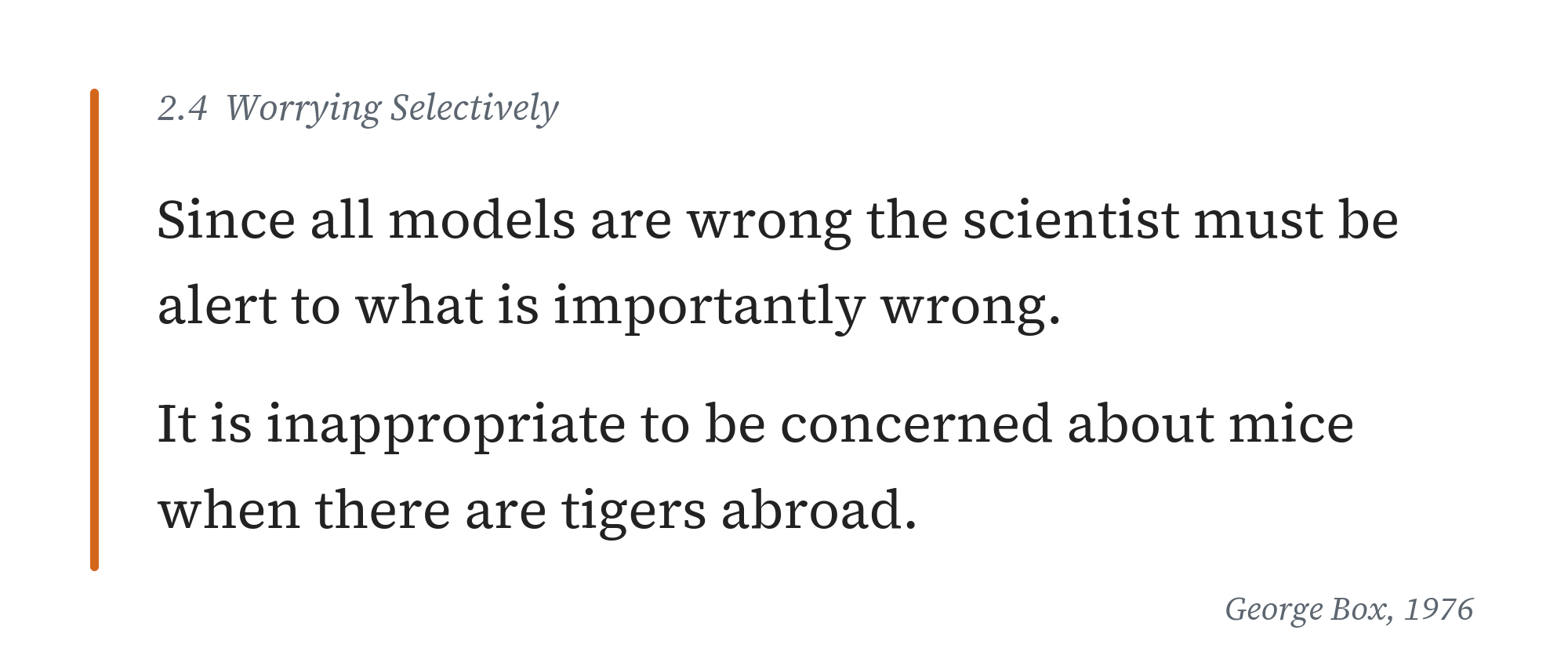
Figure 4. The line in Box’s own words, with the sentence that follows it: mice and tigers. Drawn for this piece; words from Box (1976), p. 792.
Bill heard his model miss, in his parents’ house at night, and forgot it. He wrote nothing down, so nothing changed. A household that keeps its guesses in its head gets the same argument back with every month’s heating bill.
A statistician keeps two gaps apart. The error is the gap between the model and the world, and no one ever sees it. The residual is the gap between what the model estimated and what was measured, and anyone can see it. The residuals are how the error gets estimated, and how a model’s assumptions get checked.
Here is the move that makes a model better: write the guess down before the world answers, then measure the gap. The thermostat in the hall runs on that very gap: it compares the setting with the room and acts on the difference. A statistical test starts the same way. It writes down one assumption about a population, the null hypothesis, before the data arrive, and the data then say whether that assumption still fits.
Try the move on the laundry. The line on the detergent cap is one model of a load: the maker’s. Someone in the house may pour a quarter of it, sure the line is drawn to sell more detergent. That is a second model of the same cup. Pour too much, and the extra is money down the drain; pour too little, and the shirts go back in the wash. Before the next load, whoever trusts the line and whoever pours a quarter each write one number on the back of an envelope. The number is a guess: how many shirts will come out still dirty at a quarter of the line. Then wash at a quarter and count. The gap between each guess and the count is that model’s residual, in writing. One load will not end the argument. A few loads, each guess written down first, can.
Each model needs only one number on an envelope, propped on the washer. Ask each model for that number the same way every load, and the envelope becomes a framework: the part that asks a model’s questions the same way every time.
A Closing Invitation. The thermostat in the hall stood for the model each person carries in their head. A model is judged by its job, and it gets better when its guess is written down first and checked.
- Find your model. Now, where you sit, picture the next step you want at work: the promotion, the raise, the first job after school. What does your model say gets you there? Study hard, get a good job; work hard, get promoted. That is a valve: more effort, more result. Who decides, and what number do they read?
- Count the high nights. This weekend, before you open your viewing history, write down your guess and a friend’s: how many episodes last month ran past the plan, from the “one more” at eleven to the theme song left to autoplay? Whose guess came closer? Did the extra ones rest you, or only use up the evening?
- Guess the minutes. Tonight in bed, before you open the feed, the news or short videos, type into your phone’s notes how many minutes you will give them. When you set the phone down, how far off was the note? What did your model of “just a few minutes” leave out, and how much earlier could you have been asleep?
At the sink, every plate still gets rinsed. The thermostat hangs where it always did, set at the room you want. By the bed, a note on the phone says ten minutes, and the clock above it keeps the gap.
You can be wrong about how a thing works and still right about what it does. Do not trust a belief just because it is yours; every one is wrong somewhere. Ask what job you are trusting it with.

Where This Came From
Craik wrote the “small-scale model” during the Second World War. Forrester, who founded system dynamics at MIT, told managers in 1961 that their mental models “are not the real corporation” (as Doyle and Ford quote him). Johnson-Laird made it a theory of reasoning in 1983. By 1997 the term had grown so loose that Doyle and Ford set out to fix it. Of their own definition, they wrote, “We make no claim that this conceptual definition is correct or complete.”
Intellectual Honesty Note. Bill’s words are quoted in short fragments, fillers dropped. The Johnson-Laird box puts an ellipsis where the original has a dash. Kempton never interviewed the two logged families. He wrote that their frequent changes “could be due to other causes such as domestic conflict over desirable setting.” Kimmel and colleagues’ study was commissioned by IKW, a detergent industry group, and run in a laboratory. Reading Kempton through Box, “the settings” as a name for Norman’s system image, the shadow as a statistical projection, the thermostat’s gap set beside a null hypothesis, and the hand as one of a system’s parts are this piece’s own. The laundry argument and its envelope are invented. The dishwasher and the rice are the author’s own. “Almost four times” is this piece’s division of Berkholz and colleagues’ averages: 49 liters by hand over 13 by machine, about 3.8. The abstract as indexed prints “131”, read here as 13. The furnace described is the single-stage kind; some newer ones have more than one level of heat.
References
Ackoff, R. L. (2015, November 2). Systems thinking speech by Dr. Russell Ackoff [Video]. YouTube. https://www.youtube.com/watch?v=EbLh7rZ3rhU
Berkholz, P., Stamminger, R., Wnuk, G., Owens, J., & Bernarde, S. (2010). Manual dishwashing habits: An empirical analysis of UK consumers. International Journal of Consumer Studies, 34(2), 235-242. https://doi.org/10.1111/j.1470-6431.2009.00840.x
Box, G. E. P. (1976). Science and statistics. Journal of the American Statistical Association, 71(356), 791-799. https://doi.org/10.1080/01621459.1976.10480949
Cooper Hewitt, Smithsonian Design Museum. (2013, October 11). The round thermostat. https://www.cooperhewitt.org/2013/10/11/the-round-thermostat/
Craik, K. J. W. (1943). The nature of explanation. Cambridge University Press.
Doyle, J. K., & Ford, D. N. (1997). Mental models concepts for system dynamics research [Conference paper]. International System Dynamics Conference. https://proceedings.systemdynamics.org/1997/doyle2.htm
Forrester, J. W. (1971). Counterintuitive behavior of social systems. Technology Review, 73(3), 52-68.
Johnson-Laird, P. N. (1983). Mental models. Harvard University Press.
Johnson-Laird, P. N. (2010). Mental models and human reasoning. Proceedings of the National Academy of Sciences, 107(43), 18243-18250. https://doi.org/10.1073/pnas.1012933107
Kempton, W. (1986). Two theories of home heat control. Cognitive Science, 10(1), 75-90. https://doi.org/10.1207/s15516709cog1001_3
Kimmel, T., Pauels, K., Darteh, J., & Eigenstetter, M. (2025). Effect of dosing aid size and consumer age on detergent dosage and discrepancies between perceived and measured laundry load in household washing. Tenside Surfactants Detergents, 62(5), 433-443. https://doi.org/10.1515/tsd-2025-2678
Krol, L. R. (2018). Nasir al-Mulk Mosque, Shiraz, winter prayer hall [Photograph]. Wikimedia Commons. https://commons.wikimedia.org/wiki/File:2018-09-22_Iran,_Shiraz,_Nasir_al-Mulk_Mosque_(winter_prayer_hall)_(3).jpg. CC BY 4.0.

Meadows, D. H. (2008). Thinking in systems: A primer (D. Wright, Ed.). Chelsea Green.
Munger, C. T. (1994). A lesson on elementary, worldly wisdom as it relates to investment management and business [Lecture]. USC Business School. Transcript: https://fs.blog/great-talks/a-lesson-on-worldly-wisdom/
Norman, D. A. (1988). The psychology of everyday things. Basic Books. Later editions titled The design of everyday things.
Technology Connections. (2019, May 10). Thermostats: Cooler than you think! [Video]. YouTube. https://www.youtube.com/watch?v=ZZC0SP02PqY
Technology Connections. (2024, June 11). Your dishwasher is better than you think (tips, tricks, and how they work) [Video]. YouTube. https://www.youtube.com/watch?v=jHP942Livy0