In July 1976, military veterans gathered at a hotel in Philadelphia for a convention. An illness spread among them. Thirty-nine of the people who caught it had never set foot inside. They had only been on Broad Street, within a block of the Bellevue-Stratford. Days later came aching muscles, a dry cough, and a fever that climbed fast. Five of them died. Whatever was making the veterans inside the hotel sick had reached the street.
The veterans belonged to the American Legion, and its members call themselves Legionnaires. Of the people tied to the convention, 182 fell ill, and 29 of them died. Counting the street, that made 221 sick and 34 dead. The suspects came one after another. Swine flu came first. Then a toxic metal compound, nickel carbonyl, that a person can breathe in. Then the hotel’s own pesticides and cleaning products. Through the fall, the labs tested for poisons, bacteria, fungi and viruses, and found nothing to blame.

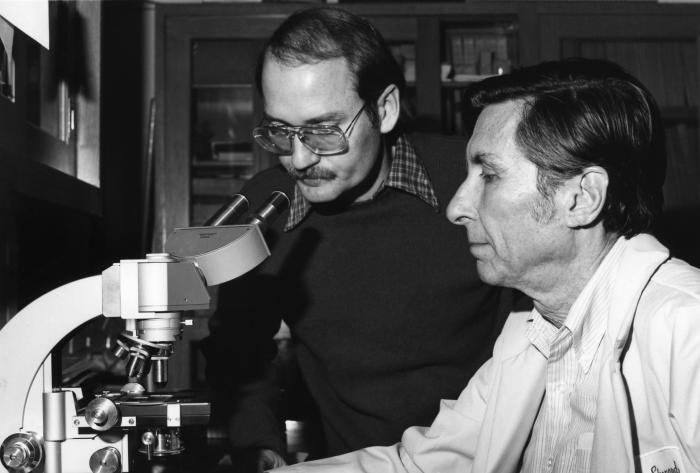
Figure 1. Two design choices. Left: the Bellevue-Stratford Hotel, with the Broad Street Line subway sign at the bottom of the frame; inside it or outside it was the population the investigators compared. Right: Joseph McDade (left) and Charles Shepard at a microscope at the CDC in 1977; the culture under it was the measure that first hid the answer. CDC Public Health Image Library (IDs 15278 and 8232), public domain.
“What is making the Legionnaires sick?” could not be answered as asked. The people on Broad Street made a simpler one possible: was the cause inside the hotel, or in the air around it? They had never eaten the food or drunk the water inside, so nothing served at the tables could have reached them. They had shared only the air near one building. Set beside the veterans, they pointed away from the kitchen. The investigators concluded that the exposure may have happened in the lobby or on the street just outside. The street cases went into the record under a name of their own: “Broad Street Pneumonia.”
The germ itself turned up in a narrower question still. Over Christmas, a CDC scientist named Joseph McDade went back to samples from the dead. The standard recipe for growing the kind of germ he was hunting added two antibiotics, to keep stray bacteria out. He left the antibiotics out, and a bacterium grew that no one had seen before. The recipe built to keep out the wrong germs had been killing the right one. The CDC announced the find on January 18, 1977. The bacterium was named for the people it first killed: Legionella pneumophila, the “lung-loving” one. Where it came from was never proven. The hotel’s cooling tower, part of its air conditioning, later became the main suspect.
Two choices solved the case, and both were made before anyone knew the answer. The first was who to compare: the people on the sidewalk against the people inside. The second was what to measure: a culture grown one way hid the germ, and grown another way showed it. Made first, those two choices turned a mystery into a question someone could check.
You sign up for a strength class, two sessions a week, on a mat that smells of rubber. Three months in, a doctor adds a new prescription. By month six the stairs feel easier, and the question is whether the class did that, or the pill, or the summer. The cost is not the two sessions a week. It is six months of not knowing whether to keep paying for them, or whether to tell your sister to join. Compared with whom, and what counts if something changed partway? Decided afterwards, any answer fits.
The first part of this series set out the question in biostatistics I return to most: how to narrow the gap between lifespan and healthspan. Healthspan is the stretch of life spent in good health. By the end of that part, I had split the question in two: the body’s own capacity, and the demands of the place a person lives in. Split once, each half is still more than a single study can take on, the way “What is making the Legionnaires sick?” was. Each splits again, into four ways in (Figure 2). Each way in needs what the sidewalk settled: who is compared, and what is measured. In my field, that pair written out in full, before any data exists, has a name: an estimand.
The woman of twenty-five from the first part is forty-seven now. Her PCOS, polycystic ovary syndrome, is a hormone condition that often comes with trouble using insulin. Three doctors saw her before anyone named it. She has started lifting weights, two mornings a week, to keep her hips strong. Whether that works is the first way in, and the first question that needs its comparison chosen in advance.
Start Higher
Ten percent more bone at the start can put off osteoporosis by about thirteen years. Osteoporosis is bone thin enough to break easily. The number comes from a 2003 computer model of a woman’s bones, built by Christopher Hernandez and colleagues. In the same model, slowing the loss by the same 10 percent bought about two years.
That starting supply is called reserve: what a body can draw on to withstand a stressor, beyond what daily life asks of it. The first way in builds a higher peak of reserve before decline begins (Q11). Then what a body can do on its own still declines, but it crosses the line where the loss matters later. Reserve works like savings before retirement. Two people can spend at the same rate, and the one with the bigger balance runs out years later. Muscle, fitness and bone are three accounts. Unlike a bank balance, they shrink when left untouched.
The question
Functional ability: capacity and environment
Four ways in
The brain keeps one too, called cognitive reserve: the ability to use its networks more efficiently, or to call up other networks when one fails.
Fitness may be the largest account, and one that builds on itself. One hard ride on an exercise bike strips marks off the genes that build a muscle’s energy supply. Months of rides add capacity for the next. Her weights pay into two of the accounts, bone and muscle: resistance training, muscles working against a load, to raise the peak before the decline.
Whether her training raises the peak needs its question written out first. Thirty-nine sick people on one street gave the Philadelphia investigators a question with four parts. Who: people who had been within a block of the hotel but never went in. Exposed to what: the air around one building. What outcome: the illness. Compared with whom: the veterans inside, who had shared the food and water as well. Leave one part out, and almost any answer fits. Bacteria shared by a mother’s milk and her baby’s gut mean little until someone asks whether a stranger’s baby would share them too.
A question written out this way is an estimand. In 2019, the international council that sets rules for drug trials told trials to state theirs before they start.
“A precise description of the treatment effect reflecting the clinical question posed by the trial objective. It summarises at a population-level what the outcomes would be in the same patients under different treatment conditions being compared.”
The woman’s estimand reads this way. Who: women between 45 and 60 who do not train yet. Exposed to what: two short strength sessions and a few brisk walks a week. What outcome: physical function, which here means walking on her own at eighty. Compared with whom: women like her carrying on as before. The estimand is about the population, not about her alone. It asks how many more of those women are walking at eighty, and she is one of them.
Life gets in the way of a question that long. In November 2025, the FDA announced it would remove its strongest warning label, the boxed warning, from menopausal hormone therapy. More women may now start hormones during the transition. If she starts them halfway through, the hormones change her bone too. Some women quit the sessions. And some die before eighty. Her PCOS makes diabetes more likely, and a 50-year-old with diabetes dies, on average, six years earlier than one without. A heart attack at seventy is the death the question has to plan for. The guideline calls each of these an intercurrent event, and the estimand must say how they count before anyone enrolls.
“Events occurring after treatment initiation that affect either the interpretation or the existence of the measurements associated with the clinical question of interest.”
One trial, two true answers. If she starts hormones halfway through, one analysis counts her as trained, hormones and all, and asks what happened to women who were handed the sessions and lived their lives. Another asks whether she would still walk on her own at eighty had she never started hormones. Both are correct on the same data, because they answer different questions. The first part of this series found one death with four true answers. Here the estimand picks which true answer a study will give, before the data exist. A death that comes first is the hardest of the events, because it ends the outcome instead of changing it. The third part gives it a method of its own.
Someone starting a strength class this month can write the four parts on the back of the receipt. Compared with whom: a friend who did not sign up. What counts as working: the stairs at month six, timed. What happens if a new prescription starts partway: it goes on the receipt, with the date. Two sessions a week for six months is the cost. A receipt with four lines on it turns the cost into an answer. A body built higher still ages, and the second way in asks whether one pill could slow what drains it.
What the Diseases Share
For twenty-two years the woman has swallowed one pill with breakfast: metformin. It is a diabetes drug, prescribed for her periods at twenty-five. A trial called TAME was designed to test that cheap pill against aging itself. The second way in slows what the diseases share at the root: the drivers that drain every reserve at once (Q12).
The field’s name for those drivers is the hallmarks of aging, a short list of processes, such as chronic inflammation and worn-out cells that refuse to die. Each one shows with age, speeds aging when pushed, and slows it when treated. The field calls the premise the geroscience hypothesis: treating what aging does to a body should hold off many diseases at once, not one at a time.
TAME’s design says how. Its authors chose not to study metformin’s effect “on each separate condition.” Instead, they wrote, “we will measure time to a new occurrence of a composite outcome that includes cardiovascular events, cancer, dementia, and mortality.” The design works like a single stopwatch for four outcomes: whichever arrives first stops it, and that time is what the trial compares. That is the outcome part of an estimand, answered for a whole way in at once.
“An intercurrent event is considered in itself to be informative about the patient’s outcome and is therefore incorporated into the definition of the variable.”
Death is on that stopwatch on purpose. A trial that counted only dementia would lose the people who died first, and the guideline names death as the plainest case for folding the event into the outcome. That is one way to handle the heart attack at seventy from the first way in: count it, instead of planning around it.
Attia’s Four Horsemen, the first part’s list of the four diseases most people die of, are heart disease, cancer, dementia and type 2 diabetes. TAME’s composite counts three of the four as one outcome and leaves the fourth out. It leaves her out too. The trial would assign 3,000 people to metformin or a placebo at random. All would be 65 to 79, without diabetes. At forty-seven she is too young, and by fifty-five, as the third part tells, she will have diabetes. Her twenty-two years on the pill make her the trial’s most interesting case and its excluded one.
Two or more chronic conditions in one person is what the field calls multimorbidity, and holding off that pile-up is the second way in. TAME’s intercurrent event can already be named: someone given the placebo is diagnosed with diabetes and starts metformin outside the trial. The estimand has to say how that person counts. TAME has not enrolled anyone. Metformin is generic, so no drug company stands to make money from proving it works. In 2025 the trial’s lead investigator, Nir Barzilai, said it was on hold while talks with the FDA went on.
The leaflet in a pharmacy bag says a drug lowers a risk by some percent. The questions to ask at the next refill: a risk of which outcome, in whom, compared with whom? A percent with no population under it fits anyone, and so fits no one. Whether a treatment slows the drivers can only be read on a stopwatch that runs for years. The third way in asks what a scan can read sooner.
Clues Outside the Building
At forty-seven, a technician scans the woman’s hip for the first time. A break, if it comes, may be twenty years off, and no study of her training can wait for it. So the study reads her hip on a bone scan instead: a number that stands in for the fracture, the way McDade’s culture stood in for the germ. The third way in catches decline early, before one loss cascades into others (Q21). Its first choice is what to measure in place of the thing itself.
In December 2025, the FDA accepted two years of change in hip bone density as a stand-in for fractures in drug trials. The rule covers women past menopause with osteoporosis. The stand-in has a name.
“A surrogate endpoint is a clinical trial endpoint used as a substitute for a direct measure of how a patient feels, functions, or survives.”
An endpoint is a variable defined precisely enough to be analyzed, chosen to reflect the outcome a study cares about. A surrogate is one that arrives sooner. It is only as good as its link to the real outcome, and the link can hold for most people and fail for a few. In type 2 diabetes, the bone scan reads better than the bone is. A 2011 study of older adults found that, for the same scan result and age, those with diabetes broke more bones than those without. Her own scan at forty-seven reads normal, and at fifty-five the third part reads it again.
The scan is one clue outside the building. There are cheaper ones. Long before a woman reports any difficulty climbing stairs, she may have changed how she climbs them, one hand on the rail, or how often. Linda Fried and colleagues named that stage preclinical disability: a task modified in method or frequency without any reported difficulty. It is the early, hidden decline of Figure 2’s third way in, read from a question instead of a scan. The last part of this series asks which such clues are worth checking at every visit.
The number on a scan report, a bone-density score or a cholesterol reading, is a stand-in for something later. The question to ask when the report comes is what the number stands in for, and whether the link holds for someone like the person holding it. A reading that stands in well for the average patient and badly for this one is a number, not an answer. Where a fall happens, on a stair or beside a bathtub, is the last way in.
Questions No Lab Can Grow
A handyman in Baltimore bolts a grab bar beside a bathtub, and the drill whines against the tile. The bar works the day it goes in. The last way in designs homes, communities and care so that a body with less can still live a full, independent life (Q22). About three in four Americans over fifty want to stay in their homes as they age.
The bar is part of a program called CAPABLE, which sends a nurse, an occupational therapist and a handyman into the homes of low-income older adults. CAPABLE was tested on 300 people, assigned at random. Five months in, those in the program had about 30 percent fewer problems with daily tasks like bathing and dressing. A later comparison estimated that Medicare saved about $22,000 per person over two years. The program cost near $3,000.
Written out like the Broad Street question, CAPABLE’s reads this way. Who: 300 low-income adults in Baltimore with difficulty in daily tasks. Exposed to what: CAPABLE. What outcome: problems with daily tasks at five months. Compared with whom: adults given about ten home visits from a research assistant. The exposure is not a pill. It is a nurse, a therapist and a handyman working together in about ten visits. My field has a name for a treatment with that many parts.
“An intervention might be considered complex because of properties of the intervention itself, such as the number of components involved; the range of behaviours targeted; expertise and skills required by those delivering and receiving the intervention; the number of groups, settings, or levels targeted; or the permitted level of flexibility of the intervention or its components.”
A trial of a complex intervention can say whether the bundle worked. It cannot say what the grab bar alone was worth, and that is a question for the last part. Its outcome can also run longer than five months. Over a whole life, limits on daily tasks add up to disability-free life years: the years a person can expect to live with no limit on what they can do. A country’s healthy life expectancy is built the same way. CAPABLE counted five months.
The woman’s own care has many parts and no bundle. At forty-seven she has three clinics. One treats the PCOS, one the blood sugar her metformin has held down for two decades, and one the hormones of the transition. Three clinics keep three files, and no file holds her bones, her blood sugar and her hormones together. The three doctors who each treated one part of her at twenty-five have become three buildings. A better trial does not fix that.
Chicago’s knock on the door set solving a problem beside dissolving it. The missing file is a problem to dissolve: a clinic built to follow one woman through every stage. That clinic would be a complex intervention, not a drug. Who would pay for it is a question no lab can grow, and the last part takes it up with the bill.
A parent with three clinics has three patient portals, and three passwords on a sticky note. The question to ask, at the next referral letter, is which clinic holds the whole list. The decision after that question is small: ask one of the three clinics to coordinate the others, and write its name at the top of the list.
A Closing Invitation. The thirty-nine people on Broad Street stood for the estimand, the comparison chosen before anyone knew the answer. A question becomes checkable once you settle who is compared, what is measured, and what counts if life gets in the way.
- Find the comparison. Now, or before the next checkup this month, write one count in your phone’s notes and what to compare it with. Try the seconds to climb the stairs at home against last spring’s, or this year’s bone-scan number against the last one. Which has moved, and would anyone have noticed without the comparison?
- Name what you are building. This week, at the gym or on the walk, say out loud what reserve you, or someone you love, are putting away (bone, muscle, wind) and one thing that could change it partway (a new prescription, a surgery, a move). Would you count the months after it, or start the count again?
- Count the files. At the kitchen table, with a parent’s appointment letters in a pile, or your own, count the clinics. Three clinics, three files: which one would you ask to hold the whole list, and what is the first thing you would want on it?
Her hip scan is the measure, read at forty-seven and again at fifty-five, when it reads low. Which of the four ways in could have changed that? On Broad Street, the sick on the sidewalk were the comparison.
Where This Came From
Russell Ackoff, in a talk on systems thinking, called a problem an abstraction pulled out of a mess. Trial statisticians reached the same worry from the other side. The 2019 estimand guideline grew from trials that reported an answer to a different question from the one they set out to ask, and the guideline is the origin of this piece’s main term. The mess this series pulls its problems from is the one my research statement names: the years a body survives against the years it survives well.
Intellectual Honesty Note. The woman at forty-seven is invented, and her weights, her hormones, her metformin, her hip scan and her three clinics are illustrations; so are the strength class, the receipt and the scenes in the closing. The hallmarks of aging, multimorbidity and the geroscience premise are given in plain words from their sources; Brian Kennedy and colleagues state the premise without using the term “geroscience hypothesis,” which is the field’s name for it. The four-part estimand for her training, the scan as a stand-in, and the CAPABLE question in four parts are designs sketched here, not studies that were run. “They had shared only the air near one building” is this piece’s reading. The four-part reading of the Broad Street question is this piece’s, not the investigators’. The guideline lists five attributes of an estimand; this piece folds them into four parts plus intercurrent events. The six years earlier is an average across 97 studies, adjusted for age, sex, smoking and body mass, and the scan-reads-better-than-the-bone finding comes from older adults, not women of forty-seven. The CAPABLE trial ran in one city.
References
Ackoff, R. L. (2015, November 2). Systems thinking speech by Dr. Russell Ackoff [Video]. YouTube. https://www.youtube.com/watch?v=EbLh7rZ3rhU
Attia, P., with Gifford, B. (2023). Outlive: The Science and Art of Longevity. Harmony.
Barrès, R., Yan, J., Egan, B., Treebak, J. T., Rasmussen, M., Fritz, T., et al. (2012). Acute exercise remodels promoter methylation in human skeletal muscle. Cell Metabolism, 15(3), 405–411.
Barzilai, N., Crandall, J. P., Kritchevsky, S. B., & Espeland, M. A. (2016). Metformin as a tool to target aging. Cell Metabolism, 23(6), 1060–1065. https://pmc.ncbi.nlm.nih.gov/articles/PMC5943638/
Binette, J., & Farago, F. (2021). 2021 Home and Community Preferences Survey: A national survey of adults age 18-plus. AARP Research.
Centers for Disease Control and Prevention. (n.d.). Public Health Image Library (IDs 8232 and 15278). https://phil.cdc.gov
Emerging Risk Factors Collaboration. (2011). Diabetes mellitus, fasting glucose, and risk of cause-specific death. New England Journal of Medicine, 364(9), 829–841. https://doi.org/10.1056/NEJMoa1008862
Eurostat. (n.d.). Healthy life years (HLY). In Statistics Explained: Glossary. Retrieved October 8, 2026, from https://ec.europa.eu/eurostat/statistics-explained/index.php?title=Glossary:Healthy_life_years_(HLY)
Fraser, D. W., Tsai, T. R., Orenstein, W., Parkin, W. E., Beecham, H. J., Sharrar, R. G., et al. (1977). Legionnaires’ disease: Description of an epidemic of pneumonia. New England Journal of Medicine, 297(22), 1189–1197.
Gregory, P. C., Szanton, S. L., Xue, Q.-L., Tian, J., Thorpe, R. J., & Fried, L. P. (2011). Education predicts incidence of preclinical mobility disability in initially high-functioning older women: The Women’s Health and Aging Study II. Journals of Gerontology: Series A, 66(5), 577–581. https://doi.org/10.1093/gerona/glr023
Henry, R. (2017). Etymologia: Legionella pneumophila. Emerging Infectious Diseases, 23(11), 1851.
Hernandez, C. J., Beaupré, G. S., & Carter, D. R. (2003). A theoretical analysis of the relative influences of peak BMD, age-related bone loss and menopause on the development of osteoporosis. Osteoporosis International, 14(10), 843–847.
International Council for Harmonisation. (2019). E9(R1) Statistical principles for clinical trials: Addendum on estimands and sensitivity analysis in clinical trials. https://database.ich.org/sites/default/files/E9-R1_Step4_Guideline_2019_1203.pdf
Kennedy, B. K., Berger, S. L., Brunet, A., Campisi, J., Cuervo, A. M., Epel, E. S., et al. (2014). Geroscience: Linking aging to chronic disease. Cell, 159(4), 709–713. https://pmc.ncbi.nlm.nih.gov/articles/PMC4852871/
Kritchevsky, S., & Espeland, M. (2018). Trials of geroscience-based therapeutics: The Targeting Aging with Metformin (TAME) example. Innovation in Aging, 2(Suppl. 1), 823. https://pmc.ncbi.nlm.nih.gov/articles/PMC6230116/
López-Otín, C., Blasco, M. A., Partridge, L., Serrano, M., & Kroemer, G. (2023). Hallmarks of aging: An expanding universe. Cell, 186(2), 243–278. https://doi.org/10.1016/j.cell.2022.11.001
Mazin, A. (2025, August 12). Nir Barzilai: “Positive evidence for metformin is mounting” [Interview]. Lifespan.io. https://lifespan.io/nir-barzilai-positive-evidence-for-metformin-is-mounting/
McDade, J. E., Shepard, C. C., Fraser, D. W., Tsai, T. R., Redus, M. A., & Dowdle, W. R. (1977). Legionnaires’ disease: Isolation of a bacterium and demonstration of its role in other respiratory disease. New England Journal of Medicine, 297(22), 1197–1203.
Romero-Ortuño, R., Martínez-Velilla, N., Sutton, R., Ungar, A., Fedorowski, A., Galvin, R., et al. (2021). Network physiology in aging and frailty: The grand challenge of physiological reserve in older adults. Frontiers in Network Physiology, 1, 712430. https://doi.org/10.3389/fnetp.2021.712430
Royles, D. (2016). Legionnaires’ disease. In The Encyclopedia of Greater Philadelphia. Rutgers University. https://philadelphiaencyclopedia.org/essays/legionnaires-disease/
Ruiz, S., Snyder, L. P., Rotondo, C., et al. (2017). Innovative home visit models associated with reductions in costs, hospitalizations, and emergency department use. Health Affairs, 36(3), 425–432.
Schwartz, A. V., Vittinghoff, E., Bauer, D. C., et al. (2011). Association of BMD and FRAX score with risk of fracture in older adults with type 2 diabetes. JAMA, 305(21), 2184–2192. https://pmc.ncbi.nlm.nih.gov/articles/PMC3287389/
Skivington, K., Matthews, L., Simpson, S. A., Craig, P., Baird, J., Blazeby, J. M., et al. (2021). A new framework for developing and evaluating complex interventions: Update of Medical Research Council guidance. BMJ, 374, n2061. https://pmc.ncbi.nlm.nih.gov/articles/PMC8482308/
Sriprasert, I., Hodis, H. N., Mack, W. J., Rosser, M., Evans, M. L., Xu, X., & Wright, J. D. (2026). Elimination of the black box warning on menopausal hormone therapy. Obstetrics & Gynecology, 147, 642–646. https://doi.org/10.1097/AOG.0000000000006226
Stern, Y. (2002). What is cognitive reserve? Theory and research application of the reserve concept. Journal of the International Neuropsychological Society, 8(3), 448–460. https://doi.org/10.1017/s1355617702813248
Szanton, S. L., Xue, Q.-L., Leff, B., et al. (2019). Effect of a biobehavioral environmental approach on disability among low-income older adults: A randomized clinical trial. JAMA Internal Medicine, 179(2), 204–211.
U.S. Department of Health and Human Services. (2018). Physical Activity Guidelines for Americans (2nd ed.). https://health.gov/sites/default/files/2019-09/Physical_Activity_Guidelines_2nd_edition.pdf
U.S. Food and Drug Administration. (n.d.). Surrogate endpoint resources for drug and biologic development. https://www.fda.gov/drugs/development-resources/surrogate-endpoint-resources-drug-and-biologic-development
U.S. Food and Drug Administration. (2025, December 19). FDA qualifies total hip bone mineral density (BMD) as surrogate endpoint for osteoporosis drug development. https://www.fda.gov/drugs/drug-safety-and-availability/fda-qualifies-total-hip-bone-mineral-density-bmd-surrogate-endpoint-osteoporosis-drug-development
U.S. Food and Drug Administration. (2026). Patient-focused drug development glossary. https://www.fda.gov/drugs/development-approval-process-drugs/patient-focused-drug-development-glossary
World Health Organization. (2016). Multimorbidity (Technical Series on Safer Primary Care). https://www.who.int/publications/i/item/9789241511650