My first daughter arrived after almost 40 hours of labor. I remember almost nothing of the hours after, except the first drops of milk, the colostrum someone in the room called liquid gold. The milk took about six days to come in strong. As I write this, my second daughter is a month old, and the night feeds are back.
The first time, I looked forward to the night feeds. The room was dark, and the only sounds were her small, quick swallows and, now and then, a sigh. She was warm and heavy against me, heavier than the week before, and her head smelled sweet, like milk. That is the half I want to keep. In the other half, my hormones swung by the hour, I was hungrier than I had ever been, and I did not sleep. She wanted to be up at night like a little monster, and spent her days as a peaceful baby.
Painters have shown mothers nursing for centuries. In Europe, many of them painted the Virgin Mary with the baby at her breast. In the Madonna Litta, painted around 1490 and credited to Leonardo da Vinci or his workshop, a mother looks down at the baby she is feeding (Figure 1). Her red dress has a slit sewn over each breast, for nursing. Her face is calm. The baby holds still and looks out at whoever is looking in. The painters kept to the calm, and to one direction: milk goes from the mother into the baby.
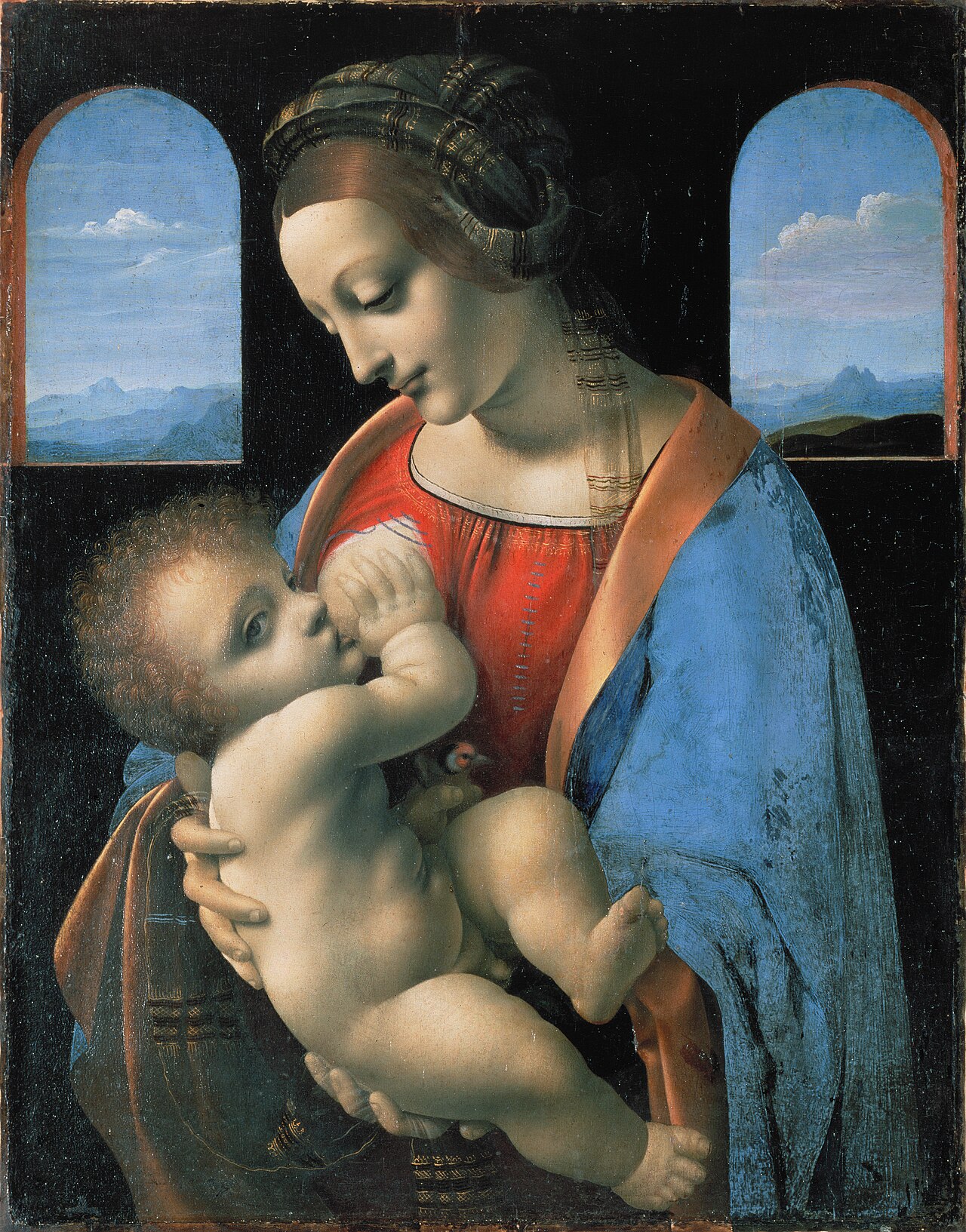
Figure 1. Madonna Litta, about 1490, attributed to Leonardo da Vinci. State Hermitage Museum, Saint Petersburg. Public domain, via Wikimedia Commons.
At 2 a.m., in another house, a six-week-old with a cold stops feeding to breathe. A reel on her mother’s phone says the baby’s spit is talking back to the milk. The baby’s nose is blocked, so she lets go with a small wet snort, then latches again. Her forehead is warm against her mother’s arm. The post says the breast learns what the baby has caught. The milk, it says, answers with antibodies made for that germ.
Her mother sends the post to the twelve mothers from her prenatal class before the feed is over, her thumb sticky with milk. Part of the claim was measured. Part of it was a guess.
In 2012, a team in Haifa, Israel, led by the newborn doctor Arieh Riskin, sampled the milk of mothers whose babies were in hospital with a fever. The babies were all three months old or younger. Each mother gave milk while her baby was sick, and again after the baby got better. Across the mothers of 31 sick babies, the milk held a median of about 5,700 white blood cells per milliliter during the illness. After recovery, it held about 2,100. White blood cells are the body’s germ fighters. In the milk of mothers of 20 healthy babies, the counts did not move that way.
The antibodies did not follow. The main antibody in milk did not change much between the sick days and the well ones. Riskin’s team picked mothers by the baby’s illness. The study also did not show how the breast would know the baby was sick.
A mother’s own infection is a separate case, and I have had one. Two months after my first daughter was born, the thermometer read 39.1 °C, and I was sure breastfeeding was over. My obstetrician said to keep going. When a mother catches an infection, her body makes antibodies against the germ, and some pass into her milk, antibodies a baby can borrow. Stopping would take those antibodies away.
In 2013, a team in Perth, Australia, led by Foteini Hassiotou, followed 21 mothers. In healthy pairs, white blood cells made up 0 to 2 percent of the cells in milk. When the mother or the baby caught an infection, the share rose, as high as 94 percent. It fell back after recovery. In three of the infections they recorded, the baby alone was sick.
Hassiotou’s team also offered a route. During a feed, milk comes in waves. At the end of each wave, the milk ducts shrink, and some milk flows back into the breast, “likely together with saliva from the baby’s mouth.” The team did not measure that backflow.
Figure 2. What milk carries and what science has yet to learn about it, from the evolutionary biologist Katie Hinde at TEDWomen 2016. Video and thumbnail: TED, CC BY-NC-ND 4.0.
Say you are one of the twelve. You wake at six to a baby who coughed all night, and the reel is the first thing on your screen. Twelve babies’ next fevers now depend on one post, and none of their mothers can tell which half was measured. The two-month checkup is a few weeks off. Whichever half you trust by then is the half you act on at the next fever.
Two earlier pieces read a 2024 review of the microbiome by Ziqi Ma and colleagues: what the microbes are, and what they do. This last one asks how a baby’s first microbes get in, and whether anything comes back out. Systems thinking calls a chain of effects that comes back to change where it started a loop. The reel claims a whole one: a baby’s cold reaches the breast, and the milk answers the cold.
A guess like Hassiotou’s can be checked piece by piece. If spit flows back into the breast, bacteria from the baby’s mouth should turn up in the milk. In 2025, Pamela Ferretti, Ran Blekhman and colleagues published a study of 195 mothers and babies in Minneapolis. They went looking for something else: which bacteria live in milk, and which of them settle in a baby’s gut. Mouth bacteria turned up in the milk anyway. Which way they had traveled was a harder question.
What a Pump Can Catch
In Minneapolis, a mother feeds her baby until the baby is full. Two hours later, she switches on a hospital pump, the heavy electric kind. It hums while she empties her right breast until the milk stops. The tubing and the bottle are sterilized. Within twenty minutes, the milk is in a freezer at minus 80 degrees Celsius.
In all, 195 mothers and babies went through some version of this. Mothers gave milk at one month and three months after birth. Babies gave stool, from a diaper, at one month and six months. Ferretti’s team, at the University of Chicago and the University of Minnesota, read those 507 samples.
Milk is hard to search for bacteria. The bacteria counted in milk in part one are real, but next to stool they are few: most of the milk is fat and the mother’s own cells. A pea-sized scoop of stool is crowded with bacteria.
Most earlier milk studies used a method called 16S sequencing. It copies one gene that every bacterium carries, then reads that one gene. The copying starts from a primer, a short piece of DNA that has to fit the gene. A primer works like a key cut for one lock, the same trouble as a DNA kit that looks for only one key. Bacteria whose gene fits get copied more. A real lock stays shut to the wrong key. A poor fit here still makes some copies, only fewer. Those studies mostly found Staphylococcus and Streptococcus, bacteria common on skin and in the mouth.
Ferretti’s team used shotgun sequencing. It breaks all the DNA in a sample into pieces and reads every piece, with no primer aimed at one gene. In their milk, the most common bacterium was Bifidobacterium longum, a gut bacterium of breastfed babies. It turned up in 55 percent of the milk samples and 98 percent of the babies’ stool.
For the gap between the two methods, the team points first to the primer. The common primers were not built to fit Bifidobacterium, so the older method may have missed much of it. A parent who reads that milk is mostly Staphylococcus may be reading the older method. In the next article about milk, the word to look for is “16S” or “shotgun.”
One kind of B. longum is B. infantis, a bacterium that can live on the milk sugars a baby cannot digest. Those sugars are food sent ahead for bacteria. In this study, the milk carried the bacteria too. Food and seed arrived together. Whether the seed takes is a question for the gut.
Who Stays
A gardener tips a rattling packet of mixed seed into one bed. In the packet, a dozen kinds fit side by side. In the soil, they compete for light and water, and one kind can take over.
A baby’s gut works like that bed. In the milk, three kinds of Bifidobacterium often lived side by side, in similar amounts: B. longum, B. breve and B. bifidum. In the babies’ guts, they mostly did not. One of them, or something else entirely, usually took over. The team reads this as “a higher level of competition” in the gut than in the milk. Unlike a garden bed, a baby’s gut is planted by whatever arrives.
The team sorted each stool sample by its most common bacterium. At one month, 68.5 percent were led by bacteria outside Bifidobacterium, mostly two common gut groups, Escherichia coli and Bacteroides. By six months, that share had fallen to 28.1 percent. The share led by B. longum rose from 15.7 to 46.6 percent. In the stool samples that had B. infantis, its average share rose from about 3 percent of the gut bacteria to about 24 percent. Babies whose gut was led by B. longum at both visits had the steadiest gut of all.
Between one and six months, B. longum and B. breve grew in babies fed breast milk alone, and Clostridium perfringens, a cause of food poisoning, shrank. In babies who also had formula, B. longum grew too. That line is for the parent who gives a bottle of formula at night and wonders what it costs the gut.
Across all 195 pairs, the amount of Bifidobacterium in a mother’s milk did not predict the amount in her baby’s gut, though in some pairs it did. Henri Tissier, in 1899, gave the milk the credit for what grew in breastfed babies. Here, how much seed the milk carried did not settle it.
The team names what else might decide: the bacteria already in the gut, the baby’s own genes, what there is to eat, and how much oxygen reaches the gut wall. Two of them, food and oxygen, are limits a body sets on its microbes, the managing part one described. The study did not test them, and which matters most is still unknown.
That is the Ackoff test of a system again: a part’s effect depends on the other parts. One seed lands differently in a different bed. And one species name in milk and in stool does not make it the same bacterium.
Which Way the Strains Went
A family walks into a shelter looking for the beagle they lost last week. A dog barks from every pen. The family walks past the shepherds and the terriers to the one beagle, then checks for the torn left ear.
Telling bacteria apart works like that. The species is the dog. A strain is the breed, and each one carries its own small changes in its DNA, its torn ear. Finding B. longum in a mother’s milk and in her baby’s stool is finding a dog in every pen: almost every baby had it. Finding the same strain in both, down to its small changes, says much more. One limit: a strain is millions of nearly identical cells, where a dog is one animal.
The team rebuilt the DNA of 77 strains. Sixty-five came from the babies’ stool. Twelve came from milk at one month, since the milk held too little bacterial DNA to rebuild more. The team found twelve cases where one strain turned up in a mother’s milk and in her own baby’s stool. The matches came from six mother-baby pairs and covered ten kinds of bacteria. Every strain they could rebuild from milk turned up in that mother’s baby. So twelve is a floor, and more milk DNA would likely find more.
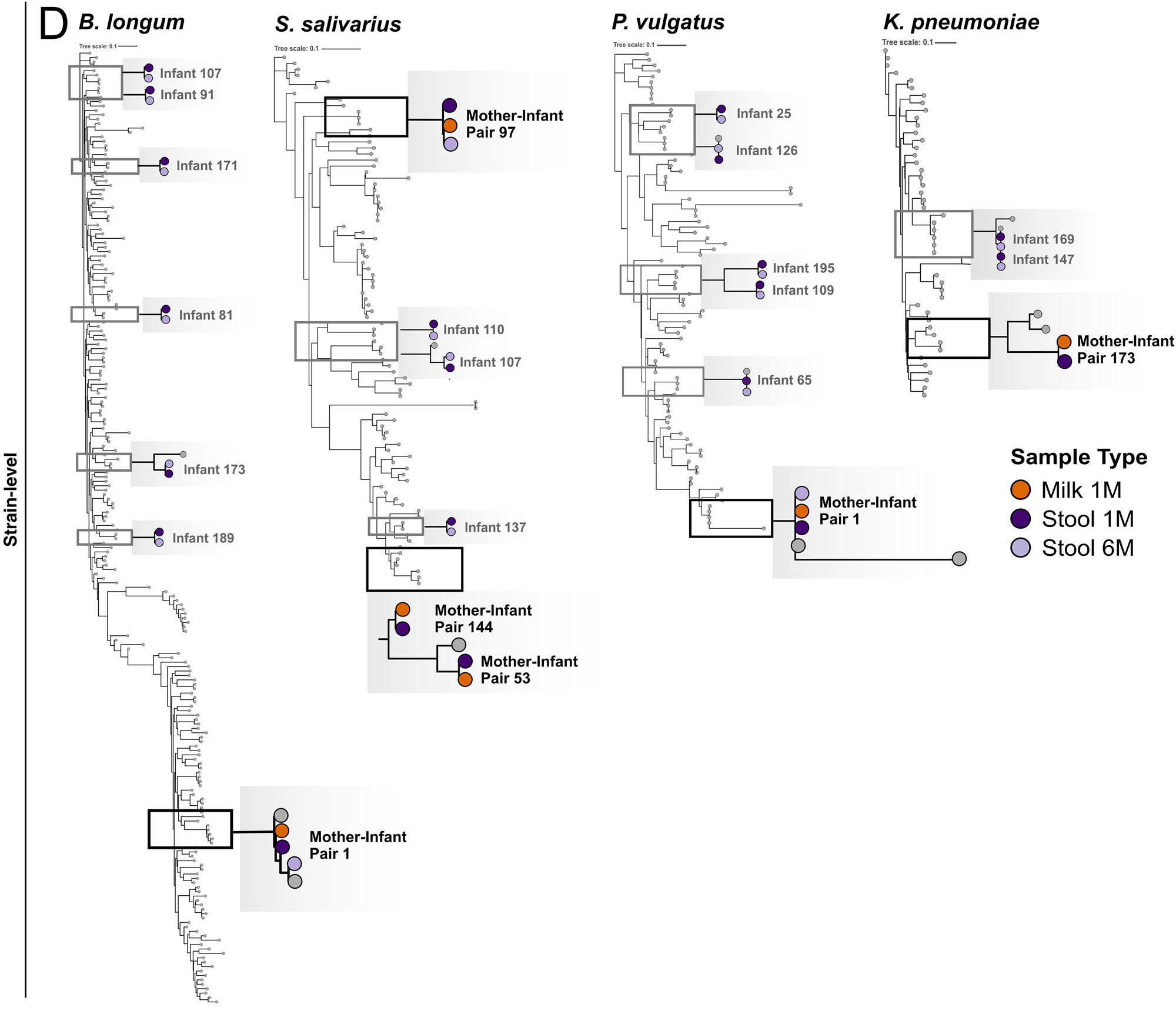
Figure 3. Six of the twelve matches, in four species. In each tree, an orange dot (a mother’s milk) lands on the same branch as purple dots (her own baby’s stool). Gray boxes mark strains that stayed in one baby from one month to six. From Ferretti et al. (2025), Fig. 3D, CC BY 4.0; cropped, nearby panels removed.
One match was Klebsiella pneumoniae, a gut bacterium that is often harmless. In newborns, it has been linked to sepsis, a dangerous infection of the blood. It is the kind of microbe part two called harmful only under the right conditions. None of the babies in the study showed signs of illness, and no mother reported a breast infection.
Two other matches were Streptococcus salivarius and Rothia mucilaginosa. Both usually live in the mouth. They are what a baby’s spit would leave in the milk if Hassiotou’s backflow is real. So the arrow may run both ways. Milk may seed the baby’s gut, and the baby’s mouth may seed the milk. If so, milk is half of a loop.
Which way came first is still unknown. The first milk samples came at one month, too late to see. A mother and a baby also share a home and the people in it, and housemates share strains too. Both could have picked up a strain somewhere else.
Strains also come and go between the one-month and six-month visits. Of the strains in a baby’s stool at the first visit, 19 percent were still there at the second. Of the strains shared with the milk, 25 percent were. Babies born vaginally kept more of their strains than babies born by C-section. Antibiotics, and whether the baby still had breast milk alone at six months, made no clear difference.
For the mother who forwarded the reel, the study checks part of the guess: bacteria from a baby’s mouth may reach the milk. What this study found was bacteria, not a message about the cold. Ask the reel what carried the message, and whether anyone watched it travel. A strain that travels can also carry more than itself.
Who Shares More
At one month, the babies’ stool carried more genes for resisting tetracycline than for any other antibiotic. So did the milk. Doctors avoid tetracycline in pregnancy and in children under eight, because it can stain growing teeth permanently.
These resistance genes let a bacterium survive an antibiotic, and they can pass from one bacterium to another. Two thirds of the babies had taken no antibiotics by six months. Many babies with no antibiotics on record, before, during or after birth, still carried the genes. Babies whose gut was led by Bifidobacterium carried fewer.
Across all the pairs, a mother’s milk and her baby’s stool showed no link in resistance genes. But a pattern across a whole group can hide what happens inside each pair. So the team asked a narrower question: does a baby share more resistance genes with its own mother than with a stranger?
Their test works like a daycare at pickup time with every baby handed to a random mother. Count the genes each baby shares with the mother holding it. Shuffle again, and count again, 1,000 times. That gives the amount of sharing that chance alone produces. Then compare the real pairs. Statisticians call this a permutation test. Unlike a real daycare, the team shuffled the milk samples’ labels on a computer, and no baby left its mother.
The real pairs shared more than the shuffled ones. The shuffle runs on an old logic: write down everything chance could produce, then see how rare the real result is. Here, a result as large as the real one turned up in fewer than 16 of the 1,000 shuffles.
Figure 4. The shuffle, done by hand. The statistician John Rauser asks whether mosquitoes prefer beer drinkers, shuffles the beer and water labels again and again, and finds the real difference out past almost every shuffle. Video: O’Reilly, Strata + Hadoop World 2014, Standard YouTube License.
Two pairs stood out, pairs 1 and 173. They shared the most resistance genes, and they were two of the six pairs with matching strains. Their samples also gave the most bacterial DNA to read, first and third in the study, and more DNA means more chances to find a match.
The shuffle question works on more than genes. When spit and milk share a strain, or two people in one home share a cough or a claim, the question is whether a stranger would share it too. The mother in the group chat who forwarded the reel is the one to send this to, with that question attached. She can ask it before her next forward, or at the two-month checkup. At six o’clock the shuffle ends, and each baby goes home in the arms that fed it.
A Closing Invitation. The reel stood for a message sent back from baby to mother. The message was a guess; the bacteria were real. Milk carries bacteria to a baby, a baby’s mouth may carry them back, and the gut decides who stays.
- Find the second path. The next time a baby feeds near you, or a toddler hands you a wet, half-eaten cracker, watch the trade both ways. Milk goes in and spit comes back; a spoon goes from one mouth to the other. What just moved, and which way? Which cold last went around your house that way?
- Split the reel. Before your next forward, or with the last one you sent, read the post aloud and say which half was measured and which a guess. The milk reel: white cells measured, the route guessed. A teething remedy or a sleep tip splits the same way. Which half would you still send?
- Bring one claim to the exam room. The baby’s two-month visit counts, and so does your own. With the paper on the exam table crinkling, ask the doctor about one claim from the group chat: was it measured, and in whom? Would a stranger show it too?
At the next 2 a.m. feed, a baby lets go of the breast to breathe, and a little of her spit may slip back with the milk. The milk does not read it. It carries it home.
Where This Came From
Ferretti’s study is one of the first to match strains between milk and a baby’s gut. The team found only one earlier metagenomic study that did. Matching strains between a mother’s gut and her baby’s gut is older and better studied, and it finds far more sharing than milk does.
Intellectual Honesty Note. The births, the night feeds and the fever night, with its 39.1 °C reading, are my own, and the reading of the Madonna Litta is this piece’s. The mother at 2 a.m., the reel, its group chat and the twelve mothers are a composite; the reel paraphrases a common claim, not one post. Riskin’s abstract does not report the mothers’ own health. The mother at the pump is drawn from the study’s methods. The key and lock, the seed bed, the beagle and the daycare are illustrations. This piece describes what milk carries, not how anyone should feed a baby. The study is observational: it cannot show that milk caused any gut change. Only 25 milk samples were sequenced at three months. The primer explanation is the team’s proposal, not a test. The 16 in 1,000 reads the paper’s bound (p < 0.016, from 1,000 shuffles) as a count.
References
Centers for Disease Control and Prevention. (2025). Influenza (flu) and breastfeeding. https://www.cdc.gov/breastfeeding-special-circumstances/hcp/illnesses-conditions/flu.html
Ferretti, P., Allert, M., Johnson, K. E., Rossi, M., Heisel, T., Gonia, S., Knights, D., Fields, D. A., Albert, F. W., Demerath, E. W., Gale, C. A., & Blekhman, R. (2025). Assembly of the infant gut microbiome and resistome are linked to bacterial strains in mother’s milk. Nature Communications, 16, 11536. https://doi.org/10.1038/s41467-025-66497-y
Hassiotou, F., Hepworth, A. R., Metzger, P., Tat Lai, C., Trengove, N., Hartmann, P. E., & Filgueira, L. (2013). Maternal and infant infections stimulate a rapid leukocyte response in breastmilk. Clinical & Translational Immunology, 2(4), e3. https://doi.org/10.1038/cti.2013.1
Hinde, K. (2017, March 28). What we don’t know about mother’s milk [Video]. TED. YouTube. https://www.youtube.com/watch?v=Bo8YN3oB0Cw
Leonardo da Vinci (attributed). (ca. 1490). Madonna Litta [Painting]. State Hermitage Museum, Saint Petersburg. Public domain image via Wikimedia Commons.
Ma, Z., Zuo, T., Frey, N., & Rangrez, A. Y. (2024). A systematic framework for understanding the microbiome in human health and disease: From basic principles to clinical translation. Signal Transduction and Targeted Therapy, 9, 237. https://doi.org/10.1038/s41392-024-01946-6
Rauser, J. (2014, October 17). Statistics without the agonizing pain [Video]. O’Reilly. YouTube. https://www.youtube.com/watch?v=5Dnw46eC-0o
Riskin, A., Almog, M., Peri, R., Halasz, K., Srugo, I., & Kessel, A. (2012). Changes in immunomodulatory constituents of human milk in response to active infection in the nursing infant. Pediatric Research, 71(2), 220–225. https://doi.org/10.1038/pr.2011.34