
Recovering from brain surgery, Stanislaw Ulam dealt himself another game of solitaire. It was 1946, and encephalitis, a swelling of the brain, had put him in the hospital that January. He played Canfield solitaire, laying the cards down one by one. Canfield starts with a pile of thirteen cards and four more in a row below (Figure 1). Each game turned out to be a gift to his future work.
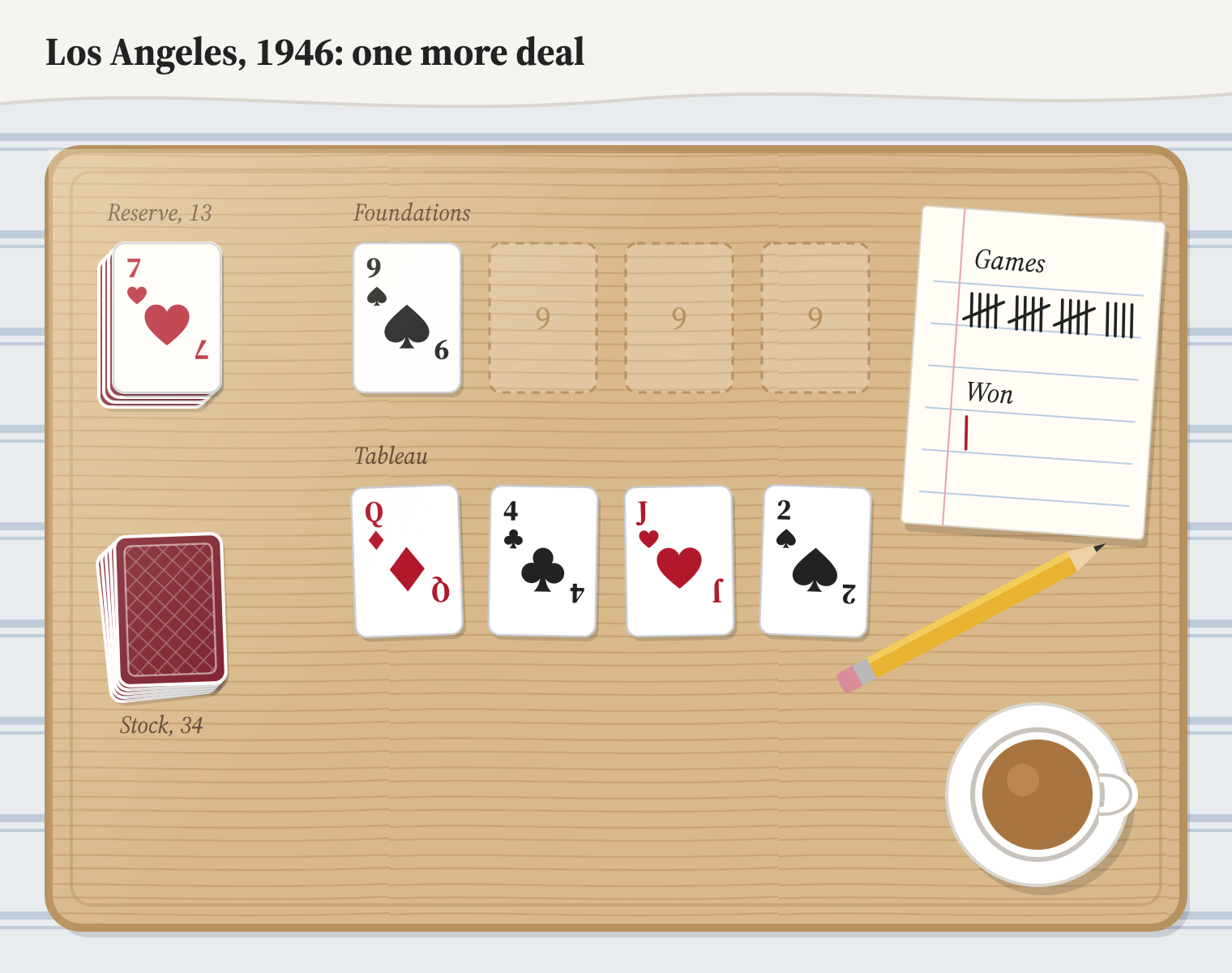
Figure 1. A game of Canfield as it is dealt, on a hospital bed tray, with a tally of games and wins. My own figure.
One question kept running through his recovery: what were the odds of winning a given game? Ulam spent a long time trying to work them out by tracing every way a deal could fall. There were far too many ways. A simpler idea came next. He could deal a hundred games, play each one out, and count the wins. The share of wins would not be the true odds, but it would close in on the odds as more games piled up. One tangled question had become a yes-or-no one, asked a hundred times.
I ran Ulam’s count again on a computer: twenty runs of a thousand games each, played by one simple rule (Figure 2). After a hundred games, the runs disagree, from two wins to eight. After a thousand, most land between 36 and 48 wins. Over 100,000 games, the share settles near one win in twenty-five. My area-under-a-curve app uses the same idea to estimate an area.
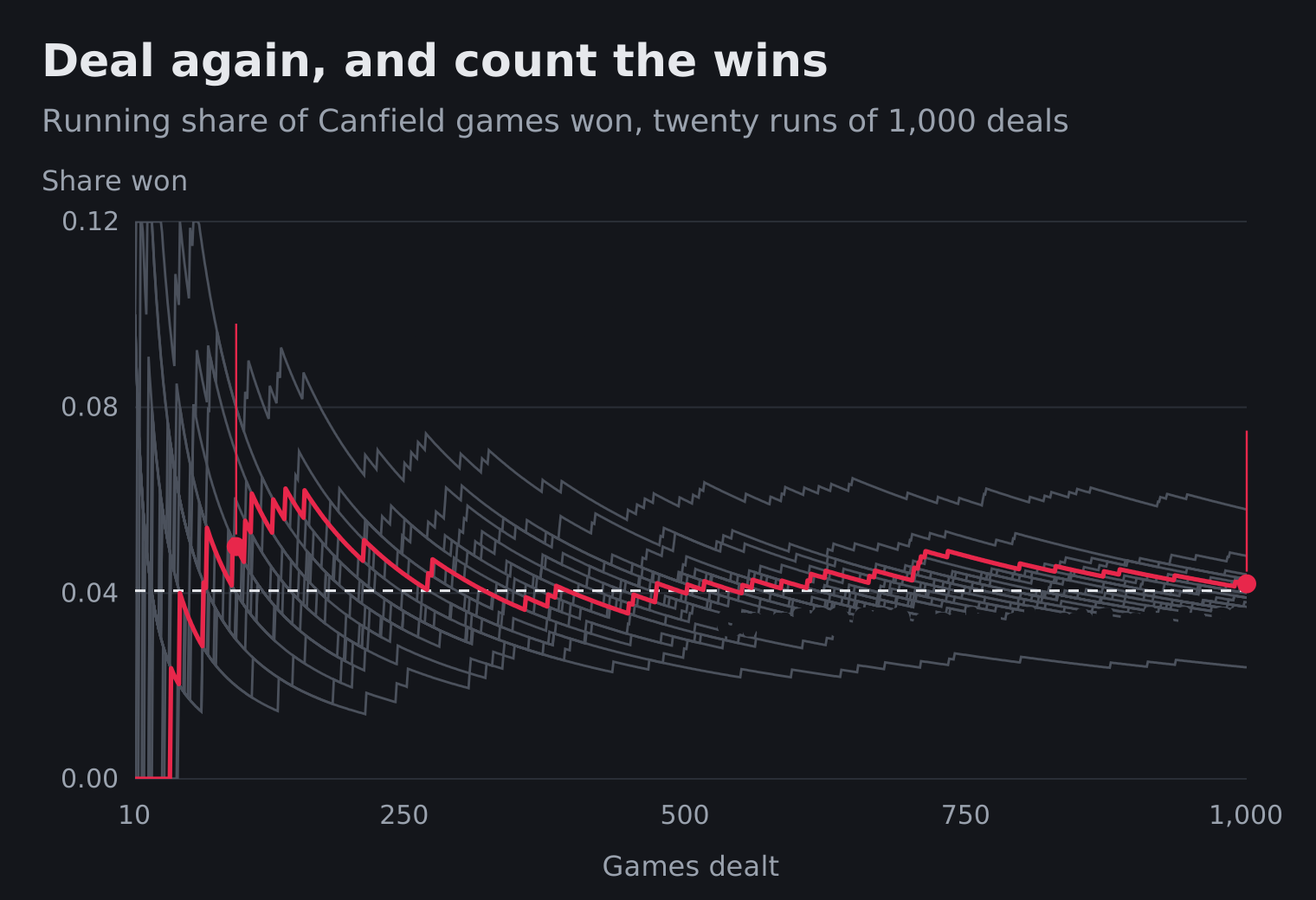
Figure 2. Twenty runs of a thousand simulated games of Canfield. My own figure.
He described the idea to John von Neumann, and the two began to plan real calculations (Figure 3). A bomb problem had the same form. The Los Alamos physicists knew how far a neutron travels, on average, through a material before it hits the nucleus of an atom. Still, they could not solve the problem with exact math. It could be counted like a game of cards instead. Their colleague Nicholas Metropolis suggested the name Monte Carlo, after the casino where Ulam’s uncle borrowed money to go.
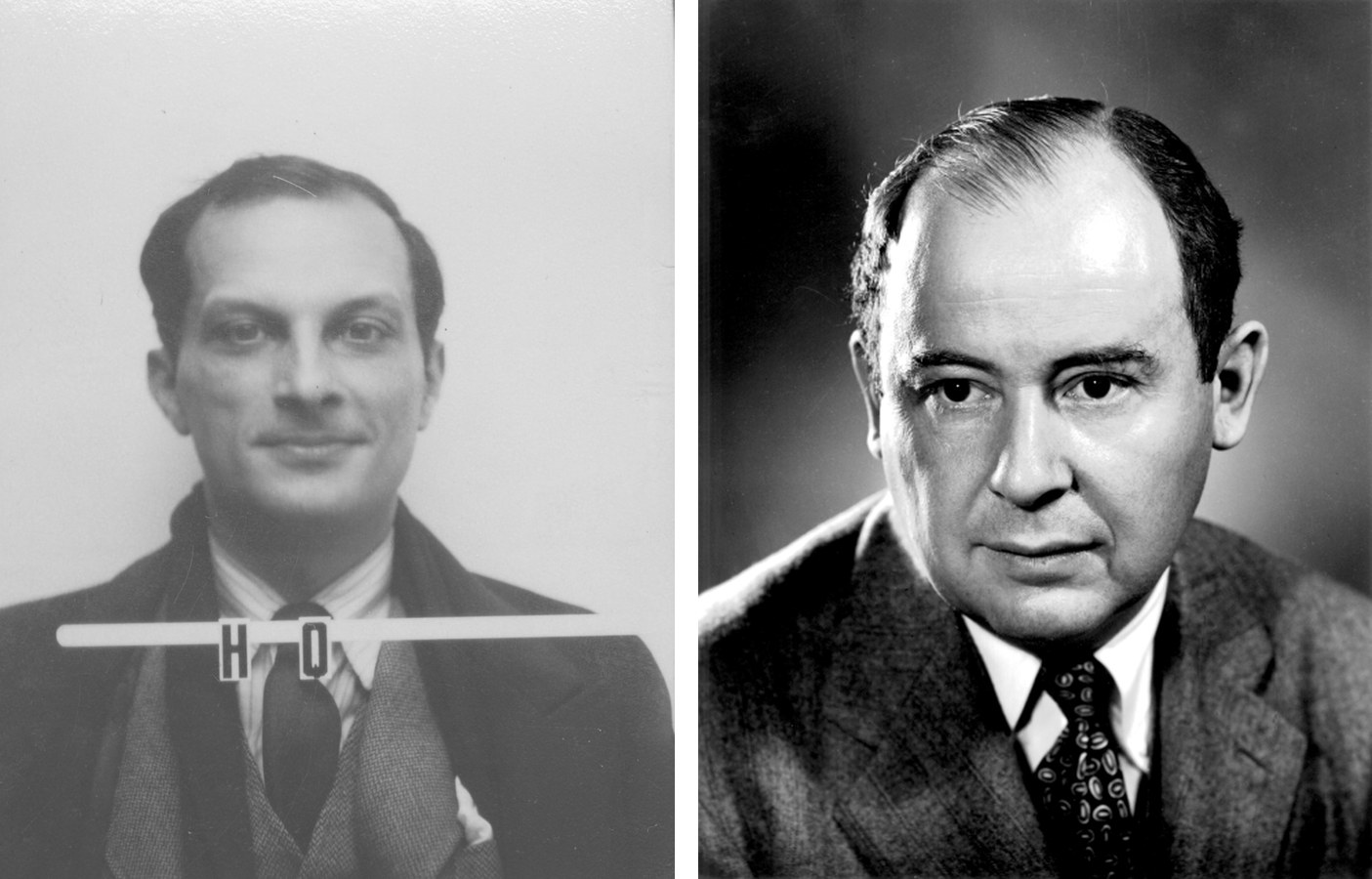
Figure 3. Stanislaw Ulam (left) and John von Neumann (right), Los Alamos portraits, 1940s. Los Alamos National Laboratory, free to use with attribution, via Wikimedia Commons (Ulam, von Neumann).


Even Monte Carlo could not settle every question. The count worked because the odds of Canfield never change: every deal comes from the same fifty-two cards. A question about a person is different. Its odds move during the count.
One evening, I asked my husband: what is something I hate?
Without hesitation, he said: snakes. I am afraid of them, and he had just been playing Sekiro, fighting a large silver snake that made me scream every time it lunged at his character on screen.
He turned the question back on me. “Name something I hate,” he said.
“Being asked a lot of questions,” I answered.
He smirked, proud of the answer.
He did not mean questions in general. He meant learned helplessness: asking before trying, reaching for help on a problem I have not yet touched. I call it the “Can you just…” urge: the reflex to give away a small household task before I have tried it myself. It comes over a stuck remote, a crooked shelf, a router light blinking the wrong color.
Each time the urge comes, it asks one small question: did I try first, or did I ask first? Every answer is a piece of evidence toward a much bigger question: what kind of wife am I becoming? In his terms, the bigger question asks whether I meet my own needs without wearing out his patience.
No single day settles the bigger question, the same way Ulam’s first game did not settle his odds. Only the share across many games did. Mathematicians call that settling of the share the Law of Large Numbers, and my Law of Large Numbers app shows a share settling.
Your own urge might come over a jar of pasta sauce on a Tuesday night. The lid will not turn, and before its ridges have pressed into your palm, “can you just” is out of your mouth. The person you live with sighs in the next room. Three asks this week, three sighs: is that only three stuck lids, or is it who you are becoming? By Sunday, the sigh comes before you have finished the sentence.
How a Tally Trails a Habit
I would score the urge the way Ulam scored his solitaire: one card a day, laid face up. A black card, a spade or a club, means I tried the task myself first, even briefly, even badly. A red one, a heart or a diamond, means “can you just…” came out before I touched the problem. Unlike the silver snake on my husband’s screen, which lunges and is gone, the urge comes back every day.
The first week would be brutal: one black day in seven. Days ten through twenty would bring a partial recovery. Somewhere between day thirty and day forty would come a real backslide, a bad stretch that shows a habit does not move in a straight line. By day fifty the climb would resume, slow and noisy. Around day sixty, the sighing would stop. What replaced it would look almost like curiosity: the raised eyebrow of a man who never asked for this experiment and now sees it working.
Dealt ten to a row, the days fill nine rows (Figure 4). At the end of each row sit two numbers: how many of its ten days are black, and the running average so far. The first row has three. Row four is all red, and over it the average falls from 0.40 to 0.30.
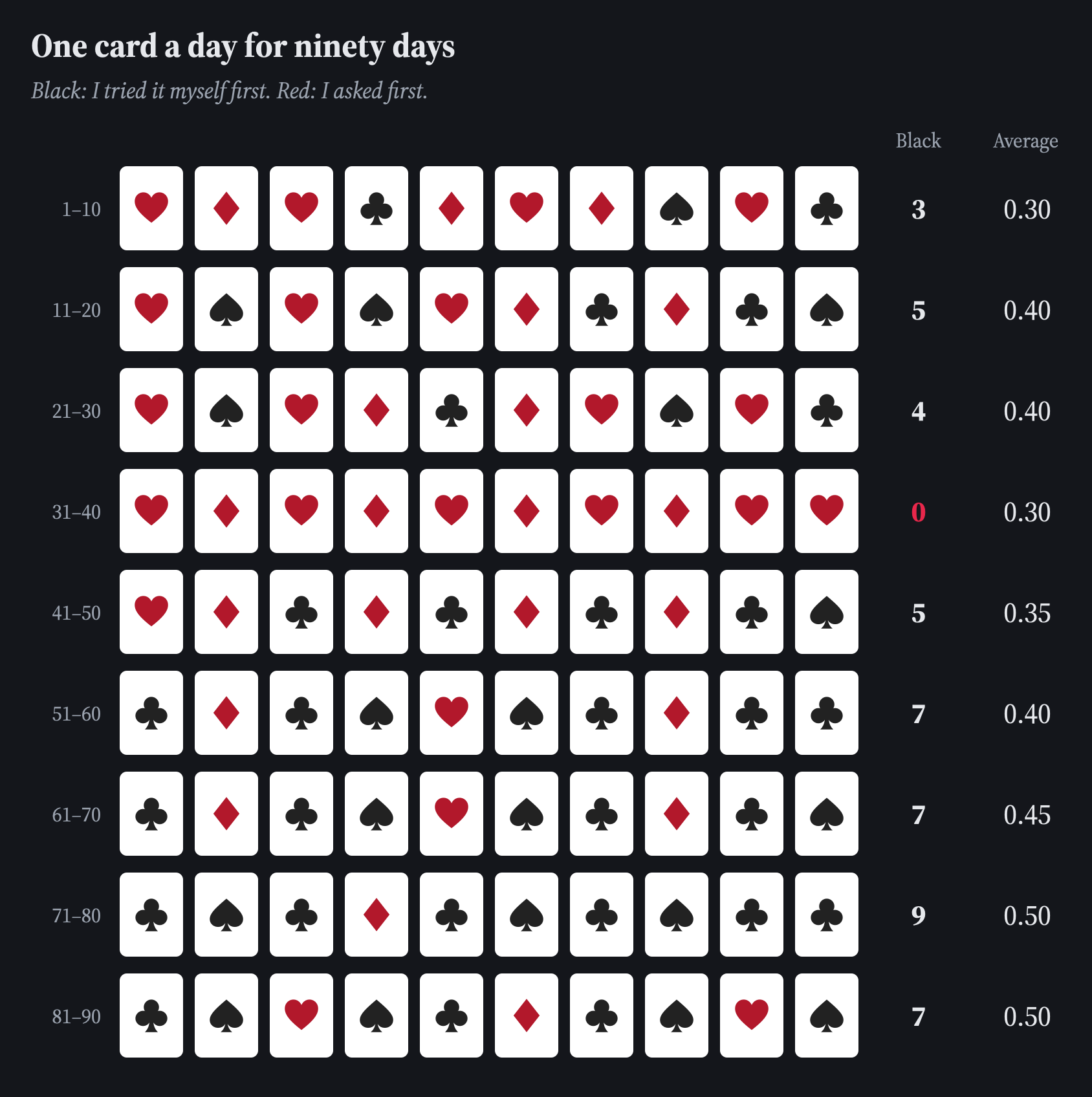
Figure 4. Ninety invented days, ten to a row, averages rounded to the nearest 0.05. My own figure.
The average is slow because it carries every day so far, the brutal first week included. After the all-red row, it climbs back slowly. Row eight is nearly all black, yet the running average reaches only one half. The count shows where the habit has been, and it trails where the habit is going.
One card on its own says even less. In a courtroom, a verdict of not guilty does not prove innocence; it says only that the evidence did not count against the accused. A black card is like that. No single day proves an identity. It only fails to count against one. What, then, could answer the bigger question?
Why the Ladder Loops
On January 3, 2024, in a notebook I call Spirited Away, I worked on a question no count could score. A tally can score did I try first. It cannot score who am I becoming, one of the twelve questions I keep for life, because no single answer closes that question. I wrote down a smaller one and kept asking it, each time about its own answer: not who am I becoming, but why do I do what I do?
The page holds seven whys (Figure 5). The first four answers climb: achieving my wants and needs, meeting them positively, developing a positive identity, and meeting them positively in a sustainable way. Then the page says LOOP iterates.
Whys five through seven add nothing new. Dealt as cards, one suit for each answer, the first four whys climb through four different suits. After that, no new suit comes up. The fifth why falls back to the diamond, and the sixth and seventh only go back and forth between the heart and the diamond, answers two and three. The ladder closes into a loop between two answers: a positive identity, and meeting my wants and needs positively.
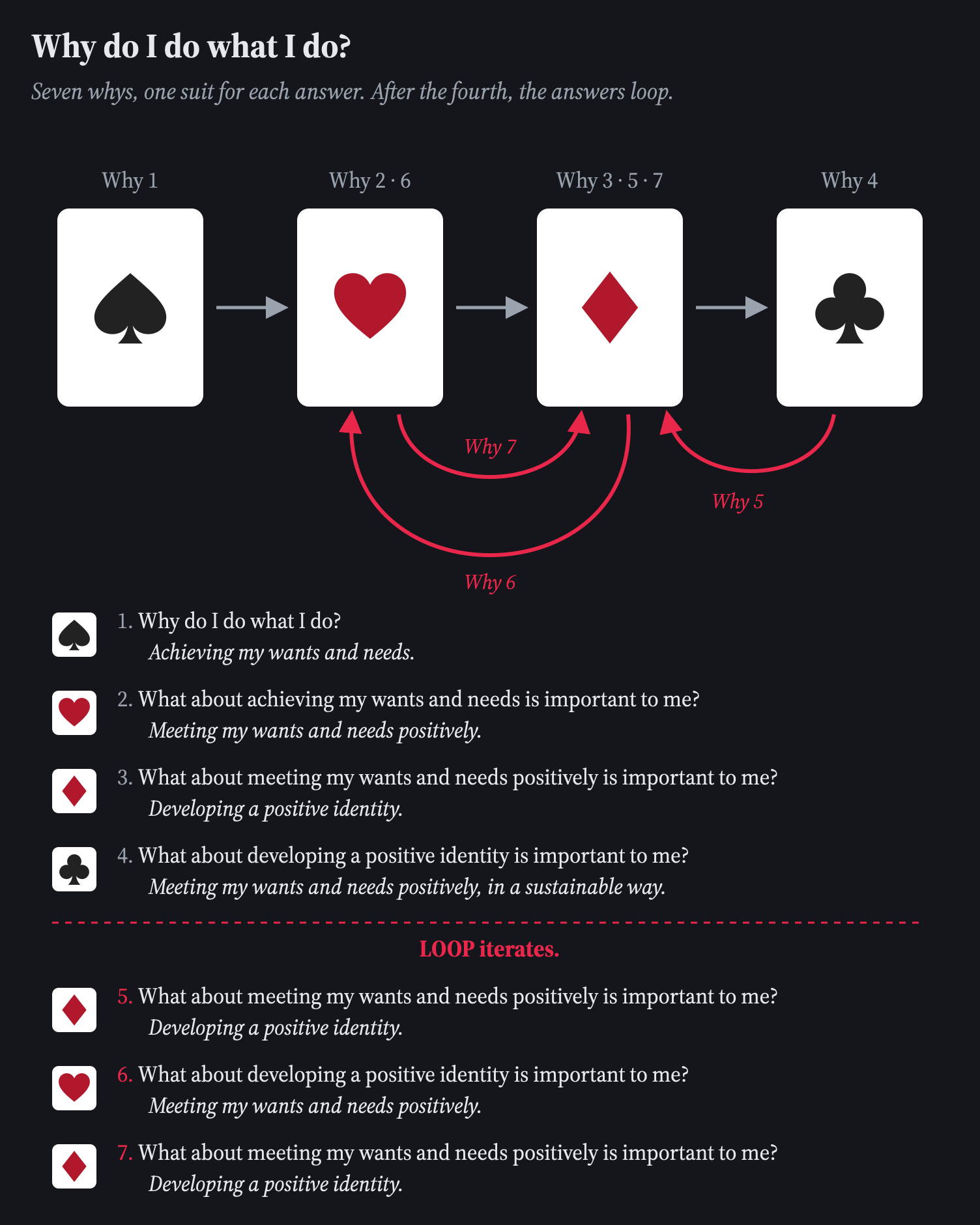
Figure 5. The seven whys from my notebook, written out and dealt as cards. My own figure.
“Meeting my wants and needs positively, in a sustainable way” has a plain test case in this marriage. It means getting what I want, help and ease, without wearing out my husband’s patience. Sustainable here means the difference between a request he is happy to grant and a pattern he has learned to dread. If the ladder is right, is becoming someone he does not sigh at part of who I am becoming, as a wife?
What the Loop Surfaces
Taiichi Ohno taught a ladder of whys at Toyota, using a stopped machine. Why did it stop? A fuse had blown from an overload. Why the overload? The bearing was dry, because the oil pump was not pumping, and the pump was not pumping because its shaft was worn. Why worn? There was no strainer, and metal scraps had got in.
This is the five whys, a core habit of the Toyota Production System that Ohno built (Figure 6). A worker asks why a problem happened, then why that answer is true, about five times, until the cause can be fixed. Without the questions, a worker might change the fuse, and the machine would stop again. With them, the worker fits a strainer, and the cause is gone.

Figure 6. Toyota’s truck assembly line, about 1954. Unknown photographer, Japan Graphic Review Vol. 9, public domain, via Wikimedia Commons.

My ladder runs the same move on a motive instead of a machine, and it ran seven rounds, not five. A worn shaft can be held up and checked, though, and a motive cannot. Whether asking why can find the true cause of a motive is still an open question. What the ladder can do is point at what to build.
Who am I becoming carries its own rule from the twelve questions: a real favorite question is never answered once and put away. The loop is how I keep it open. Each time it runs, it gives the question a fresh state I can check, and any new habit or decision can go through it later.
A positive identity, in the plainest version I have written for myself, is one that meets my wants and needs in a way that lasts. They are the wants and needs the ladder kept circling. That identity is a working deal between who I am and what I need, built to hold up over a season, not one good day.
That deal needs something concrete to stand on: a gift to a future self, one small thing given today that the person I am becoming can use. Ten seconds spent on a stuck lid before calling out is one. So is a walk after dinner instead of a scroll, or a hard question answered in full when “fine” would be easier. The person who sighs from the next room is the one to send this piece to, since they keep the other half of the count. Every gift is a black card turned face up on a count that never closes.
A Closing Invitation. Ulam’s dealt games stood for any question too tangled to solve once: you answer it by asking a small version again and again, and keeping count.
- Count the last ask. Right now, think back to this week’s last “can you just”: a jar lid passed to a partner, a printer jam left for a coworker. Was it a black card or a red one, and what did the person who helped you give up to do it?
- Ask why twice. Before lunch today, when the urge comes to eat at your desk or skip the meal, ask why, then ask why again about that answer. Is that desk lunch rest you are giving away, or a need you have not said out loud?
- Lay down a card. Tonight, lay one card face up where the person you ask most will see it, a roommate or a parent. Black means you tried first; red means you asked. Two mugs and a coin work too; you will hear it land. Which color do you want there by Sunday, when a sigh could be a thank-you?
Ulam never needed one game to win. He needed the count. Tonight’s card, black or red, is a gift on that pile for whoever you are becoming.
Habits are averages, and averages are slow learners. One early morning or one workout barely moves the average, but the average is only those days, added up. Tomorrow, get up at the first alarm and exercise, even for ten minutes.

Where This Came From
Ulam’s sickbed idea had an earlier, quieter run. Metropolis later wrote that Enrico Fermi had used the same kind of sampling about fifteen years before, while studying how neutrons move through matter, and never published it. In 1947 he had a small trolley built at Los Alamos, the FERMIAC, pushed by hand across a drawing to trace neutrons one random step at a time (Figure 7). The count was older than its name.
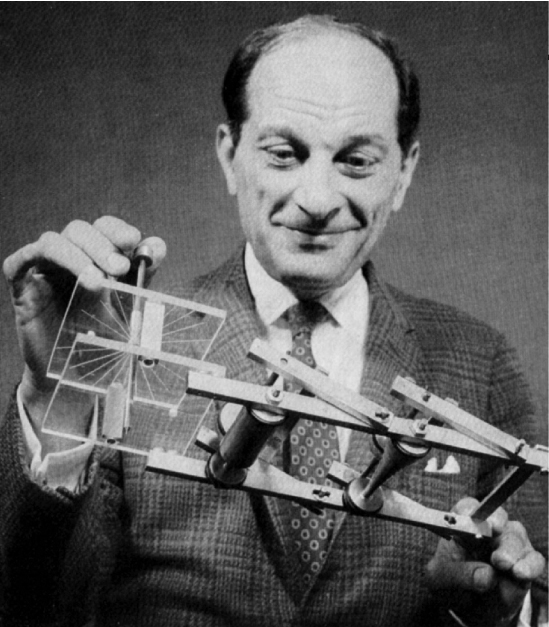
Figure 7. Stanislaw Ulam, years later, holding Fermi’s FERMIAC. Los Alamos National Laboratory, public domain, via Wikimedia Commons.

Intellectual Honesty Note. Figure 1 imagines Ulam’s bed tray; no photo of his 1946 stay exists. The ninety-day card count and its figure are invented; I never kept that tally. The Law of Large Numbers is stated for fixed odds; the piece applies it to a habit whose odds move. The neutron’s path is cut to one distance; real neutrons also bounce or get absorbed. Ohno’s stopped machine is his own teaching example, not a single recorded breakdown. The seven-why ladder is my own journal entry, reproduced close to verbatim in Figure 5. The Canfield games in Figure 2 are simulated, played by a simple rule of my own, not by Ulam; a stronger player wins more often. The conversation with my husband is real, reported as it happened.
References
Eckhardt, R. (1987). Stan Ulam, John von Neumann, and the Monte Carlo method. Los Alamos Science, 15, 131-141.
Metropolis, N. (1987). The beginning of the Monte Carlo method. Los Alamos Science, 15, 125-130.
Ohno, T. (1988). Toyota Production System: Beyond Large-Scale Production. Productivity Press.
Ulam, S. M. (1976). Adventures of a Mathematician. Charles Scribner’s Sons.
Wikipedia contributors. (2026). FERMIAC. Wikipedia. Retrieved October 25, 2026, from https://en.wikipedia.org/wiki/FERMIAC