
Carlos King was holding the book for Danielle Staub, because she was wearing a dress too tight to hide it. The book was about her ex-husband. She set it on the table at the dinner Teresa Giudice was hosting at a local restaurant.
At that table, Teresa’s heart rate was the one number nobody was watching.
“Prostitution whore!” Teresa screamed, as she shoved her hands beneath the table and flipped it, with the cameras still running (Figure 1).

Figure 1. The dinner scene from the season 1 finale, from Bravo (2026), YouTube embed. The scene runs from 8:43 to 10:28.
The table was over, but nobody watching could have said what had given out. TIME later credited the flip with changing Teresa’s career, the New Jersey show and reality television more broadly. Michelle Obama has named this scene one of her favorites from Real Housewives.
I do not watch this genre, and for a long time its pull made no sense to me. Now I see that the pull needs nothing on the screen to resemble my own life. Parasocial attachment is the name for that pull: a one-sided closeness an audience builds toward someone they only know through a screen. Horton and Wohl first described this closeness in 1956 as “intimacy at a distance.”
What holds me in this clip is not the screaming. It is the pattern under the screaming: strain taken in, and taken in, until there is no room left for more. My own version looks nothing like Teresa’s. It goes quiet, or it goes to tears, long before it gets near a table. A book on a tablecloth can start that pattern. It cannot build the pattern from nothing.
The nearest picture I have is a kettle left on the stove (Figure 2). The water takes the heat for a long time, and nothing shows on the outside. Then it reaches its threshold, the boil. Steam forces the little cap on the spout, and the whistle goes all at once.
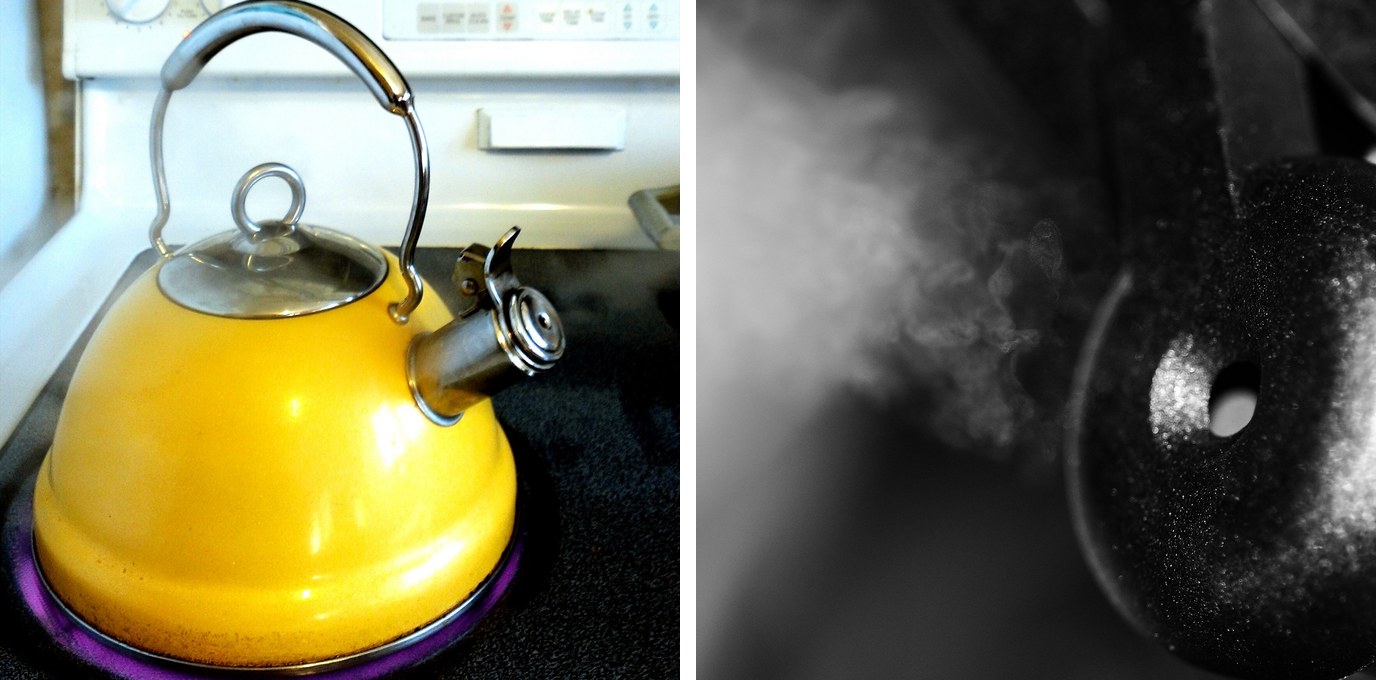
Figure 2. A whistling kettle, on the burner and at the boil. Photos by Sage Ross (Ragesoss), CC BY-SA 3.0, via Wikimedia Commons, and by dbbent, CC BY-SA 2.0, via Flickr; both cropped.

Your version is probably smaller, and it might come this week. You and your partner are at the kitchen counter, arguing about whose turn it was to call the pediatrician. Your heart is loud in your ears and your face is hot. A racing heart is one of the signs a body gives as it nears the boil. You say the one sentence you had been holding back, and within the hour you regret it. What could you do in the moment you feel your heart climb, before the sentence that costs you an evening of apologizing? Get that moment wrong, and your partner remembers that sentence long after the pediatrician has called back.
The book explains why the fight started. It does not explain how a woman paid to look good on camera lost her composure at the dinner she was hosting.
When the Kettle Boils
The easy explanation is that Teresa simply stopped caring how she looked on camera.
A viewer watching that clip asks why the table went over. A therapist asks the same thing afterward, looking for the mechanism under the moment: the part that would still be there in a different room with no camera. A mental model is a description of that mechanism, not a verdict on the person. An earlier essay worked through how to tell a real mental model from a guess. Here the mechanism is a threshold the body crosses.
1. What Boiled Over
In 1980, John Gottman and Robert Levenson recruited thirty married couples. Each couple talked in the lab while monitors tracked both spouses’ heart rate, sweat and movement. Three years later, the team reached nineteen of those couples again. Nineteen of thirty is about two couples in three, by my count. The couples whose bodies had run most stirred up in the lab had lost the most satisfaction in their marriages. That is a link, not proof of a cause. The study could not say whether the stirred-up bodies soured the marriages or the marriages stirred up the bodies.
The stirred-up state has a name at the Gottman Institute: flooding, or diffuse physiological arousal. Flooding is a body so activated that listening starts to go offline. Gottman also gave it a number. Past about one hundred beats a minute, he writes, a spouse cannot hear what the other is saying, however hard they try. The body then needs about twenty minutes away from the fight, on average, for the stress hormones to clear. A 2013 interview with John and Julie Gottman gives the same two numbers (Figure 3). Hearts passed one hundred beats a minute while couples only sat and talked, and the break the interview describes lasts twenty minutes. Water boils at 100 degrees Celsius. The hundred here counts beats. The match is luck, but it makes the hundred-beat line easy to remember.

Figure 3. Drs. John and Julie Gottman on physiological flooding, a radio interview from The Gottman Institute (2013, 2:21), YouTube embed. The two numbers come at 1:06 and 1:19.
Listening is not the only thing flooding takes. Self-presentation, the running sum of how a moment will look and whether it is worth it, needs the same slow, effortful thinking, and that thinking needs a calm body. Teresa did not stop noticing the camera. She lost the ability to act on what she noticed. The part of her that had tracked how each scene would look was, at that moment, offline too. That was what gave out at the table: a system shutting down past a line, with no choice in it. The book turned up the heat. The body set the boiling point.
Flooding is a mechanism, not a mood, and it passes the two tests the earlier essay used without naming them.
The Simple Test. A real mental model names a few parts and shows how they push against each other. Flooding has two: how stirred up the body is, and how much attention is left for self-control. As the first goes up, the second goes down, and past about one hundred beats the second runs out. The Portable Test. A real mental model explains cases it was not built for. Gottman built this mental model from married couples in a lab. It also explains a dinner table flipped on camera. It explains the sentence said at a kitchen counter and regretted within the hour, and the reply typed to a coworker mid-dispute and regretted by morning. In each, the useful question afterward is how fast the heart was going when the words came out. Portability may explain part of the parasocial pull too: a viewer whose own fights stay quiet has felt the same heat climb at home.
2. What Takes It Off the Heat
Knowing the hundred-beat line does nothing for a body already past it. A framework exists to close the gap between knowing the line and acting on it.
A framework is a decision rule built on a mental model. It tells someone what to do with what the mental model explains. Gottman’s framework turns the threshold into four steps, and each has a twin at the stove (Figure 4).
Figure 4. The four steps, and their twins at the stove
The framework discovers nothing new about flooding. It makes the threshold something a person can run mid-fight, when nobody is in a state to plan.
The Act Test. A real framework changes what a person does next, not only what they understand. Knowing the hundred-beat line is a mental model. Leaving the room for twenty minutes is a framework. A couple who knows the line and never leaves the room has the same fight at the same counter next month, with the same sentence in it. The Repeat Test. A real framework can be run again on a new instance of the problem. One timeout that worked by luck is not a framework. A person who calls the same timeout every time the heart races is running a framework. Gottman’s institute suggests coming up with a key phrase to start the break. That phrase works only if the other person in a recurring argument knows it, so the rule is worth sharing before the next fight.
All four tests fit on one card. Their first letters spell SPAR, a fight with rules where nobody gets hurt (Figure 5).
Four Tests Before the Next Fight
Two tests for the mental model, two for the framework. Together they spell SPAR: a fight with rules, where nobody gets hurt.
Simple
Names a few parts, and how they push?
✓ A body more stirred up, less attention for self-control
✗ She just lost her temper
Portable
Explains cases it was not built for?
✓ A reply typed to a coworker mid-dispute
✗ Only that one dinner on camera
Act
Changes what a person does next?
✓ Leave the room for twenty minutes
✗ Know the hundred-beat line
Repeat
Runs again on the next fight?
✓ The same key phrase, every time the heart races
✗ One timeout that worked by luck
Owning a framework and running it are two different things. Many adults have some version of “walk away before you say something you will regret” stored somewhere. Teresa did not run it that night. A framework that lives in someone’s head and is not run under the conditions it was built for is a document, not a practice. A table flipped at a restaurant is what a framework left unrun looks like on camera.
The first step, noticing the signs, needs a place to look, and a 2014 study offers one. Researchers led by Lauri Nummenmaa asked 701 people to color body silhouettes wherever they felt activity rise or fall with different emotions. On their maps, black means nothing changed, red to yellow means more feeling, and blue means less. Most emotions lit up the upper chest, and the head lit up in all of them. Anger runs bright down both arms to the hands. Happiness warms the body from head to feet. Sadness glows in the chest while the arms and legs go blue. The maps record where people report a feeling, not what their muscles or blood flow are doing there. Figure 6 is a blank outline of the same kind, for a reader to mark where their last argument showed up first.
Think of the last argument that heated up. Pick a color, then tap where you felt it first. Tap a part again to clear it.
Figure 6. An interactive blank body outline with a ten-step color scale, from less feeling to more. My own figure, built for this piece.
Still, a person who knows their anger starts in the arms has one quick place to check: a look down at clenched hands while the voice is still level. At that dinner, the strain ended in Teresa’s hands, beneath the table.
A Closing Reflection. The table stood for a body past its threshold before anyone saw it coming. Yours has one too, and it shows up in ordinary weeks.
- Count your pulse right now. Put two fingers on your wrist and count for fifteen seconds, times four. That is your number before a landlord’s text or a manager’s email makes your face go hot and you type a reply you would take back. Where do you feel it first: your chest, your head or your arms?
- Trace your last apology. Think back to the last sentence you took back, in a group chat with old friends or on a Sunday call home. What was your body doing in the minute before you said it: a racing heart, or something else? How long did the apology take?
- Agree on the break phrase. Before your next argument, tell the person you argue with most, a partner or a roommate, the phrase that will call a break. It means twenty minutes apart, then try again. The evening you would have spent apologizing stays yours. When one of you says it, how does the house sound with the door closed?
Teresa crossed her line at her own dinner, with the cameras rolling. Most lines are crossed with no camera at all. A dinner table stays upright when someone counts the beats before the next sentence.
Past a certain pulse, nobody is listening, least of all you. Pick your break words while you are calm; some people write them on a palm or snap a rubber band. Say them when your face goes hot.

Where This Practice Came From
Munger’s latticework is the idea that a person needs multiple mental models, across many fields, not one.
Intellectual Honesty Note. Nobody measured Teresa Giudice’s heart rate at that table. This is an interpretation that applies a well-documented threshold to a documented behavior. It is a reasonable read of the tape, not a diagnosis of a real person. Gottman’s work studied married couples talking in a lab; counting self-presentation among the functions flooding takes offline is this piece’s extension. The hundred-beat line is his average, not a line drawn for any one body; where one person’s own line sits is not yet measured in these sources. Linking the parasocial pull to the Portable Test is my own reading. Figure 6 is a blank outline for the reader’s own map; it shows none of the study’s data. The four test names and the SPAR that spells them are my own. The four steps in the table are this piece’s grouping of the institute’s timeout advice, and the kettle and its stove-side twins are this piece’s own picture, not Gottman’s.
References
Bravo. (2026, September 25). Teresa Giudice’s 5 most iconic moments from RHONJ [Video]. YouTube. https://www.youtube.com/watch?v=DfXdKtv48w4
Earnshaw, E. (n.d.). How Stress Affects Relationships. The Gottman Institute. https://www.gottman.com/blog/how-stress-affects-relationships/
Gottman, J. M., & Silver, N. (1999). The Seven Principles for Making Marriage Work. Crown Publishers.
The Gottman Institute. (n.d.). Does Flooding Play a Role in Your Perpetual Conflict? https://www.gottman.com/blog/does-flooding-play-a-role-in-your-perpetual-conflict/
The Gottman Institute. (2013, October 3). The impact of physiological flooding [Video]. YouTube. https://www.youtube.com/watch?v=X2s0KvztrLo
Horton, D., & Wohl, R. R. (1956). Mass Communication and Para-Social Interaction: Observations on Intimacy at a Distance. Psychiatry, 19(3), 215–229.
Lang, C. (2022, August 4). The Story Behind Teresa Giudice’s Game-Changing Table Flip on Real Housewives. TIME. https://time.com/collection/reality-tv-most-influential-seasons/6197788/the-real-housewives-of-new-jersey-table-flip-story-behind/
Levenson, R. W., & Gottman, J. M. (1985). Physiological and Affective Predictors of Change in Relationship Satisfaction. Journal of Personality and Social Psychology, 49(1), 85–94.
Munger, C. T. (2005). Poor Charlie’s Almanack: The Wit and Wisdom of Charles T. Munger (P. D. Kaufman, Ed.). Donning Company Publishers.
Nummenmaa, L., Glerean, E., Hari, R., & Hietanen, J. K. (2014). Bodily Maps of Emotions. Proceedings of the National Academy of Sciences, 111(2), 646–651.
Printup, J. (2026, February 16). Michelle Obama Details One of Her Favorite Scenes From the ‘Real Housewives’ Franchise. The Blast. https://theblast.com/775188/michelle-obama-favorite-scenes-real-housewives/
The Real Housewives of New Jersey. (2009, June 16). Finale (Season 1, Episode 6) [TV series episode]. Bravo.