
In Cascais, I started getting visitors: my questions, one after another, uninvited. The first visitor had wings, and it was carrying sugar. It landed on the windowsill and tapped on the glass to be let in.
I let it in. I invited it for tea.
In my mind, the table had been set all along. A white lace cloth covered a round table, with blue-and-gold cups on their saucers and a teapot in the middle. Chairs were pulled up for whoever came.
I had been burned out for a while by then, a burnout a weekend off does not touch. I kept working harder anyway, because slowing down felt riskier than staying tired. A conference in Lisbon had come up. Cascais, a small coastal town about half an hour outside the city, felt like a good place to disappear to for a few days afterward.
In front of me, the shoreline had cracked into stacked layers of dark rock, split along long straight lines, as if the shoreline had been sliced instead of formed. Small yellow wildflowers grew right out of the cracks anyway (Figure 1). The Atlantic kept coming in below. I felt relaxed and exhausted at the same time, which should not be possible, but was. Something still felt missing. I had already tried letting a new place fix the burnout, and no place had.

Figure 1. The coast at Cascais, four views from the cliff path. Photos by the author (2023).
The question was about the size of a teacup. It had a tumble of pink curls under a crown of tiny white flowers. Its eyes were huge and blue-green, wide open, as if everything in the room were news. Its dress was yellow and puffed out like a buttercup. Its wings shaded from sky blue to green to a faint peach at the edges, the way light looks through sea glass.
It had come through the window with a sugar cube hugged in each arm, braced under a weight far too big for it. Then it flew straight to the table and dropped both cubes into one of the blue-and-gold cups, side by side at the bottom. Now it stood on the rim on one toe, hands clasped under its chin and the other foot kicked up behind it. It was beaming, the way a guest does once the door has opened and the chair is pulled out (Figure 2). It had brought something to the tea, and it had been asked to stay.
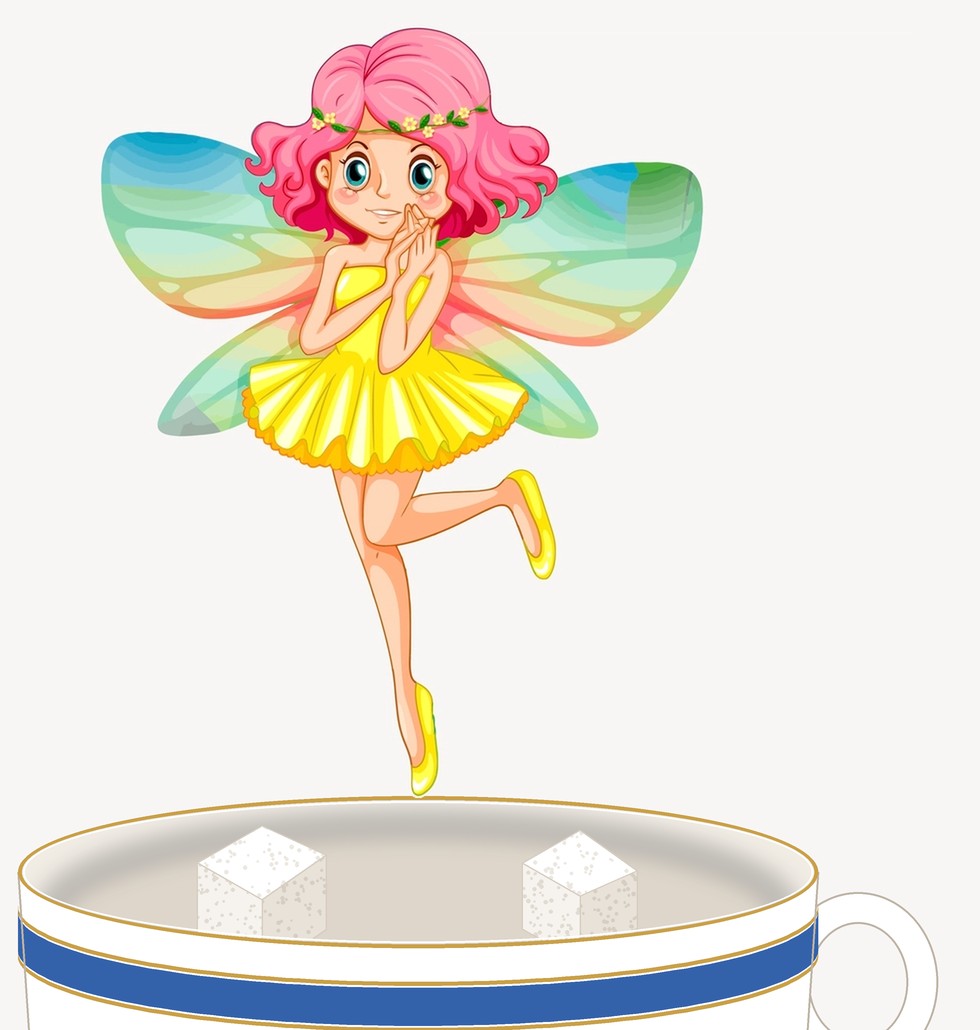
Figure 2. A fairy, with the teacup and sugar cubes I added. Illustration via rawpixel, CC0.
When I got back to the house where I was staying, three more were waiting at the window. Their wings beat at slightly different speeds, and each one carried sugar of its own. One landed on my shoulder on a morning walk. Another arrived around midnight while I was doomscrolling. I started writing them down on the back pages of a notebook I had brought for something else. Within a few days I had filled almost twenty pages.
Richard Feynman had his own version of that week. After the war, he started teaching physics at Cornell and found he could not get any research done. He decided to play with physics instead, “whenever I want to, without worrying about any importance whatsoever,” as he put it. Within a week he was in the cafeteria when “some guy, fooling around, throws a plate in the air.” The plate wobbled as it rose, and the red Cornell medallion on it spun around. Feynman worked out the wobble for fun. Years later he said the work that won him the Nobel Prize “came from that piddling around with the wobbling plate.”
A plate in the air is a small thing to build a Nobel on. The plate mattered because Feynman was already carrying questions it could land on.
Picture a Sunday brunch, the one you keep with a friend once a month. Halfway through the eggs, your friend sets down a fork and asks out loud, “Is this work adding to my life, or using it up?” You have heard it before, on a bad month, and watched it get dropped when the month got better. A year later, at the same table, your friend pushes the plate away and says, “I still can’t tell you what my work is measured against.” You nod a little too fast. The question was never the problem. It never got a chair at the table, so nothing in that year was weighed against it.
So after a year with nothing weighed against it, how does a question like that get a chair, and stay long enough to grow wise?
Who Kept a Dozen Guests
In April 1996, MIT held a conference in honor of the mathematician Gian-Carlo Rota. Rota stood up and gave a talk called “Ten Lessons I Wish I Had Been Taught.” One lesson was advice Feynman was fond of giving.
“You have to keep a dozen of your favorite problems constantly present in your mind… Every time you hear or read a new trick or a new result, test it against each of your twelve problems to see whether it helps. Every once in a while there will be a hit, and people will say: ‘How did he do it? He must be a genius!’”
The plate was one of those hits. From the wobble, Feynman moved to the orbits of electrons, then to their equations, “and then quantum electrodynamics,” the theory of how light and matter trade energy. He shared the 1965 Nobel Prize in Physics for that work with Julian Schwinger and Sin-Itiro Tomonaga. The cafeteria did not hand him an answer. It handed him a new angle on a question he had been holding for years.
A photo from a conference on gravity near Warsaw in 1962 shows what holding a question looks like from the outside (Figure 3). Feynman faces the physicist Paul Dirac, both hands raised as if weighing something, while Dirac leans back against a stone pillar under the trees, listening.
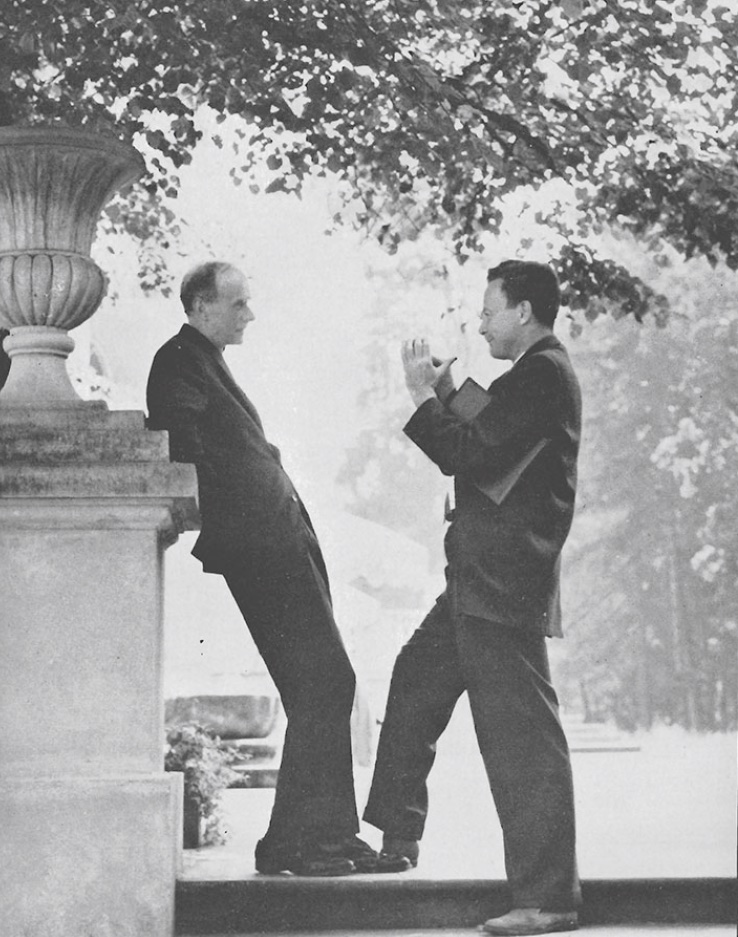
Figure 3. Paul Dirac and Richard Feynman at Jabłonna, near Warsaw, July 1962. Photo by Marek Holzman, CC BY 4.0, via Wikimedia Commons.

A list of favorite problems works like a table set for twelve guests. Every new thing that comes through the door gets passed around the table. Most guests shake their heads. Once in a while one guest reaches out and takes it. The comparison stops at choice: the guests do not pick anything. The person holding the list does the passing and the testing.
Feynman does not seem to have left a written list of his own twelve. The advice survives mostly in Rota’s memory. And no study seems to have tested whether keeping twelve open problems makes a person more creative. The evidence is stories from people who tried it and got a hit. The people who tried it and never got one do not write memoirs.
Still, the habit costs almost nothing to test. Think of a worry about work or family that hung around for years. Then think of the small thing that finally settled it, a line overheard at dinner or a scene in a film. Which question had been waiting for that line or that scene? If nothing comes to mind, the question may not be written down yet.
Who Came to My Table
The questions I wrote down in Cascais still fill the back pages of a notebook. Some were not even close to a full question, only a feeling with no sentence built around it yet, like the yellow flowers in the cracked rock. I crossed a lot of the questions out. I rewrote some of what I had crossed out a few days later. By the time I left, the visitors had filled more of the notebook than I had.
Mine now holds twelve, though it did not start out that tidy.
Figure 4 lists them in order, from what I was made for at the top to who my people are at the bottom.
Twelve Questions
The twelve questions I keep, in the order I keep them.
What is the end for which I am created?
What is the place of the in-between person, fluent in many worlds but native to none?
Given any problem, how do I find the question actually worth answering?
When should I pivot from divergence to convergence, from opening up options to closing them down?
How do I shape an idea so it is ready to be received?
How do I master beginning again?
How do I create and capture value?
What daily practices keep my mind sharp and my knowledge system trustworthy?
What do I owe the world?
Who are my people?
Read top to bottom, the list is closer to a self-portrait than a to-do list. It used to look like a lack of focus. Now each pull of interest reads as a question that would not leave.
I did not sit down and invent rules for what gets on the list. Over time, mostly after getting it wrong, I caught myself sorting the list by two tests.
How a Guest Earns a Chair
A map app passes the first test: it holds every trip and is used up by none.
The Generous Test. A favorite question does the same: it holds many decisions without being used up by any of them. Question four asks for an objective function. The term comes from math, where it is the number a calculation tries to make as large or as small as possible.
In the app, the setting picks that number: time or distance. Set the app to fastest, and the route takes the highway. Set it to shortest, and the route runs through town, on the same map. The setting decides the route before the car moves. The comparison stops at the settings menu: a life’s objective function is not written down anywhere, and it changes as the person does.
In map-app terms, each job is one route. “Is this job worth it?” looks like the whole question on a bad week, but the job is only a test case. What the work gets measured against is the real question, and it stays in play through every job that comes after.
On the next bad Sunday, there is one line to write before the list of complaints: “What is my work measured against?” Money, time with the people at home, the craft itself, the chance to be useful: the line says which of them counts most. Read it to a partner or a close friend. If the line stays blank, the week will fill it in, and next year the same Sunday comes back.
A task on a to-do list ends with a tick in a box. “Book the flight” gets its tick, and nobody thinks about it again. A favorite question never gets a tick. That difference gives the second test.
The Open Test. A favorite question stays open after a good answer arrives. Question three, about the in-between person, can be put in plainer words. Where does someone belong when many cultures, many fields and more than one career have made them? The question looks like one that gets settled once a person picks a city or a field and stays there. Belonging does not work that way. It keeps getting renegotiated.
Both tests fit on one card, a large G for Generous and a large O for Open. Together they spell GO, the word a question needs to come in (Figure 5).
Two Tests at the Door
A question earns a chair when it passes both. Together they spell GO: generous enough to hold a life, and still open after a good answer.
Generous
Holds many decisions, used up by none?
✓ What is my work measured against?
✗ Is this job worth it?
Open
Still open after a good answer?
✓ Who am I becoming?
✗ Which city should we live in?
A guest who passes both tests gets a chair. Twelve chairs is a lot of guests, though, and the twelve do not all ask the same kind of question.
Where Each Guest Sits
Write the twelve questions on index cards, and they sort into six piles (Figure 6). The order is the seating plan: each pile rests on the one before it.
The top pile, North Star, asks why I exist and who I am becoming. Identity rests on it, because the reason I exist has to meet the life I actually live, between worlds. Compass turns that reason into a measure every choice gets weighed against. Craft is the work itself, through the life of a project. Find the question worth answering, narrow the options, form the idea so others can take it in, and start over when the project fails. Fuel keeps the work going, money on one side and daily practice on the other. Communion comes last because a direction, good work and money mean little if nobody is around to share them.
Six Piles
The twelve questions sorted into piles, each pile resting on the one before. The numbers are the questions in Figure 4.
Why I exist, and who I am becoming
Where that reason meets a life lived between worlds
How to tell signal from noise once a direction is set
How the actual work gets done
Money on one side, daily practice on the other
What is owed, and to whom
Pile by pile, the six ask why, who, toward what, how, with what and for whom.
A reader’s own cards will not sort into these six piles, and they should not. What matters is which pile comes up empty. An empty Fuel pile may belong to someone whose money and daily habits get no attention. An empty Communion pile may belong to someone working alone by habit. The first Sunday evening of the month, with the next week’s calendar open, is a good time to look.
A sorted list is still only a table set for guests. What the list gives back comes slowly. Each year the same twelve questions are asked by someone a little older, who has lived through a little more, and the answers that come back are a little wiser. The questions stay; the person asking them changes.
Each of those answers adds one sugar cube to a loose pile at the center of the table. The cubes stack crooked, a few tipped onto their corners, with sugar dust on the lace cloth around them. The pile grows slowly, and it never shrinks.
Somewhere on a cafeteria floor, a plate comes down, and a guest at the table already knows what to ask it.
A Closing Invitation. The winged visitors in Cascais were questions that kept coming back, and the tea was the attention it takes to let one stay. Most questions arrive with no wings at all.
- Notice the returning guest. Right now, before you get up, name the question that keeps coming back on a drive or before sleep, about who you are turning into or what the next ten years are for. How many times has it tapped on the glass? Was it ever written down, in a notes app or a notebook?
- Sit with one guest. On the first Sunday evening of the month, pick the question that came back most often, about a parent’s slower walk or the bill you keep reopening. What do you understand about it now that you did not a year ago? Which pile is still empty?
- Write the line first. This Sunday, before the week’s work starts, write one line: what is my work measured against? Who should hear the line over tea, a partner or a friend? Does this week’s work add to your life, or only pay for it?
The tea went cold long ago. The sugar cubes sit in a small uneven pile at the center of the table, one for every answer a guest carried in, and not one guest has left.
Wisdom is not a stack of answers. It is a handful of questions kept at the table long enough to see your life from every chair. Write yours down; the ones that keep returning were never distractions.

Where This Practice Came From
Rota’s 1996 talk was printed the next year in the Notices of the American Mathematical Society and in his book Indiscrete Thoughts. The plate story has a twist. Feynman wrote that the medallion spun twice as fast as the plate wobbled. In 1989 the geophysicist Benjamin Chao pointed out in Physics Today that the ratio runs the other way: the wobble is twice as fast as the spin. The memory got the number backwards and kept the question.
Intellectual Honesty Note. The winged visitors, the sugar cubes and the tea table are my own images, not anything found in Feynman or Rota. The six piles, their names, and the reading of the Craft pile as the life of a project are my own construction, and so are the two tests and the GO that names them. The friend at the Sunday brunch is a composite, and the fairy in Figure 2 is a stock drawing standing in for the one I picture, with the teacup and the two cubes added by me. Feynman tells the plate as play. Reading it as a hit on a question he already carried is mine, by way of Rota’s advice. The gloss of quantum electrodynamics as light and matter trading energy is a one-line simplification. Calling the habit’s evidence stories, and the reversed ratio a slip of memory, is my reading. That Feynman left no list of his own twelve, that the advice comes down to us mostly through Rota, and that no study has tested the habit, rests on what I could find, not on a full search.
References
Chao, B. F. (1989). Feynman’s dining hall dynamics. Physics Today, 42(2), 15.
Feynman, R. P. (1985). “Surely You’re Joking, Mr. Feynman!”: Adventures of a Curious Character. W. W. Norton.
Holzman, M. (1962). Paul Dirac and Richard Feynman at Jabłonna, July 1962 [Photograph]. Wikimedia Commons, CC BY 4.0.
Nobel Prize Outreach. (1965). The Nobel Prize in Physics 1965. NobelPrize.org.
Rota, G.-C. (1997a). Indiscrete Thoughts. Birkhäuser.
Rota, G.-C. (1997b). Ten lessons I wish I had been taught. Notices of the American Mathematical Society, 44(1), 22–25.