A finger running down the first column of an FDA table stops at Alzheimer’s disease. The screen is cool. The next cell reads “Reduction in amyloid beta plaques.” In 2021 the FDA approved a drug for clearing that plaque from the brain, though the patient whose plaque fell most got worse. The plaque from part one is still on the list. The finger keeps going, past high blood pressure, kidney disease and diabetes. It finds no row for aging.
Across the plaque’s row, the cells fill in one by one. The patients are people with mild problems of memory and thinking, or mild dementia, from Alzheimer’s. The approval was Accelerated. The drug was a Monoclonal antibody, an antibody made in a lab to latch onto the plaque. Five columns, read left to right, and every one of them filled. Below the last row of the table, the finger stops on white space.
The finger scrolls back to the top of the page. The table is the US Food and Drug Administration’s own public list, the Table of Surrogate Endpoints That Were the Basis of Drug Approval or Licensure. Each row holds a stand-in: a measurement used in place of the thing a patient would notice, how they feel, function or survive. A blood pressure reading, for one, stands in for strokes that never happen. Every stand-in on the list once carried a drug to approval. The page says the list is for drug developers, who read it for endpoints “that may be considered and discussed with FDA” for their own programs. The page says its content is current as of April 29, 2026. Section 507 of the US drug law has the agency update the list every six months.
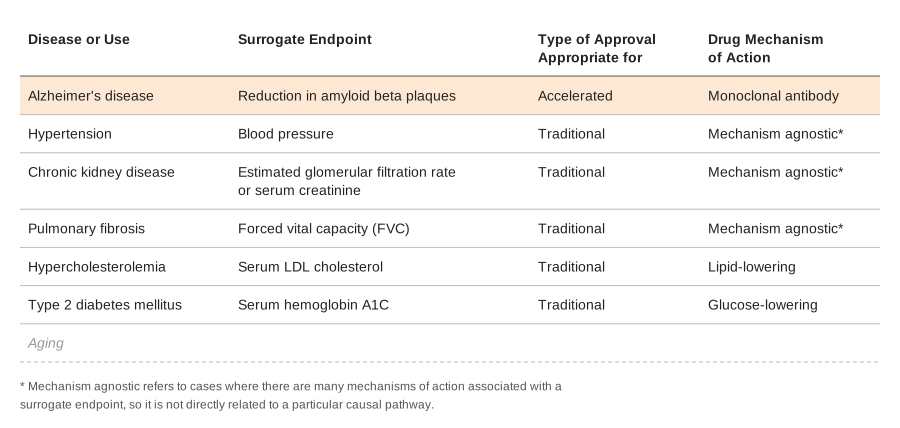
Figure 1. Selected rows, re-set word for word, from the FDA’s Table of Surrogate Endpoints, Table 1 (Adult Surrogate Endpoints, Non-Cancer), content current as of April 29, 2026. Look down the last column: three rows read Mechanism agnostic, and the plaque’s row reads Monoclonal antibody. The rows are not next to each other on the page, and the Patient Population column is left out. The grey “Aging” row is this piece’s mark, not the FDA’s. A work of the US government, public domain.
Lower on the page, the finger stops on a sentence about what leaves the list. Stand-ins that were accepted once but “are no longer acceptable” are left out. In part one, the agency’s own statistician found no evidence that the plaque was a stand-in for how patients did. By the page’s own rule, a stand-in the agency had stopped trusting would be gone. The plaque still has its row.
The finger runs down the first column again, slower this time. Osteoporosis, the thinning of bones. Chronic kidney disease. Pulmonary fibrosis, a scarring of the lungs. Getting older raises the risk of many diseases on this list, Alzheimer’s among them. Ways to slow aging are being tested in people. If one drug slowed aging itself, would it not show up in several of these rows at once? So why does the thing behind so many rows have no row of its own?
This month’s refill of a healthy-aging supplement is in your cart. The front of the jar promises younger cells. On the back, in small grey print, is a line every such label must carry. It says the product is “not intended to diagnose, treat, cure, or prevent any disease” at all. Your mother forwarded the link a year ago, and the grocery money you share has paid for eleven jars since. In one trial that assigned diets by chance, two years of eating a quarter less slowed one aging clock by a few percent. An aging clock is a blood test that estimates how fast a body is aging. Would twelve jars buy a single healthy year? The label says in law what the table says by leaving a row out. Click reorder, and the twelfth jar ships on a claim the FDA never evaluated.
Every Row Names a Disease
The first column of the table has a heading: “Disease or Use.” Under it run words a doctor would write on a chart. Acromegaly. Anthrax vaccine. Hypertension. Pulmonary fibrosis. Type 2 diabetes mellitus. Every row starts with something a drug treats or a vaccine prevents.
The closest the table comes to age is two vaccine rows. A pneumococcal vaccine row names “Persons (≥ 50 years of age),” and an RSV vaccine row names “Adults aged 60 years and above.” Even there, the first column names the vaccine or the virus, never the years. No row names aging. None names healthspan, longevity or frailty.
A stand-in stands in for something. On this table, that something is always a disease or a use. A drug that slows aging has no disease to name in the first column. A trial of the diabetes drug metformin against aging, called TAME, was meant to test such a drug. In September 2026 the trial had still not started, and it was still raising money.
Someone whose friend has a doctor’s prescription for a diabetes drug “for aging,” a pill a day for years, can check one line. The leaflet stapled to the pharmacy bag says what the drug is for. That line names a disease. The friend can read it aloud and ask what the doctor means to treat. The first column says what a stand-in is for. The next columns say how far the agency trusts it.
Two Kinds of Yes
The fourth column of the table holds one of two words: Traditional or Accelerated. The field calls a stand-in a surrogate endpoint. Section 507 of the US drug law names two kinds. One “is known to predict clinical benefit and could be used to support traditional approval.” The other “is reasonably likely to predict clinical benefit” and can support accelerated approval.
The plaque’s row says Accelerated. That is the lower yes, the faster route the plaque’s approval took in part one. The upper yes has its own name, the top of three levels in the FDA and NIH glossary.
“An endpoint supported by a clear mechanistic rationale and clinical data providing strong evidence that an effect on the surrogate endpoint predicts a specific clinical benefit.”
A reasonably likely stand-in, the middle level, is “expected to be correlated” with benefit, but is “without sufficient clinical data” to be called validated. A candidate, the bottom level, is an endpoint “still under evaluation for its ability to predict clinical benefit.” The table holds the top two levels. No aging marker has a row, so none stands above the bottom level.
The levels work like the checks behind a hiring test. A job applicant may be asked to sit an hour-long online quiz, a timer ticking in the corner of the screen. The applicant can ask which level the quiz score has reached. Has the score been checked against how past hires did on the job, or is it only expected to predict how they did? One score decides whether the application goes any further. The next posting that asks for a test is when to ask. The fourth column says which yes a stand-in earned. The last column says which drugs that yes covers.
The Last Column
Back on the plaque’s row, the last column reads “Monoclonal antibody.” Its heading is “Drug Mechanism of Action,” the way a drug works in the body. The plaque was accepted on the lower yes, for one kind of drug: antibodies built to clear it. LDL cholesterol reads “Lipid-lowering,” drugs that lower fats in the blood. Hemoglobin A1C, a blood sugar measure, reads “Glucose-lowering.”
Three rows in Figure 1 read differently. Blood pressure, the kidney filtration rate and the lung test FVC all say “Mechanism agnostic,” with an asterisk: each counts whatever way the drug works. A first reading stops at the first column, where aging has no row. The last column is the harder test. A drug that slows aging could work through many pathways, the chains of steps by which a drug changes the body. A stand-in tied to one pathway would stand in for that drug, not for aging. An aging stand-in would need the word on blood pressure’s row.
Blood pressure earned that word over many trials. On June 15, 2005, an FDA advisory committee on heart and kidney drugs met in public about blood pressure pills. Outcome trials had used drugs from “numerous pharmacologic classes,” among them diuretics, beta blockers and calcium channel blockers. Strokes fell in trial after trial. The agency’s 2011 guidance wrote down what that meant. Drugs with “disparate mechanisms of action” had similar effects. So “it is the decrease in blood pressure, rather than any other property of the drugs,” that was “largely responsible for these benefits.”
The same guidance admits there was “no regulatory precedent” for carrying one outcome claim across drug classes this different. It did so anyway, because there had been “consistently favorable effects on outcomes across many drug classes” in the trials. The trials gave more than one drug at a time, so the data “cannot easily be used to distinguish the contributions of individual drugs or classes.”
“Mechanism agnostic refers to cases where there are many mechanisms of action associated with a surrogate endpoint, so it is not directly related to a particular causal pathway.”
At a yearly checkup, the cuff tightens around the upper arm, then hisses as it lets go. That one reading is trusted whichever kind of pill lowers it. Any other number on the chart can be asked one question: has it held for more than one kind of drug? The next checkup’s blood pressure reading is the cue to ask that question. Blood pressure needed many kinds of drug to earn its word. The aging candidates would have to fill the last column the same way, trial by trial.
What the Candidates Have
A trial called CALERIE assigned 220 adults without obesity, by chance, to eat less or to eat as usual. For two years, the eat-less group aimed for 25 percent fewer calories. Later, in an analysis the trial had not planned, Waziry and colleagues ran the blood samples through several aging candidates: blood tests that estimate age from DNA.
One moved. In the group eating less, DunedinPACE, which reads how fast a body is aging, slowed by 2 to 3 percent. Two others, PhenoAge and GrimAge, did not move. The authors called the effect sizes “small.” A conclusive test, they wrote, “will require trials with long-term follow-up” on healthy-aging outcomes, such as chronic disease and death.
DunedinPACE started from 19 measures of how well the body’s organs held up, in one group of people. Each was taken four times over twenty years. Its makers turned that record into a test read from one blood draw. A reading of 1 means one year of body-wide decline per calendar year. Faster than 1 is faster aging. Faster readings go with more illness, disability and death, its makers report. So DunedinPACE has done two jobs. Elsewhere it predicts who gets sick; in CALERIE, it moved when the diet changed. The glossary keeps those jobs apart.
“A biomarker used to identify likelihood of a clinical event, disease recurrence or progression in patients who have the disease or medical condition of interest.”
“A biomarker used to show that a biological response, potentially beneficial or harmful, has occurred in an individual who has been exposed to a medical product or an environmental agent.”
The first definition is written for patients who already have a disease. The people in CALERIE were healthy, so the aging markers borrow the word. A marker can do both jobs and still not stand in for aging. Standing in for aging would take the validated level and the last column’s word.
The other candidates have done the first job. A frailty index is the share of a list of health problems a person has, from 0 for none to 1 for all. In one study of older adults, “the frailty index, age and sex” were “significant predictors of mortality.” Grip strength and walking speed predict too, but modestly. Statisticians grade that sorting with the C-index, a “concordance probability”: how well a score sorts who dies first. A coin toss would score 0.5, and a perfect sort would score 1. One analysis of three studies covered 8,362 people. There, age and sex alone scored 0.65. Adding grip and walking speed “only increased” it to 0.67.
Any score also wobbles from one try to the next. That wobble has a name, measurement error. A measurement guide defines it as “the systematic and random error of a patient’s score that is not attributed to true changes” in what is measured. A change smaller than that error cannot be told apart from the wobble.
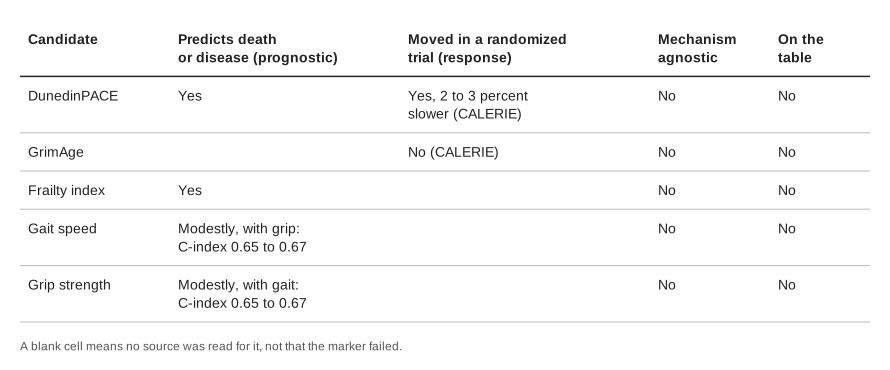
Figure 2. What each aging candidate has, in the table’s own order of proof; the last two columns read No in every row. A blank cell means no source was read for it, not that the marker failed; whether any candidate is qualified was not checked. Sources: DunedinPACE, Belsky et al. (2022) and Waziry et al. (2023); GrimAge, Waziry et al. (2023); frailty index, Searle et al. (2008); gait speed and grip strength, Westbury et al. (2024); the last two columns, the FDA table as of April 29, 2026. Drawn for this piece.
A 2026 review pooled 51 studies of ways to slow aging. The clocks “trained to predict mortality or pace of aging” responded most strongly. Responding in many studies is not the same as standing in for years lived well, whatever the drug.
Someone opening the bank’s monthly credit-score email, a needle on a red-to-green dial, meets both jobs. A score that predicts who will miss a payment is not the same as one that moves when a debt is paid down. Only the second can tell whether paying it down worked. When the next email arrives, the question is which job its number was built for. Neither job puts a marker on the list; a small mark beside two rows shows what does.
The Way Onto the List
Two osteoporosis rows on the table carry a small mark, ¤. One row is for men, the other for people whose bones thinned on steroid medicines. Both accept bone mineral density as the stand-in, with a condition in the footnote. Bone density counts only “after efficacy based on new morphometric vertebral fractures has been established in postmenopausal women.” In plain words, drugs first had to prevent new broken bones in the spine, in women past menopause. Then that number could stand in for men.
Bone density reached those rows drug program by drug program. The FDA also has a route for a marker on its own, outside any one drug.
“A conclusion, based on a formal regulatory process, that within the stated context of use, a medical product development tool can be relied upon to have a specific interpretation and application in medical product development and regulatory review.”
The route has three stages: a Letter of Intent, a Qualification Plan and a Full Qualification Package. In December 2025, the FDA qualified one bone marker this way. It was the change in hip bone density over two years, for drug trials in women past menopause with osteoporosis. The key words are “within the stated context of use.” That marker is trusted for that one use, in those women.
Someone about to renew a healthy-aging supplement, whose product page cites an aging-clock study, has one question before the renewal email’s button. In whom, and for what use, has that study’s number been shown to mean better health? The FDA’s line under the claim gives part of the answer. Without the question, a year of renewals rests on a claim the FDA never evaluated. The question is worth sending to the parent who forwarded the link.
Aging has no row of its own for two reasons on the page. Every row names a disease or a use. An aging stand-in would also need “mechanism agnostic,” the word blood pressure earned across many kinds of drug, and no aging marker has that proof yet. How many trials would that proof take, and what would they have to show? From the first row on the page to the last, the finger finds no cell in the first column that says Aging.
A Closing Invitation. The missing row stood for every aging number sold before anyone showed it stands in for health. Each stand-in the regulator accepts belongs to a disease, and most to one kind of drug.
- Turn the jar over. Now, if a supplement jar is within reach, turn it over and read the small line about the Food and Drug Administration aloud. What did the front promise: younger cells, better sleep, more years? Which of those has a number behind it, and what did the last jar cost?
- Name the number’s job. When this month’s credit-score email or a lab result lands, ask which job its number was built for: to predict what happens, or to move when something changes. Is there a payment or a pill you chose by a number read for the wrong job?
- Ask before the renewal. Before your next supplement renewal, or when a parent forwards a link promising younger cells, call them and ask two questions together. In whom was the product’s number shown to mean better health? For which kind of treatment? Does either answer name a disease and a drug? If not, what could next month’s jar money buy instead?
Under the diabetes row, no line says aging. The empty row waits for a number that moves the same way whatever the drug; until one earns it, the jar’s small print is aging’s only row.
Where This Came From
On October 9, 2026, I read the FDA’s table row by row, as its page stood that day, and each candidate’s paper for its own cell in Figure 2.
Intellectual Honesty Note. This piece’s own reading is the step from the last column to what an aging stand-in needs; the column and its footnote are the FDA’s. The table says which stand-ins were accepted, not how strong the proof behind each row is. TAME’s status rests on a news report until the sponsor’s own statement is read. The finger, the jar, the cart, the mother, the leaflet, the hiring test, the cuff and the credit-score email are invented.
References
21 C.F.R. § 101.93(c)(1). Certain types of statements for dietary supplements. https://www.ecfr.gov/current/title-21/chapter-I/subchapter-B/part-101/subpart-F/section-101.93
Belsky, D. W., et al. (2022). DunedinPACE, a DNA methylation biomarker of the pace of aging. eLife, 11, e73420.
COSMIN. Definitions of domains, measurement properties, and aspects of measurement properties. After Mokkink, L. B., et al. (2010). Journal of Clinical Epidemiology, 63(7), 737-745. https://www.cosmin.nl
FDA-NIH Biomarker Working Group. (2016-, last revised 2025, January 16). BEST (Biomarkers, EndpointS, and other Tools) Resource. National Center for Biotechnology Information. https://www.ncbi.nlm.nih.gov/books/NBK338448/
Federal Food, Drug, and Cosmetic Act § 507, 21 U.S.C. § 357.
Harrell, F. E. Regression modeling strategies (online ed.), chapter 5. https://hbiostat.org/rmsc
Sakay, Y. N. (2026, September 14). The TAME trial: Can a common diabetes drug extend human life span? Medical News Today. https://www.medicalnewstoday.com/articles/tame-trial-common-diabetes-drug-extend-human-life-span-aging
Searle, S. D., Mitnitski, A., Gahbauer, E. A., Gill, T. M., & Rockwood, K. (2008). A standard procedure for creating a frailty index. BMC Geriatrics, 8, 24.
Sehgal, R., et al. (2026). Responsiveness of epigenetic aging biomarkers to longevity interventions in humans. Nature Medicine, 32, 3477-3490. https://doi.org/10.1038/s41591-026-04562-9
U.S. Food and Drug Administration. (2011, March). Hypertension indication: Drug labeling for cardiovascular outcome claims [Guidance for industry]. https://www.fda.gov/media/134777/download
U.S. Food and Drug Administration. (2021, July 7). About biomarkers and qualification. https://www.fda.gov/drugs/biomarker-qualification-program/about-biomarkers-and-qualification
U.S. Food and Drug Administration. (2025, December 19). FDA qualifies total hip bone mineral density (BMD) as surrogate endpoint for osteoporosis drug development. https://www.fda.gov/drugs/drug-safety-and-availability/fda-qualifies-total-hip-bone-mineral-density-bmd-surrogate-endpoint-osteoporosis-drug-development
U.S. Food and Drug Administration, CDER and CBER. (2026, April 29). Table of surrogate endpoints that were the basis of drug approval or licensure. https://www.fda.gov/drugs/development-resources/table-surrogate-endpoints-were-basis-drug-approval-or-licensure
Waziry, R., et al. (2023). Effect of long-term caloric restriction on DNA methylation measures of biological aging in healthy adults from the CALERIE trial. Nature Aging, 3, 248-257.
Westbury, L. D., et al. (2024). Predictive value of sarcopenia components for all-cause mortality: Findings from population-based cohorts. Aging Clinical and Experimental Research, 36, 126. https://doi.org/10.1007/s40520-024-02783-x