On a gravestone, the shortest mark holds the longest span: the dash between the two years. A stonemason’s chisel taps those years into gray granite. They are the easy part: a birth and a death, facts anyone can check. The dash is the rest, the whole life, read as the last date minus the first. Mathematicians have a sign for that kind of subtraction. Long before it was theirs, it was a letter, and the letter stood for a door.
The letter is delta. The Phoenicians called it dalet, their word for a door, an opening to pass through on the way somewhere else. The Greeks bent it into a triangle, Δ. In Herodotus’s telling, they gave its name to the land where the Nile fans out to meet the sea (Figure 1). Today that land is some of Egypt’s most fertile farmland. Later still, the letter became a sign for something less poetic.
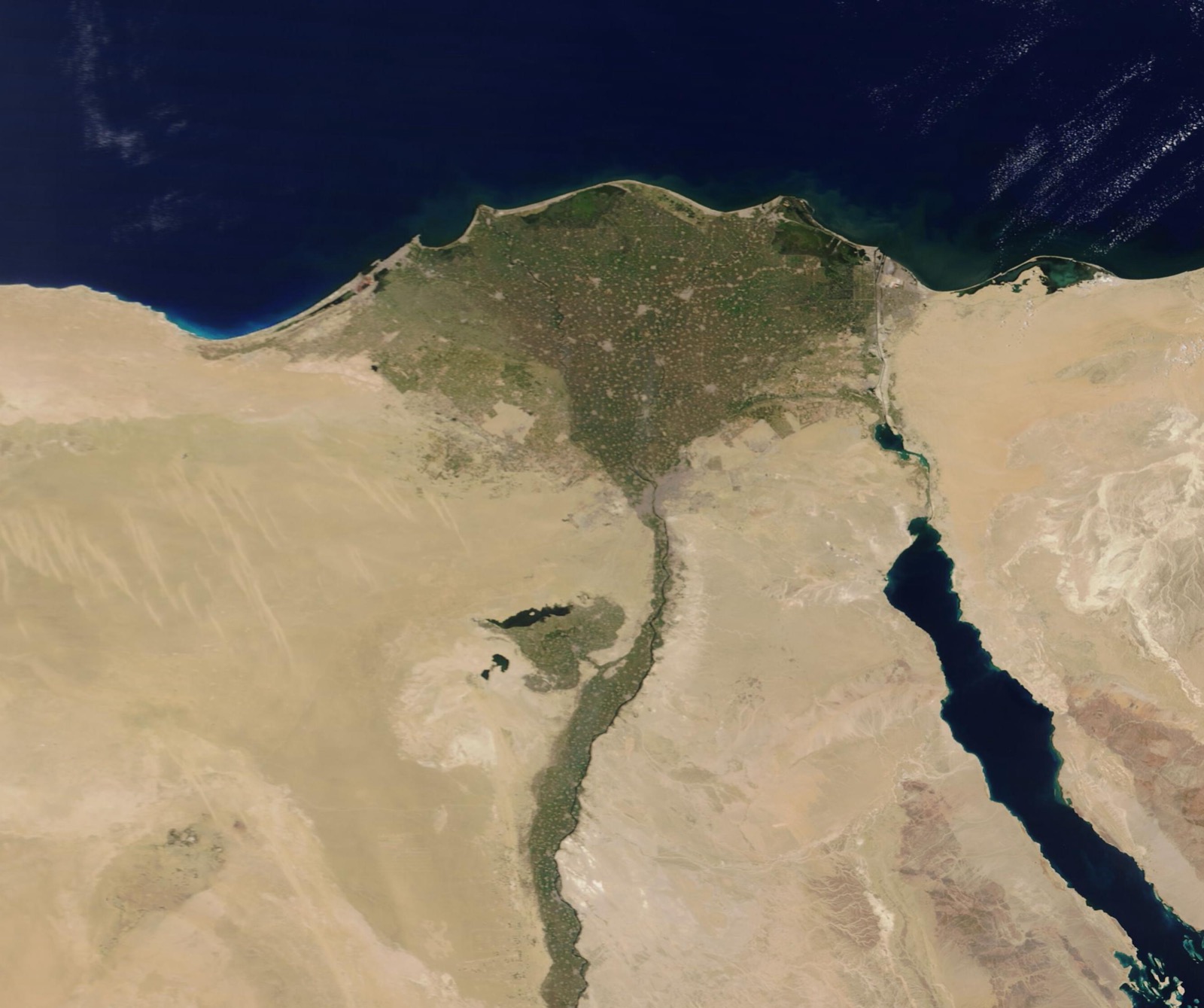
Figure 1. The Δ the Greeks named: the Nile fanning out below Cairo before it meets the Mediterranean, seen by NASA’s Terra satellite on 15 June 2020. NASA Goddard Space Flight Center, MODIS Land Rapid Response Team, public domain.
Written before a quantity, Δ means how much that quantity changed: the end minus the start. Between two dates, Δt is the time that passed; Δw is the kilos a bathroom scale shows between two weigh-ins.
A biostatistician’s unit of attention is a difference. For years I have studied the gap between how long we live and how long we live well. Now, I find myself measuring other gaps.
In June, in my third trimester, I stepped away from work. Stepping away was a choice we made together, so I could rest and give my attention to becoming a mother of two. For the first time since I finished college in 2009, there was no paycheck. Then our second daughter arrived. Another gap runs between the career I had and the one I might want next, in academia or in industry, a question I left open in 2022. Another runs between the careful voice I learned for journals and the one I wrote in as a fourth grader for the school paper.
Gap was my word for them. Delta came later, and it fits better. Read as a hole, a gap is a stretch with nothing in it. Read as a delta, it is a difference between two ends and a change from one to the other.
The Greeks had a story about a gap like this. Persephone was gathering flowers when the earth split open beneath her, and Hades carried her below. Her mother, Demeter, goddess of the grain, grieved, and nothing grew. Below, Persephone had eaten one pomegranate seed, red and smaller than a fingernail. For that seed, she must spend a third of every year below, and each spring she comes back (Figure 2). I used to read the myth as a story about loss. Now, a mother of two daughters, I read it as a story about seasons. Persephone’s year holds a delta: the field in spring, minus the field in winter.

Figure 2. Frederic Leighton, The Return of Persephone (c. 1891). Hermes lifts Persephone out of the dark toward Demeter: the spring end of her months below. Leeds Art Gallery, public domain.
A shorter span than a life is one most of us know from childhood: summer break. On the last day of school, the bell rings. The summer looks long enough to hold anything: the book you will finally read, the fort you will build with a friend. Write down on the first day what you want to be different by the end, and the last day has something to be checked against. Write nothing, and in September a teacher asks, “What did you do over the break?” You list whatever happened to fill it.
So a ten-week summer, or a months-long leave, comes down to one question: when is a gap a hole, and when is it a delta?
Which End Moved?
A stonemason chisels the second date into a gravestone only after a death. For the living, the second date is still blank, so a lifespan has to be borrowed from the people dying now.
The World Health Organization keeps one table for each country, listing the share of people at each age who died that year. Each table runs a crowd of made-up newborns through one year’s death rates, age by age, from first cry to last breath. The average age they reach is the country’s life expectancy.
Counting only the crowd’s years in good health gives the country’s healthy life expectancy. The years between the two numbers make a gap.
Both averages belong to the crowd, not to anyone in it. A grandmother who lives to ninety-five, the last ten years in a chair by the window, lands far from both.
Demographers call each country’s table a life table, and the gap between its two averages the healthspan-lifespan gap. When I reran the WHO numbers for 185 countries, in a project I call GapYears and wrote up as a series, the median country’s gap came to 9.3 years. The median is the middle country when all 185 are lined up by gap.
Those 9.3 years are easy to read as a hole: nine years of a life taken out by illness. But the number started as two measured ends, a lifespan and a healthspan, with a minus sign between them. A hole has one edge to point to. A delta has two, and either one can move. A hole asks “how big is the loss?” A delta asks “which end do I push on?”
Both ends have been moving. In 2000, the gap in the median country was 8.85 years. By 2019 it had grown to 9.51 (Figure 3). Medians can hide how countries differ, so I fit a country fixed-effects model. It compares each country only with itself, the way a bathroom scale works. A person steps on it twice, a week apart, and the second number means something only against the first. Each year a country added to its own life expectancy came with about a seventh of a year lived unwell. Across 3,949 country-years, the model’s figure was 0.145 years.
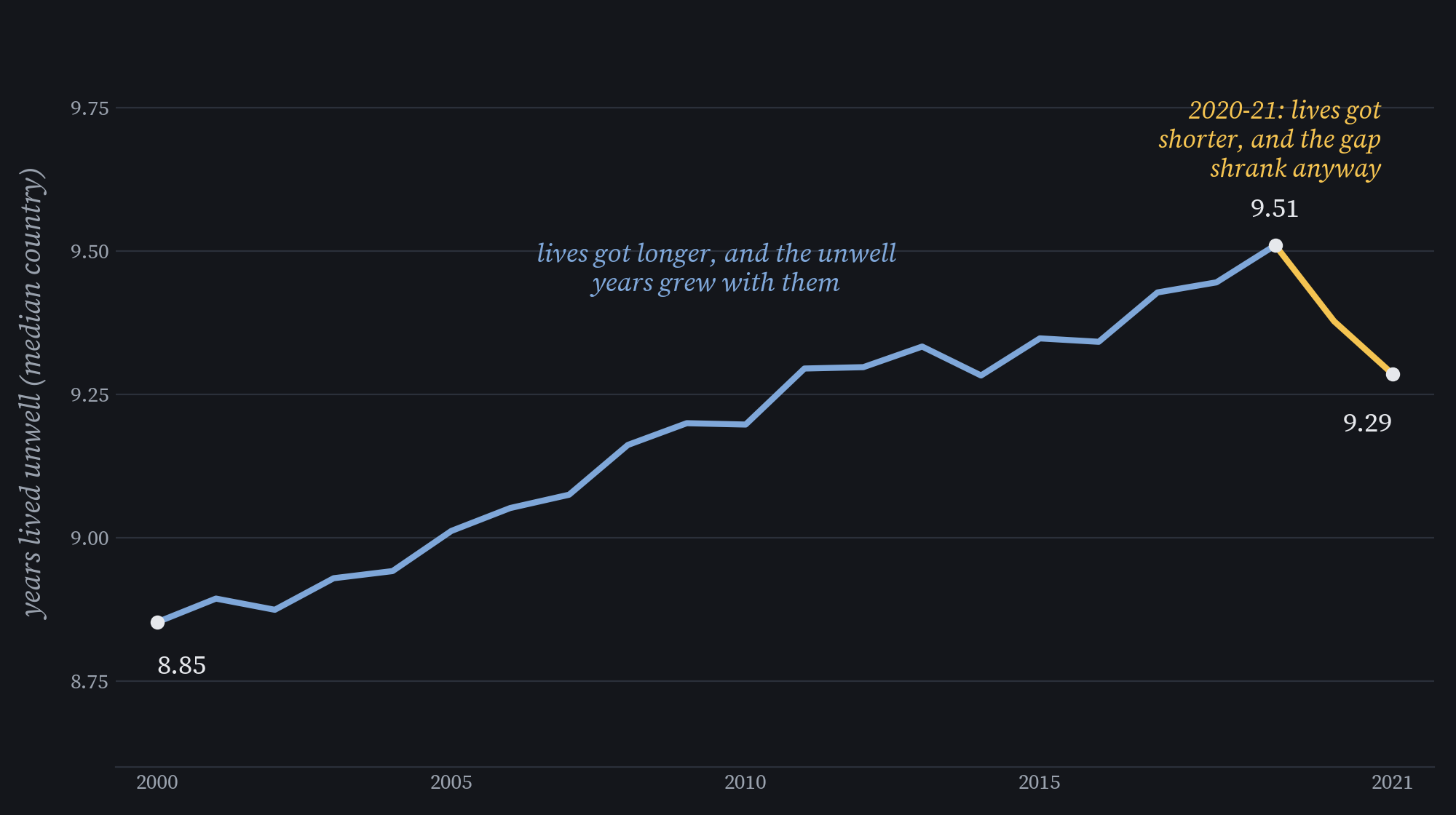
Figure 3. The median healthspan-lifespan gap across 185 countries, by year. The line climbs for two decades, then turns down after 2019. Drawn for this piece from my GapYears rerun of World Health Organization data (Global Health Observatory).
Then the line turns down: by 2021 the gap had shrunk to 9.29 years. Median life expectancy fell from 73.8 years to 72.2, and median healthy life expectancy fell too.
That 0.22-year drop hides a trap I check for in every analysis: a difference of two medians is not the median of the differences. The median country of 2019 and the median country of 2021 need not be the same country. Paired, each country against itself, the median change was a drop of 0.02 years, about a week. Ninety-eight gaps shrank and eighty-seven grew (Figure 4). In all ninety-eight, both lifespan and healthspan fell, and lifespan fell further. If life expectancy drops two years and healthy life expectancy drops one, the gap shrinks. The gap closed from the wrong end: lifespan came down to meet the healthy years, instead of the healthy years rising to meet it.
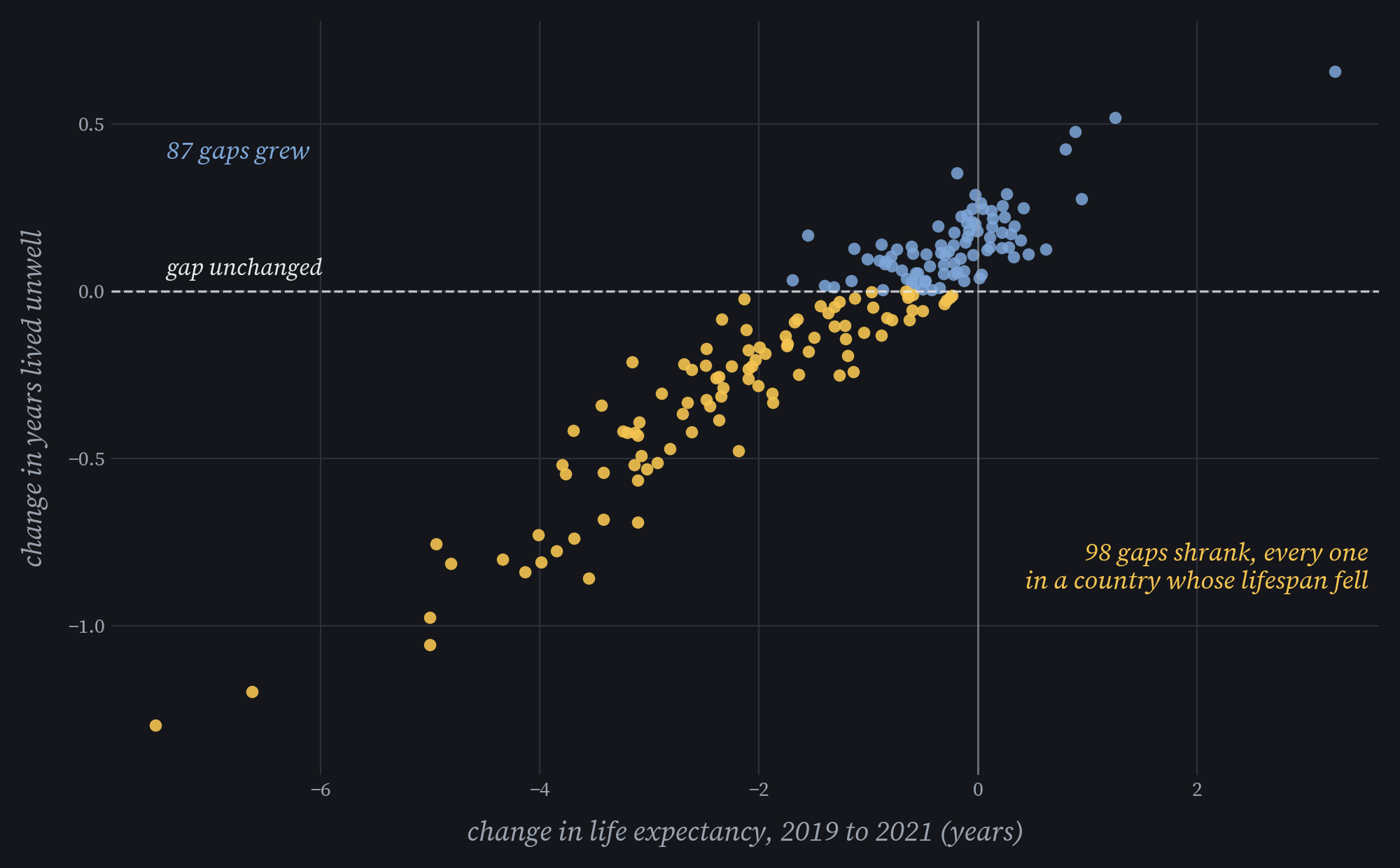
Figure 4. Each country’s change from 2019 to 2021. Every gap that shrank did so where lifespan fell further than the healthy years did, closing from the wrong end. Drawn for this piece from my GapYears rerun of World Health Organization data (Global Health Observatory).
Which end is the right one?
Which End Comes First?
Dan Sullivan and Benjamin Hardy name the end to push on: measure the gain, not the gap. In their self-help book, The Gap and the Gain, the gap is how far a person still is from an ideal. The gain is how far that person has come since the start.
As a statistician, I hear two minus signs in their advice. The gain is now minus the start. The gap is the target minus now. A coworker’s gain of ten pages on a novel written in the evenings means one thing against a target of twelve. Against a target of three hundred, those ten pages mean another. It is hard to measure the gain without knowing the gap, so I look at the gap first.
Read as a gain, the healthspan numbers to 2019 look good: lives got longer. Read against a target of every year lived well, the gain looks smaller: the years lived unwell grew too.
Whether the unwell years shrink, grow or arrive later as lives lengthen is the open question the healthspan series is built around.
A clinical trial avoids reading its result only afterward by naming its target first. Before the first patient enrolls, a statistician writes down the smallest difference between treatments that would matter to a patient, such as a drop in pain big enough to feel. The trial’s size is then built to find that difference if it is there. In the formula for that size, the difference is written as a delta, δ, and it sits squared in the denominator. Halve the difference worth detecting, and the trial needs four times as many patients.
“The treatment difference to be detected may be based on a judgement concerning the minimal effect which has clinical relevance in the management of patients…”
A trial that named its difference in advance ends with a test: the gain reached the target, or it did not. A trial that named nothing is left to report what happened and explain it afterward. Whether the target itself was worth reaching, no amount of data can say.
Which End Is Worth Reaching?
In a talk the systems pieces quote, Russell Ackoff ranked what a mind can hold: data, information, knowledge, understanding, wisdom. A target named on the first day belongs to the first four: it says how far, never whether the goal is the right one. The fifth sits across a gap of a different kind.
“Wisdom is a qualitative change from the previous four. Data, information, knowledge and understanding are all concerned with increasing the efficiency with which we pursue our ends but they don’t tell us anything about the ends that are being pursued.”
A qualitative change is a delta that cannot be read on the same ruler as the four before it. More data does not add up to wisdom, the way pressing harder on the gas pedal does not change where the road goes.
A parent can grow very efficient at the days: the feeds, the naps, the laundry, each a little faster than the week before. None of that says what the days are for. Wisdom is the step back from the schedule to ask what kind of people my daughters are growing into, and what kind of mother I am growing into beside them.
Asked whom he envied, the actor Bob Odenkirk, Saul Goodman on Better Call Saul, named “anybody who’s still got little kids at home growing up.” In those years, he said, “I understood my purpose.” Bronnie Ware, a palliative-care nurse for years, heard the same from the far end of life. One of the regrets she wrote down most often was “I wish I hadn’t worked so hard.” It came, she wrote, from every male patient she nursed: “They missed their children’s youth and their partner’s companionship.” The days I am trying to get faster at are the ones they would take back.
A whole life can be run the same way, every year busier than the last. A gravestone records two dates and leaves the dash blank: it says nothing about the ends the years were spent on. Wisdom is asking that question while the busy days are still here, not after the second date is cut.
Demeter answered that question with a year of her own.
Which End Is Mine?
In the Hymn to Demeter, Hades takes her daughter into the dark, but Demeter chooses the year that follows. For nine days she wanders with flaming torches. Then, disguised as an old woman, she nurses a king’s infant son at Eleusis.
And then she puts down her own work. The Hymn calls what followed “a most dreadful and cruel year for mankind”: “the ground would not make the seed sprout, for rich-crowned Demeter kept it hid” (Figure 5).

Figure 5. Evelyn De Morgan, Demeter Mourning for Persephone (1906). The goddess of the grain kneels on bare rock with wheat in her hair, in the year she chose to let nothing grow. De Morgan Collection, public domain.
Demeter and I stepped away from our work for the same reason: a daughter. Like her, I have spent my days since September with a newborn. This one has a big sister, a toddler who takes a lot of those days too. Her gap, though, was grief, and she made it a weapon: she swore the whole world would go hungry until she saw her daughter again. Mine was rest and time with my daughters, and all it emptied was a paycheck.
When I stepped away in June, I knew where I was starting from. I did not write down where I wanted to be at the far end of my own dash.
So far, what I can count is the essays on this site dated June 23 or later, this one included. Without a target, I cannot say whether that is a lot or a little. A gap stays a hole while only its first end is written down, and becomes a delta once the far end is too.
One end I can name now: being ready for my next job, in academia or in industry. My research fits either. Regulators, companies and universities all ask how long we live well. That readiness I can measure before I know which door opens. The rest I am keeping as an open question, on purpose.
Next time, I will write down on the first day what I want to be different by the end.
The Nile slows where it reaches the sea, and that is where it builds its richest ground. These slow months built some of mine: a second daughter, a shelf of essays, a voice I had not used since the school paper.
A Closing Reflection. The dash between two dates is the life lived, and every gap in it has two ends. Read with both, a gap is a change, not a hole you explain.
- Ask the far end. This week, think of one person you envy and one regret you have heard from someone older, like a grandparent or a retired neighbor. What do your envy and their regret have in common? Does your week leave any time for it?
- Step back from the schedule. Tonight, look back at how you spent last week: the commute, the emails that ping after dark, the dinners eaten fast. Which hours only did the usual things more quickly? Which hours went to something you want more of? Which kind got more of your week?
- Write both ends. This weekend, pick a time behind you, like a leave, a move or the months between jobs. Find a photo from its first day and one from its last, and under each, write one line about your life then. Alone or with someone who was there, compare the lines. Was that time empty, or did it give you something new?
The spring field shows what changed while Persephone was below; Demeter had named what she wanted back. Your dash holds both ends once you name the far one, while the days are still here.
A scale means nothing until the second weigh-in, and a gap stays a hole until its far end is written down. Write it down on the first day, and the gap becomes a delta: a change you can measure.

Where This Came From
In my Backstory, I call 2026 the year of Delta. This piece stands beside Put a Pin on It at the turn between the science essays and the life ones.
Intellectual Honesty Note. Pairing Δ with Demeter and Persephone came from Derectum’s The Grammaticon: Delta, an artist’s reading of the Greek letters. The myth is told from the Homeric Hymn to Demeter; reading Demeter’s withheld harvest as a chosen gap is this piece’s. The gravestone dash as the life lived is a familiar image, best known from Linda Ellis’s poem “The Dash”; reading it as a subtraction is this piece’s. “Measure the gain, not the gap” is Sullivan and Hardy’s advice in my words; reading it as two subtractions is this piece’s. The bathroom-scale Δw is this piece’s notation. Applying ICH E9’s “treatment difference to be detected” to one year of a life is this piece’s reading.
Healthy life expectancy counts a year lived with an illness in part, weighted by how severe the illness is; this piece speaks of whole years, healthy or unwell. Each median is taken on its own, so the medians of the two ends do not subtract exactly to the median gap. The fixed-effects model covers the 183 countries with health-spending data and holds each country’s spending steady; its 0.145 is an association, not a cause. Ackoff is quoted from an automatic transcript of a recorded talk. Odenkirk is quoted from a podcast transcript. The regrets Ware lists are one nurse’s account of her patients, not a survey. The essays’ dates are Tuesday slots set after writing, not the days each was finished.
References
Ackoff, R. L. (2015, November 2). Systems thinking speech by Dr. Russell Ackoff [Video]. YouTube. https://www.youtube.com/watch?v=EbLh7rZ3rhU
Birbiglia, M. (Host). (2025). Bob Odenkirk: The art of anger in comedy [Audio podcast episode]. In Mike Birbiglia’s Working It Out. https://pod.wave.co/podcast/mike-birbiglias-working-it-out/bob-odenkirk-the-art-of-anger-in-comedy
D’Angour, A. (2024, August 5). D is for delta. Substack. https://armanddangour.substack.com/p/d-is-for-delta
Derectum. (n.d.). The Grammaticon: Delta. Medium. https://medium.com/@derectumillustrator/the-grammaticon-delta-f8dadbe76259
Ellis, L. (1996). The dash [Poem]. https://lindaellis.life/the-dash-poem-author
Encyclopaedia Britannica. (n.d.). D. In Encyclopaedia Britannica. Retrieved October 11, 2026, from https://www.britannica.com/topic/D-letter
Gauran, I. I. (2026). GapYears (Version 1.0.0) [Computer software]. GitHub. https://github.com/gauranii/GapYears
Herodotus. (1920). The histories (A. D. Godley, Trans.; Book 2, §§15–17). Harvard University Press. https://www.perseus.tufts.edu/hopper/text?doc=Hdt.+2.15
Homeric hymn to Demeter. (1914). In Hesiod, the Homeric hymns, and Homerica (H. G. Evelyn-White, Trans.). Harvard University Press. https://www.perseus.tufts.edu/hopper/text?doc=Perseus:text:1999.01.0138:hymn=2
International Council for Harmonisation of Technical Requirements for Pharmaceuticals for Human Use. (1998). E9: Statistical principles for clinical trials. https://database.ich.org/sites/default/files/E9_Guideline.pdf
Kadam, P., & Bhalerao, S. (2010). Sample size calculation. International Journal of Ayurveda Research, 1(1), 55–57. https://doi.org/10.4103/0974-7788.59946
KAUST Global Branding and Communications. (2022). Meet the postdocs [Video]. YouTube. https://www.youtube.com/watch?v=NlcLUwZM8pI
NASA Earth Observatory. (n.d.). The Nile Delta’s disappearing farmland. Retrieved October 11, 2026, from https://science.nasa.gov/earth/earth-observatory/the-nile-deltas-disappearing-farmland-149183/
Sullivan, D., & Hardy, B. (2021). The gap and the gain: The high achievers’ guide to happiness, confidence, and success. Hay House Business.
Ware, B. (n.d.). Regrets of the dying. https://bronnieware.com/blog/regrets-of-the-dying/
World Health Organization. (n.d.). Healthy life expectancy (HALE) at birth (years) [Indicator metadata]. Global Health Observatory. Retrieved October 10, 2026, from https://www.who.int/data/gho/indicator-metadata-registry/imr-details/66