A beekeeper lifts a frame out of the hive. It is as warm as skin, it hums with bees, and it smells of honey and wax. This part of the hive is a nursery. Thousands of small six-sided cells cover both sides. In most, a single larva lies curled at the bottom, a pale comma smaller than a grain of rice.
Near the edge of the frame, a few cells hang straight down, long and bumpy, like peanut shells made of wax (Figure 1). In each one, a larva floats on a pool of thick white jelly, far more than it can eat.
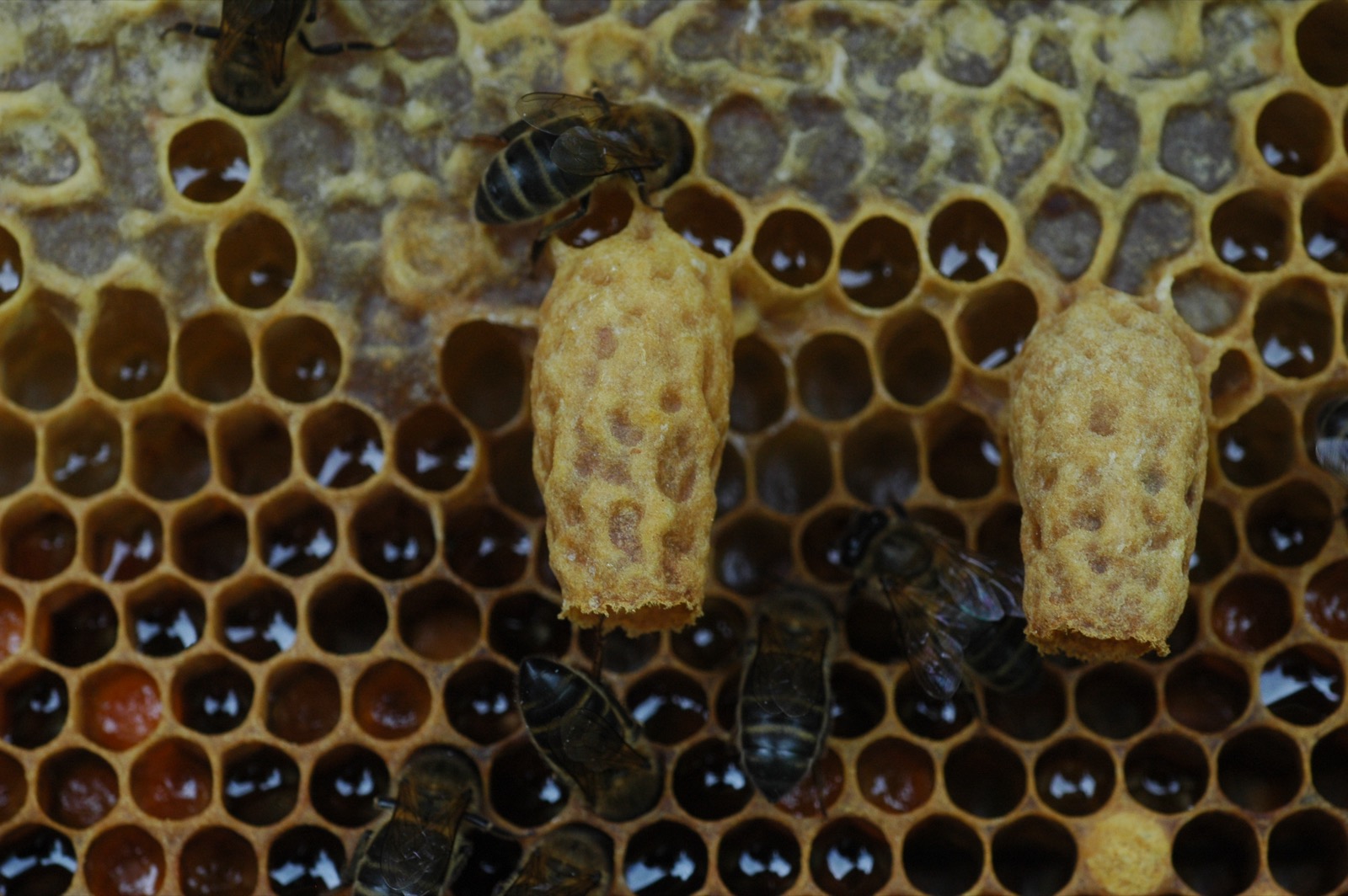
Figure 1. Two queen cells on the comb, one turn of a loop. A larva fed royal jelly in each will come out a queen, and the queen will lay the eggs of the workers who feed the next one. Photograph by Piscisgate (2014), Wikimedia Commons, CC BY-SA 4.0.
Any female larva in the hive can grow into a queen or a worker. Her genes do not decide which. The larvae in the hanging cells become queens. A queen lives for years and can lay more than a thousand eggs a day. A worker lives a few weeks in summer and usually lays none.
Food decides which. The white jelly is royal jelly (Figure 2), a rich food made in glands in the workers’ heads. The workers feed it to a few larvae for as long as they are larvae. The rest get a plainer mix with pollen and honey in it, and become workers. Food cannot rewrite a gene. So what does it change?
Figure 2. How royal jelly makes a queen, from SciShow (2015), YouTube embed. The video credits one jelly protein, royalactin. A later team could not reproduce that result.
Think of a larva’s genes as a cookbook. Each gene is a recipe for one molecule the body uses, and every larva in the hive carries the same book. Cells can stick small chemical marks onto some of the recipes, like notes in the margin that say “skip this one.” Biologists call them methylation marks. They help decide which recipes the cell cooks and which it skips.
In 2008, a team at the Australian National University, in Canberra, tested whether those notes were what the jelly changed. The team switched off one gene in newly hatched larvae: the recipe for the enzyme that writes the notes. Then they fed the larvae a worker’s diet. Most of them came out as queens, with full ovaries. The team called the result “a royal jelly-like effect.” Each larva kept the cookbook it was born with. What changed was which recipes got cooked.
Which bee each larva became depended on what its cookbook was connected to: the notes, the food, and the workers who chose which larvae to feed. Any cookbook raises five questions: what it counts, what it keeps, what it answers, what it misses, and what it cannot decide.
Say you mail a spit sample to a DNA testing company, and the report comes back: you probably cannot digest milk as an adult. You start drinking your coffee black, bitter at the first sip. You stop buying cheese, pay extra for lactose-free milk and read every label in the shop. Your partner switches to oat milk so the fridge needs only one carton. By your next checkup, you have gone months without an easy source of calcium.
Here is how such a report could be wrong. For most people in the world, the body puts the recipe for digesting milk away after childhood. Some people carry a one-letter difference in the cookbook that keeps the recipe in use. In Europe, most people who have one share the same spelling. Many families who kept cattle in East Africa carry a different spelling that keeps the same recipe in use. Say the test looks only for the European spelling. A person who carries the East African one gets a report that finds nothing it knows and says the recipe is closed. That person gave up milk for nothing. The test read the right page, looked for the wrong spelling, and never asked where the family came from. Systems thinking has a question for any test result that costs someone milk, cheese and calcium: what else is that result connected to?
What the Cookbook Counts
Counting human genes started as a bet. In May 2000, at Cold Spring Harbor, the geneticist Ewan Birney opened a pool on how many genes human DNA would turn out to hold. Biology was about to get its first full cookbook for a person: every gene, every recipe (Figure 3).
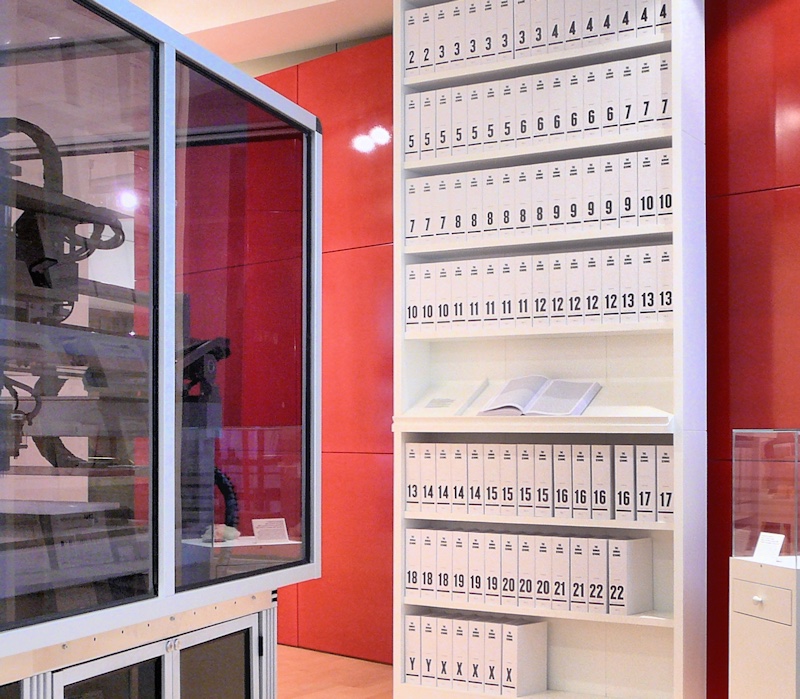
Figure 3. The human genome printed as books at the Wellcome Collection, in London: a volume or more for each chromosome, from 1 to 22, then X and Y, in type almost too small to read. Photograph by Russ London (2010), Wikimedia Commons, CC BY-SA 3.0.
The guesses ran from about 20,000 to more than 200,000. In 2003, the count came in at 24,847. The closest guess, 25,947, belonged to Lee Rowen, who worked at the Institute for Systems Biology. She won $600 and a signed copy of The Double Helix.
Later counts settled lower, near 20,000. The worm C. elegans, about a millimeter long, has a little over 20,000 genes of its own. A person and a worm carry cookbooks of about the same size, so the number of recipes could not be what makes a person a person. In Donella Meadows’ definition of a system, the parts matter less than the rules that connect them. Here the parts are the genes, and the rules decide which recipes get cooked, when, and how much. Two kitchens with the same book can serve very different dinners.
A full gene count is one example of omics: measuring one layer of a living thing all at once. Each layer takes the suffix -ome. Two of them explain the bees.
“The genome is the entire set of DNA instructions found in a cell.”
“The epigenome consists of chemical compounds that modify, or mark, the genome in a way that tells it what to do, where to do it, and when to do it.”
In this piece’s kitchen, the genome is the cookbook, and the epigenome is the notes in its margins. The genome is the layer the walkthrough of DNA, transcription, and translation takes apart. The epigenome is the layer the natural experiment on methylation follows.
The book also closes some recipes on its own schedule, and a single letter can keep one open for life.
What the Cookbook Keeps
Milk is the recipe most bodies put away. Babies make their own enzyme for lactose, the sugar in milk. The enzyme is called lactase, and in most mammals the body stops making it after weaning. A short stretch of DNA near the gene closes the recipe after childhood. In about a third of adults alive today, the recipe stays open. The European spelling is a single changed letter in that stretch, and it keeps lactase coming for life.
The East African spellings are other one-letter differences nearby, and each arose on its own. In 2007, the geneticist Sarah Tishkoff and her colleagues traced the most common of them, carried by many herding peoples in Kenya and Tanzania. It had spread fast, over roughly the last seven thousand years.
Why keep that page open? Herds. Herds put fresh milk within reach. Adults who carried the spelling could digest the milk, got more food from it, and more of their children lived to carry the spelling too. The more people could drink milk, the more a herd was worth, and herding spread further. In Meadows’ terms for feedback, that is a reinforcing loop: a change that feeds itself. Even this loop has a ceiling. A herd can grow only as large as the grass and water around it allow. The cookbook kept the page. The herds outside made it worth keeping.
A DNA sample can show which spelling someone carries. It cannot show the herds that made the spelling worth carrying, or the grass and water that capped the herds. So a kit report that rules out milk earns one email to the company within the week: which spellings did the test look for? A parent who skips the email may cut milk from the children’s plates too, on a test that never looked for the spelling the family carries. A parent who already cut the milk can still ask.
What the Cookbook Answers
The herds and their milk changed the book over thousands of years. The body asks the book questions every day, and it answers within hours.
In 2012, Romain Barrès and his colleagues put eight sedentary men on an exercise bike twice, at least a week apart. One ride was easy, at 40 percent of each man’s maximum effort, and one was hard, at 80 percent. Both rides stopped once the rider had burned 400 calories. With a needle, the researchers took small plugs of thigh muscle before each ride, right after it, and three hours later.
One recipe they read was PGC-1α, which tells a cell to build more of its energy supply. Right after the hard ride, the notes on PGC-1α had dropped to about half their resting level. Three hours later, the muscle was cooking that recipe several times as much as at rest. After the easy ride, the notes barely moved, yet the recipe still got cooked more. The notes are one rule among several.
That energy supply is mitochondria (Figure 4), the parts of a cell that burn fuel. Over months of training, more mitochondria mean more capacity for the next ride.
The ride changes the notes. The notes change which recipes get copied out to the counter, a layer called the transcriptome. The copies change which dishes get made, the proteome. The dishes change what the body can do on the next ride. The cookbook answers the ride, and the answer shapes the next question.
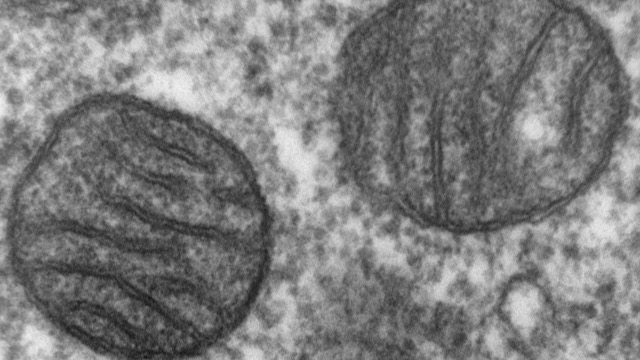
Figure 4. What more mitochondria do for a cyclist, from Pedaling to the Top (2025), YouTube embed. Thumbnail: two mitochondria in lung tissue, electron micrograph by Louisa Howard, public domain.
To see the answer, the team had to sample the muscle three times in one day. Many omics studies draw one tube of blood from each person, once. Peter Senge defines systems thinking as seeing “patterns of change rather than static ‘snapshots.’” One tube is a snapshot. It can show the notes in the margins, but not which ride wrote them.
What the Cookbook Misses
Reading 5.4 million genomes still left out the meals. In 2022, a study led by the geneticist Loïc Yengo pooled those genomes. It found 12,111 small spellings tied to height, each with a tiny effect. Together, in people of European ancestry, they account for about 40 percent of how much heights differ. In other ancestries, the share falls to about 10 to 20 percent. Part of the 60 percent the spellings miss is genetic and not yet mapped.
The rest sits on the plate. In the 1800s, Dutch soldiers averaged about 165 centimeters, shorter than men in most of Europe. Dutch men are now the tallest in the world. They stand about 20 centimeters taller, most of a head above those soldiers. A cookbook cannot change that fast. Food, health, and living conditions can.
Say a youth basketball coach ranks twelve-year-olds by a height score built from those 12,111 spellings and cuts the bottom three. A parent shown the ranking can ask which people the score was built on. The score says less for players outside the ancestry it was built on, and nothing about what their childhood meals will add.
What the Cookbook Cannot Decide
A cell can hold a recipe and still never cook it.
Malaria kills close to 600,000 people a year, most of them young children in Africa. One of the main malaria drugs is artemisinin (Figure 5), which comes from a plant called sweet wormwood. The supply of wormwood swings. A short harvest sends the price up, so more farmers plant wormwood. Once their crops flood the market, the price falls, and the next shortage begins.
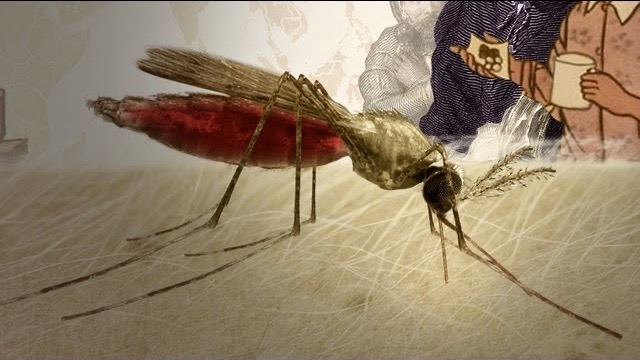
Figure 5. A short history of malaria drugs, from NPR’s Skunk Bear (2012), YouTube embed.
In 2003, a team led by the chemical engineer Jay Keasling, at Berkeley, looked for a steadier source. They copied recipes from baker’s yeast and one from wormwood into E. coli, and the bacteria made an early form of the drug. The team then moved the work into yeast itself. In April 2013, the drug company Sanofi started making artemisinin with yeast in Garessio, in northern Italy. That year, the factory made about 8 percent of the world’s supply.
By 2015, farmers had a great year. So much wormwood grew that artemisinin from the plants sold for less than $250 a kilogram. Sanofi needed $350 to $400 to break even. That is at least $100 a kilogram above the plants. Sanofi’s rivals would not buy from it, and the world wanted no more of the drug than before.
“If that price is already very low and there’s a bumper crop,” Keasling said, “there’s no reason to fire up a fermenter.” The fermenter, the steel tank where the yeast grows, stood idle. The yeast still had the recipe. The price of wormwood decided.
That is the edge of every cookbook. No page inside the yeast held the price of wormwood. The jelly, the herds, the ride, the meals and the market all came from outside the book, and each one decided what got cooked.
A test report that says to give up a daily food has read one book. A friend holding such a report can ask three things first. What did the test look for? Which people was it built on? What else is the result connected to? The larva’s cookbook could not say which bee it would become. The jelly in its cell could.
A Closing Reflection. The cookbook counted, kept, answered and missed, and it did not decide. The jelly, the herds, the ride, the plate and the price of wormwood each changed which recipes reached the table, and none rewrote a recipe.
- Spot the idle fermenter. Right now, look around for something you paid for that still works and stands unused: a bread maker in the cupboard, an app on the phone in your hand. It still has its recipe. What around it changed?
- Read the margin notes. Think back to one habit that changed this year. Something around you changed first: a new gym on your street, an office move that added forty minutes to the commute, a friend who started walking at six. Which of your own recipes got cooked more, which got skipped, and who at home noticed first?
- Ask which spelling. When the next report tells you to give up a food, from a DNA kit or your next checkup, ask what the test looked for before the shopping changes. One question may keep the cheese on the table. Who would give the food up with you, the one who cooks or the one who shops?
Open a packet of baker’s yeast and smell it. Split the dough: one bowl by a warm window, one in a cool corner. Look again in an hour. Same packet, same recipe. One bowl rose like a queen.
You can read every page of the cookbook and still not know what is for dinner. Your genes hold the recipes; what gets cooked is decided outside the book.
Where This Came From
This piece follows systems thinking into a single cell. Konopka’s post on systems thinking (2026) started it.
Intellectual Honesty Note. The cookbook is this piece’s image, not a biologist’s term: genes as recipes, methylation marks as notes in the margin, gene variants as spellings, RNA copies as recipes copied out, proteins as dishes. A methylation mark does not always mean “skip”; on the genes in the exercise study, fewer marks went with more activity. The hive scene is built from standard beekeeping descriptions, not one hive.
The stakes paragraph’s report is hypothetical, and which spellings a kit tests depends on the kit. This piece reads lactase persistence as a reinforcing loop with a grazing ceiling. It adds the exercise loop’s last step, “more capacity for the next ride.” Its point about a snapshot not naming the ride is its own reading, not a finding. The stretch of DNA near the lactase gene is an enhancer, which raises a gene’s activity; “closes the recipe” simplifies how it is turned down. The exercise study measured single rides, not months of training. The 60 percent and the $100 gap are subtractions made here from the cited numbers, and the ride’s “about half” and “several times” are read off the exercise paper’s Figure 2. The protein step and the link from PGC-1α to mitochondria are standard physiology. The bee experiment switched the methylation enzyme off by hand; how much methylation steers caste in an ordinary hive is still debated (Oldroyd and Yagound, 2021).
References
Altun, Z. F., & Hall, D. H. (2009). Introduction. In WormAtlas. https://doi.org/10.3908/wormatlas.1.1
Barrès, R., Yan, J., Egan, B., Treebak, J. T., Rasmussen, M., Fritz, T., et al. (2012). Acute exercise remodels promoter methylation in human skeletal muscle. Cell Metabolism, 15(3), 405–411. https://doi.org/10.1016/j.cmet.2012.01.001
Buttstedt, A., Ihling, C. H., Pietzsch, M., & Moritz, R. F. A. (2016). Royalactin is not a royal making of a queen. Nature, 537(7621), E10–E12.
Enattah, N. S., Sahi, T., Savilahti, E., Terwilliger, J. D., Peltonen, L., & Järvelä, I. (2002). Identification of a variant associated with adult-type hypolactasia. Nature Genetics, 30(2), 233–237.
Gerbault, P., Liebert, A., Itan, Y., Powell, A., Currat, M., Burger, J., et al. (2011). Evolution of lactase persistence: An example of human niche construction. Philosophical Transactions of the Royal Society B, 366(1566), 863–877.
Howard, L. (n.d.). Mitochondria, mammalian lung – TEM [Electron micrograph]. Wikimedia Commons, public domain. https://commons.wikimedia.org/wiki/File:Mitochondria,_mammalian_lung_-_TEM.jpg

Kamakura, M. (2011). Royalactin induces queen differentiation in honeybees. Nature, 473(7348), 478–483.
Konopka, A. (2026, May 6). Systems thinking [Substack post]. https://thinkmicrobe.substack.com/p/systems-thinking
Kucharski, R., Maleszka, J., Foret, S., & Maleszka, R. (2008). Nutritional control of reproductive status in honeybees via DNA methylation. Science, 319(5871), 1827–1830.
Martin, V. J. J., Pitera, D. J., Withers, S. T., Newman, J. D., & Keasling, J. D. (2003). Engineering a mevalonate pathway in Escherichia coli for production of terpenoids. Nature Biotechnology, 21(7), 796–802.
Meadows, D. H. (2008). Thinking in Systems: A Primer. Chelsea Green.
National Human Genome Research Institute. (n.d.). Epigenome. In Talking Glossary of Genomic and Genetic Terms. https://www.genome.gov/genetics-glossary/Epigenome
National Human Genome Research Institute. (n.d.). Gene Sweepstakes (GeneSweep). https://www.genome.gov/virtual-exhibits/GeneSweep
National Human Genome Research Institute. (n.d.). Genome. In Talking Glossary of Genomic and Genetic Terms. https://www.genome.gov/genetics-glossary/Genome
NCD Risk Factor Collaboration. (2016). A century of trends in adult human height. eLife, 5, e13410.
NPR. (2012, December 17). Herbs and empires: A brief history of malaria drugs | Skunk Bear [Video]. YouTube. https://www.youtube.com/watch?v=IrNL27eWKOI
Oldroyd, B. P., & Yagound, B. (2021). The role of epigenetics, particularly DNA methylation, in the evolution of caste in insect societies. Philosophical Transactions of the Royal Society B, 376(1826), 20200115.
Paddon, C. J., Westfall, P. J., Pitera, D. J., Benjamin, K., Fisher, K., McPhee, D., et al. (2013). High-level semi-synthetic production of the potent antimalarial artemisinin. Nature, 496(7446), 528–532.
PATH. (2013, April 11). Sanofi and PATH announce the launch of large-scale production of semisynthetic artemisinin against malaria. https://www.path.org/our-impact/media-center/sanofi-and-path-announce-the-launch-of-large-scale-production-of-semisynthetic-artemisinin-against-malaria/
Pedaling to the Top. (2025, January 23). Improve your mitochondria, improve your cycling [Video]. YouTube. https://www.youtube.com/watch?v=sy-4P_aN97k
Peplow, M. (2016). Synthetic biology’s first malaria drug meets market resistance. Nature, 530(7591), 389–390.
Piscisgate. (2014). Honeybee queen cells 14 [Photograph]. Wikimedia Commons, CC BY-SA 4.0. https://commons.wikimedia.org/wiki/File:Honeybee_queen_cells_14.jpg

Ro, D.-K., Paradise, E. M., Ouellet, M., Fisher, K. J., Newman, K. L., Ndungu, J. M., et al. (2006). Production of the antimalarial drug precursor artemisinic acid in engineered yeast. Nature, 440(7086), 940–943.
Russ London. (2010). Wellcome genome bookcase [Photograph]. Wikimedia Commons, CC BY-SA 3.0. https://commons.wikimedia.org/wiki/File:Wellcome_genome_bookcase.png

SciShow. (2015, July 6). How bees choose their queen [Video]. YouTube. https://www.youtube.com/watch?v=m_SlH3Uwslc
Senge, P. M. (1990). The Fifth Discipline: The Art and Practice of the Learning Organization. Doubleday.
Spieth, J., & Lawson, D. (2006). Overview of gene structure. In WormBook. https://www.ncbi.nlm.nih.gov/books/NBK19701/
Stulp, G., Barrett, L., Tropf, F. C., & Mills, M. (2015). Does natural selection favour taller stature among the tallest people on earth? Proceedings of the Royal Society B, 282(1806), 20150211.
Tishkoff, S. A., Reed, F. A., Ranciaro, A., Voight, B. F., Babbitt, C. C., Silverman, J. S., et al. (2007). Convergent adaptation of human lactase persistence in Africa and Europe. Nature Genetics, 39(1), 31–40.
Visscher, P. M., Medland, S. E., Ferreira, M. A. R., Morley, K. I., Zhu, G., Cornes, B. K., et al. (2006). Assumption-free estimation of heritability from genome-wide identity-by-descent sharing between full siblings. PLoS Genetics, 2(3), e41.
World Health Organization. (2024). World malaria report 2024: Addressing inequity in the global malaria response. World Health Organization.
Yengo, L., Vedantam, S., Marouli, E., Sidorenko, J., Bartell, E., Sakaue, S., et al. (2022). A saturated map of common genetic variants associated with human height. Nature, 610(7933), 704–712.